
You know you need fresh content on your site every week, maybe every day. But you don't have hours to write it, and you can't justify a full-time hire. That's the exact gap automated content creation was built to close. Whether you're a solo insurance agent chasing local rankings, a SaaS manager scaling organic traffic, or a roofing or med spa business trying to outrank the competitor down the street, the challenge is the same: consistent, quality content without burning out your team. This guide breaks down exactly how to make it work for your business, starting today.
Table of Contents
- What Automated Content Creation Really Means in 2026
- Why Small and Medium Businesses Are Turning to Automated Content Creation
- How an Automated Content Pipeline Actually Works
- Choosing Between DIY Tools, Agencies, and Full Automation Platforms
- What to Look for in an Automated Content Creation Platform
- Automated Content Creation for Search Engines and AI Answer Engines
- Real-World Results: What Businesses See After Automating Content
What Automated Content Creation Really Means in 2026
From single blog posts to always-on content engines
A few years back, "AI content" meant typing a prompt into a chatbot and copy-pasting whatever came out. That's not what it means anymore. Today the term describes a full pipeline: software that researches keywords, drafts a long-form article, adds images, writes the meta description, and pushes it live to your site — all without a human touching a keyboard. The shift is from tool to system. One does a task. The other runs a business function.
This matters because content marketing was never really about writing. It was about volume, consistency, and relevance sustained over months. A solo agent or a med spa owner doesn't need a clever paragraph. They need dozens of well-targeted pages built up over time, each one answering a real local search. That's a production problem, not a writing problem. It's why so much has moved toward end-to-end systems rather than single-use generators.
It also explains why teams researching this space often start at a general blog covering the mechanics before picking a tool. The learning curve isn't about prompts anymore. It's about workflows, publishing cadence, and what happens after the article goes live.
Why timing matters: search + AI visibility in the same strategy
Google's algorithm increasingly rewards sites that publish often and go deep on a topic, not just sites with a few polished pages. Thin, one-off content gets buried. Sites that show up daily, on a coherent theme, tend to build authority faster — even brand-new domains with zero backlink history. That's a real, documented pattern, not a theory.
At the same time, AI answer engines like ChatGPT and Perplexity are pulling from freshly indexed, frequently updated pages when they cite sources. If your site posts once a quarter, you're nearly invisible to both systems. Post daily, and you've got a far better shot at showing up in a search result and an AI-generated answer on the same afternoon. For a deeper technical breakdown of how machines actually generate and structure this content, Automated Content Generation: Aprimo's Solutions (2025) is a solid primer. Timing isn't a bonus feature here. It's the entire strategy.

Why Small and Medium Businesses Are Turning to Automated Content Creation
Most small business owners aren't skeptical about content marketing. They're skeptical about doing it themselves at 11pm after a full day of actual work. That gap between wanting to show up online and having the hours to make it happen is exactly why so many owners are handing the job to software instead of a person.
The cost of manual content vs. automated publishing
A roofer with twenty years of local trust can still be invisible on Google, because reviews and referrals don't teach a search engine anything. Reputation offline and visibility online are two different problems, and only one of them gets solved by word-of-mouth. Manual content production also runs into a simple math problem: freelance writers charge $150 to $400 per article, agencies charge more, and neither one publishes daily without a retainer that most local businesses can't justify.
Here's what's actually pushing owners toward automated publishing instead of a one-off blog push:
- Insurance agents and med spa owners need dozens of location and service pages, not five posts written once and forgotten;
- Roofing and legal niches are crowded enough that competitors publishing weekly will simply out-rank a business that publishes quarterly;
- Businesses have no in-house writer and no appetite for managing freelancers, edits, and publishing schedules by hand;
- Getting cited by ChatGPT, Perplexity, and Gemini now matters as much as ranking on page one, and that requires steady, structured content those systems can pull from;
- Brand-new domains need both volume and backlinks together, since content alone without authority signals rarely moves the needle fast.
Even setup itself used to be a barrier. Connecting a content tool to WordPress or another CMS took technical know-how many owners simply didn't have. That friction is disappearing. It's part of why one writer's account of Automating Content Creation: How AI Transformed My Workflow resonates with so many small teams facing the same time crunch.
How an Automated Content Pipeline Actually Works
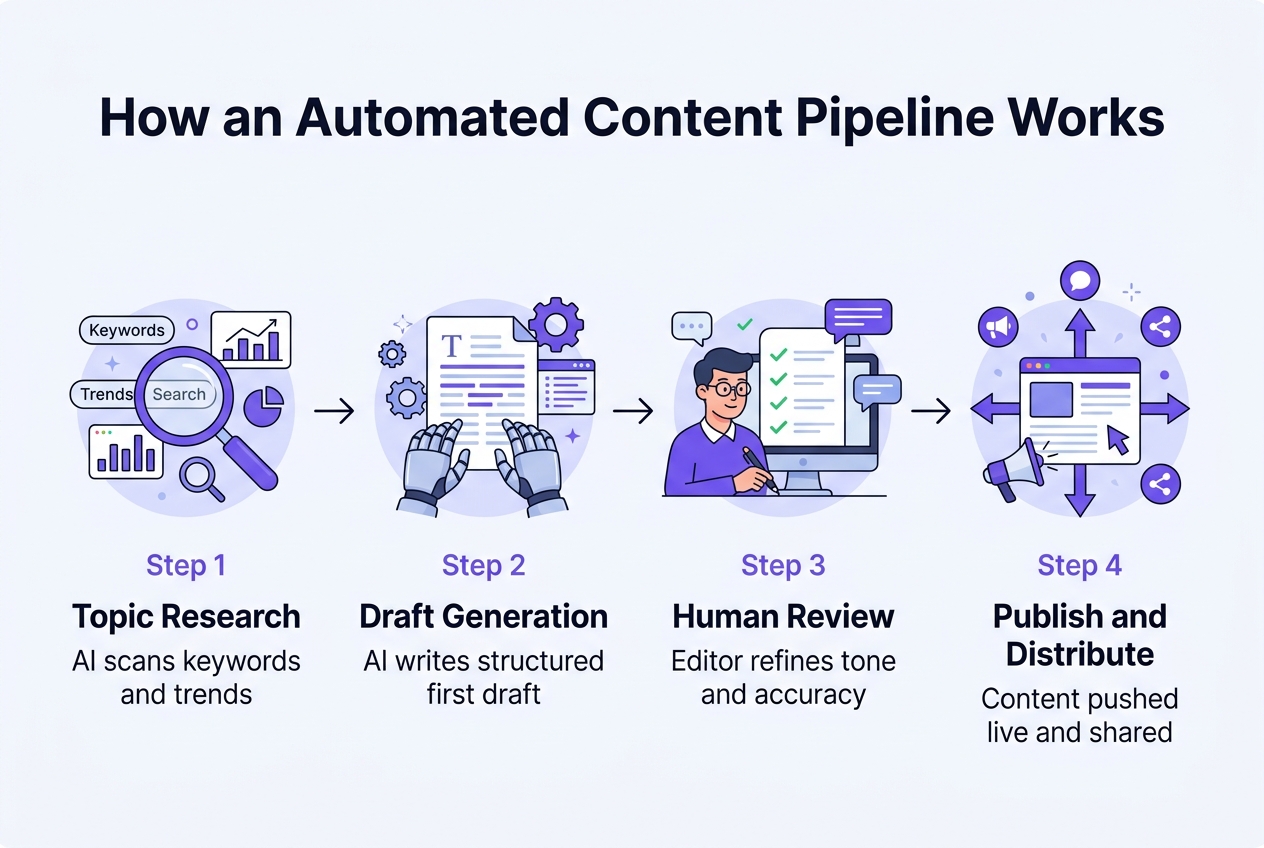
Every article that goes live follows a sequence, not a guess. Skip a step and you get generic content that ranks nowhere. Here's what actually has to happen before a single word is published, and what keeps working after.
What happens before the article is written
It starts with research, not writing. The system scans your niche for high-volume, low-competition terms — a roofing company might target "metal roof cost Tampa" instead of fighting for "roofing contractor" nationally. Once a topic's locked in, the draft gets built: 3,000+ words, matched to your brand's tone, with images and internal and external links placed where they make sense. Before anything touches your site, it's screened for plagiarism and scored against SEO and GEO benchmarks. If it fails, it doesn't publish. That gatekeeping step is the part most cheaper tools skip entirely.
| Step | What Happens | Why It Matters |
|---|---|---|
| 1. Keyword research | Finds niche-specific terms with real search volume | Targets traffic you can actually win |
| 2. Drafting | Writes 3,000+ words with images and links | Matches depth Google rewards |
| 3. Quality checks | Plagiarism and SEO/GEO scoring | Blocks weak content before it ships |
| 4. Publishing | Auto-posts to your CMS or via webhook | Removes manual upload work entirely |
| 5. Extension | Backlink building and Reddit replies | Builds authority beyond the article page |
What happens after it's published
Publishing isn't the finish line. Once an article clears its checks, it's pushed straight to WordPress, Shopify, Wix, or Webflow — sites on webflow now get the same direct connection, no copy-pasting required. From there, the work shifts to reach: verified backlinks from niche-relevant sites and drafted replies on active Reddit threads extend the article's visibility past the page itself. For a broader sense of where this fits, it's worth exploring the wider landscape of tools reshaping content production before deciding what your business actually needs.

Choosing Between DIY Tools, Agencies, and Full Automation Platforms
Not every business needs the same setup. A local roofer publishing twice a month has different needs than a SaaS team chasing 50 keywords a quarter. The trick is matching your output goal to the right tool, instead of paying for more than you'll use.
When a manual AI writer is enough
Tools like Jasper, Copy.ai, and Canva's writing features are fine if you only need a handful of posts a month and have someone willing to do the legwork. They draft text fast, but you still handle the keyword research, editing, image sourcing, and publishing yourself. That's a real time cost. If you're weighing options here, it helps to review Automated Content Creation Tools in 2026 before committing to a workflow that leaves most of the manual labor on your plate. Agencies solve the strategy gap but move slowly and charge accordingly, often $2,000 or more a month for four or five posts.
When you need daily, hands-off publishing
If you want a new article every day, indexed and linked properly, manual tools and agency retainers both fall apart. Full automation platforms handle research through publishing without a person clicking "go" each time. That's the whole point: no bottleneck, no missed weeks.
| Option | Speed | Typical Cost | SEO Depth | Hands-On Effort |
|---|---|---|---|---|
| DIY AI writer | 1-2 posts/week (manual) | $20-$100/mo | Shallow, depends on user skill | High |
| Freelance writer | 2-4 posts/month | $400-$1,500/mo | Moderate | Medium |
| SEO agency | 4-8 posts/month | $2,000-$5,000/mo | Strong strategy, slow execution | Low-Medium |
| Full automation platform | 1 post/day | Flat monthly fee, often under $150/site | Built-in, consistent | Very Low |
Budget and speed usually decide the answer. If you can't commit real hours weekly, manual tools won't get used. Agencies work if you have cash to spare and patience for slow rollouts. For daily, compounding output, automation is the only format built for that pace.
What to Look for in an Automated Content Creation Platform
Not every platform that promises "automated content" actually delivers the same thing. Some just spit out drafts you still have to edit, format, and publish yourself. Others handle the whole loop. Before you commit money, it helps to separate what actually moves the needle from what just sounds nice in a sales demo.
Must-have features vs. nice-to-have features
Some features determine whether you get results at all. Others just make life easier once the basics are covered. Here's how to sort them:
- Daily publishing frequency matters more than most people expect — a platform that ships one article every 24 hours builds topical authority far faster than one publishing weekly, since search engines reward sites that show consistent, ongoing activity.
- Native platform integrations for WordPress, Shopify, Wix, or Webflow save you from manually copying and formatting drafts; if a tool only exports files, you're back to doing the tedious part yourself.
- Verified dofollow backlinks included in the plan give new domains a credibility boost that content alone can't provide — this is a must-have if your site has little to no existing authority.
- Multilingual content generation is essential if you serve non-English-speaking customers or markets; a platform stuck in English-only mode limits how far your local or international reach can go.
- Brand voice customization stops your articles from reading like every other generic AI post out there — this is nice-to-have at first, must-have once you're publishing daily.
- Transparent pricing with no contracts lets you test results without getting locked into a year-long commitment you can't walk away from.
AI visibility tracking — seeing whether ChatGPT, Perplexity, Claude, or Google's AI Overviews are citing your content — is quickly moving from nice-to-have to must-have. Plenty of business owners are comparing notes right now on which tools actually pull this off. Threads where people discuss what tools they're using to automate content are worth skimming before you buy. Skip that step and you're flying blind on half the search landscape.
Automated Content Creation for Search Engines and AI Answer Engines
How ranking for Google differs from getting cited by AI
Google still plays by familiar rules. It wants topical depth, a web of internal links tying your pages together, and freshness signals that come from publishing regularly. A local roofing site that adds a new, well-researched article every day tells Google's crawlers there's something alive here, worth revisiting often. That's still the backbone of traditional SEO, and it hasn't gone away. It's just no longer the whole game.
AI answer engines think differently. ChatGPT, Gemini, and Perplexity aren't ranking ten blue links — they're picking a handful of sources to summarize and cite. They favor pages that are structured clearly, updated often, and easy to lift a clean answer from. A wall of vague marketing copy won't get quoted. A page with clear headers, direct answers, and specific numbers might. Tools built for workflow automation, like Automate Your Content Creation, show how connected, repeatable systems are becoming standard practice across marketing, not just content.
This is why GEO — generative engine optimization — is climbing up the priority list fast. It scores content on citation-worthiness, not just keyword density. Ignore it, and you're invisible in half the places people now search. Businesses that win going forward need a strategy built for both audiences at once: crawlers that reward consistency, and language models that reward clarity. Publishing daily helps satisfy both, but only if what you publish is actually structured to be understood, not just indexed.
Real-World Results: What Businesses See After Automating Content
What early metrics to track (impressions, clicks, indexed pages)
Before you get excited about rankings, watch three things in Search Console: impressions, clicks, and indexed pages. Impressions come first, usually within a few weeks, as Google starts crawling and indexing daily posts. Clicks lag behind, often by a month or two, as pages climb from position 40 to position 12. Indexed page count matters more than people think. A brand-new insurance or roofing site with zero authority needs volume in the index before Google trusts it enough to rank anything on page one.
Local service businesses tend to see the clearest early signal in impressions for city-plus-service terms, like "roof repair Tampa" or "med spa Botox Scottsdale." A single article rarely does much alone. But 30 or 60 stacked up, each targeting a slightly different local query, start pulling impressions across a wide net. That's the pattern worth tracking, not any one post's performance.
How long before automated content shows measurable traffic growth
Most brand-new domains start showing real Search Console movement within two to four months of consistent daily publishing. Not overnight, but far faster than the six-to-twelve-month timeline typical of a traditional SEO retainer. A solo insurance agent or med spa owner with zero prior visibility can realistically expect first-page rankings for long-tail local terms inside that window, especially in less competitive niches like roofing or specialty legal services.
SaaS companies see a different curve: organic traffic scales without adding headcount, since a growing content library compounds rather than resets each month. If you're comparing platforms, it helps to look at how tools such as workflow-based content automation handle scale versus one-off article generation, since sustained output is what actually drives compounding growth. E-commerce stores often see it fastest at the category-page level, where product-focused articles funnel traffic sideways into buying pages within weeks.
Here's the blunt part: agencies quote months just to onboard. Automated setups take minutes. That gap alone changes the math for most small businesses.
Before you commit to a direction, it's worth being honest about which problem you're actually solving: a site that can't be crawled properly needs a developer or technical specialist, and no amount of publishing will paper over that. Once the foundation is sound, the questions shift to things like how quickly you need results, whether you want traffic that compounds or traffic you rent, and how much of the work you're willing to automate versus hand to a person. Sitting with those trade-offs for a moment usually clarifies more than another comparison chart will.