
You know you need fresh content on your site every week — maybe every day — but you're not a writer, and hiring one isn't cheap or fast. Between running your business and keeping up with Google's changing rules, manual blogging just doesn't scale. That's where seo automation comes in. This guide breaks down exactly how to use it to rank faster, publish consistently, and stop trading your time for traffic.
Table of Contents
- What SEO Automation Actually Means Today
- Which Parts of SEO Can Be Automated
- seo automation Tools Compared: Manual SEO vs Automated Platforms
- What to Look for in an SEO Automation Platform
- How an Automated Content Pipeline Works Step by Step
- Is SEO Automation Worth It for Small and Local Businesses
- Getting Started: Rollout and Common Pitfalls
- The Future of seo automation: Ranking on Google and Being Cited by AI
What SEO Automation Actually Means Today
From scheduling tools to AI content engines
A decade ago, "SEO automation" meant a rank tracker that emailed you a spreadsheet once a week. That was it. Someone still had to do the keyword research, write the post, format it, and hit publish. It saved a little time. It didn't touch the actual work.
Today the term covers something much bigger. Software now handles the entire chain of repetitive tasks — keyword research, drafting, publishing, internal linking, even outreach for backlinks. Full-pipeline automation is the real shift here. Instead of one tool doing one job, you get research feeding writing, writing feeding publishing, and publishing feeding tracking, all without a human touching each step. If you're comparing your options, it's worth scanning a rundown of SEO Automation Tools for Better Rankings in 2026 before picking one, since not every platform automates the same slice of the process.
This matters because most small businesses never had a content team to begin with. Automation isn't replacing staff. It's doing work that simply wasn't happening before.
Traditional search vs AI answer engine visibility
Google still runs on crawlable, well-structured, frequently updated content. That part hasn't changed much. What's new is a second audience: AI answer engines like ChatGPT, Perplexity, and Gemini, which pull from the web to generate direct answers instead of just links. Both systems reward the same underlying habits — depth, clarity, and consistency — but they read your site differently.
Ranking on Google is about matching search intent over time. Getting cited by an AI engine is more about being a clear, well-organized source it can quote confidently. Publishing daily, structured articles helps with both at once. It's a two-front effort now, not one.
Task automation handles a single job — say, generating meta descriptions. End-to-end automation runs research through publishing on autopilot. Know which one you're actually buying.
Which Parts of SEO Can Be Automated
Not every SEO task deserves a human's afternoon. Some jobs are repetitive, data-heavy, and honestly better suited to a machine that never gets bored. Others still need a person's judgment. Here's a practical breakdown of where automation earns its keep.
- Keyword research and competitor gap analysis — software can scan thousands of search terms and pull out what competitors rank for that you don't, in minutes instead of days.
- Content writing and long-form drafting — AI models can produce structured, researched articles of 2,000 to 3,000+ words on a set schedule without a writer touching a keyboard.
- Publishing directly to CMS platforms — posts can go live on WordPress, Shopify, or Webflow automatically, with no copy-pasting or manual formatting required.
- Internal and external linking plus image generation — tools can insert relevant links and generate featured images on their own, following basic on-page rules.
- Backlink outreach and exchange — some platforms handle this too, though it's worth remembering that SEO Automation Software: Monitor, Track & Report tools vary widely in how transparently they source those links.
- Meta descriptions, plagiarism checks, and SEO scoring — these quality-control steps run in the background, flagging issues before content ever gets published.
What doesn't automate well? Brand strategy, offer positioning, and the final gut-check read before something represents your business publicly. A machine won't know your differentiator is 24-hour emergency service or that your med spa's real edge is a specific injector's reputation. Before signing up for any tool, it's smart to read the fine print on data ownership and cancellation, similar to how you'd review a platform's terms before committing. Automation handles the grind; you still steer the ship.

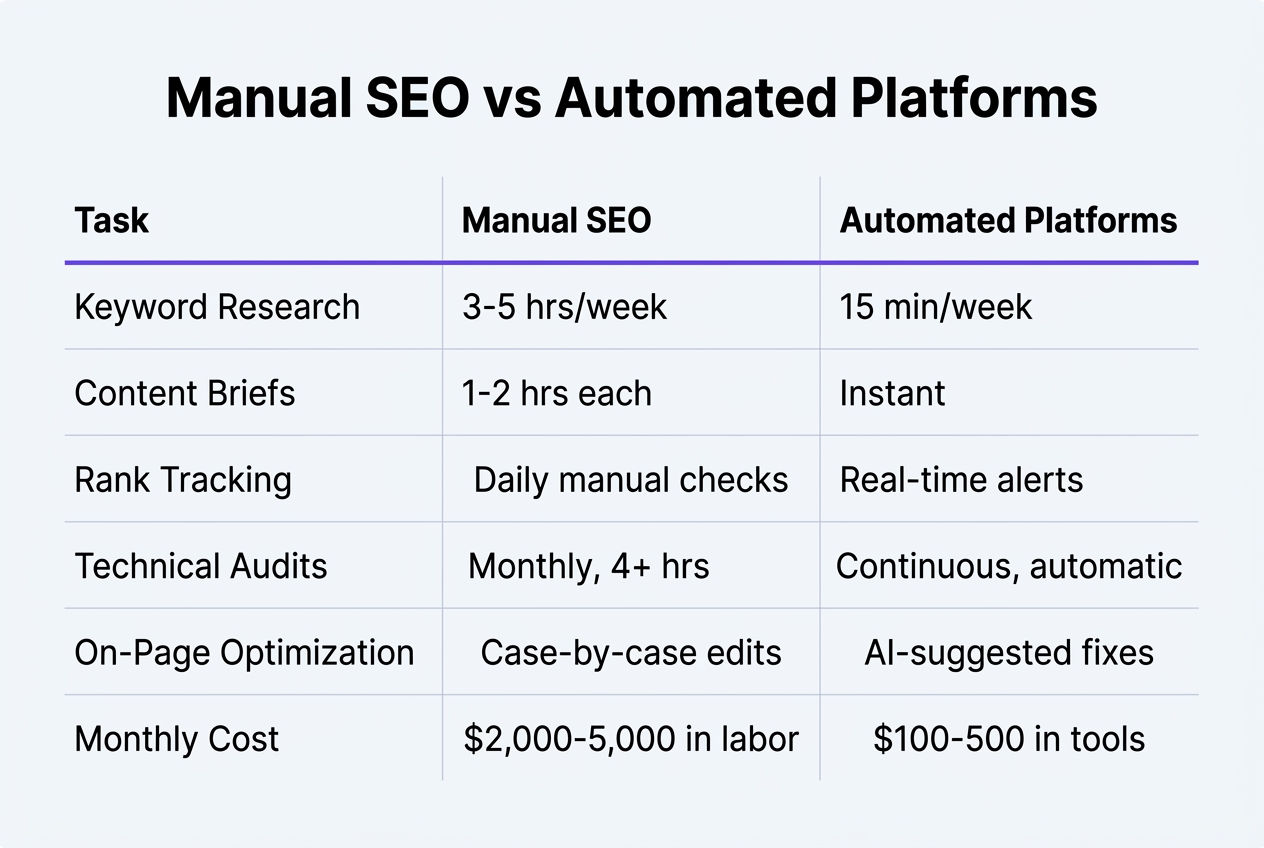
seo automation Tools Compared: Manual SEO vs Automated Platforms
Not every SEO option belongs in the same bucket. Hiring an agency, using a point solution like a keyword planner, and running a full-service automation platform solve different problems at different costs. The table below breaks down what each actually demands from you, and what you get back.
| Approach | Time Investment | Cost | Output Frequency | SEO Experience Needed | AI Search Optimization |
|---|---|---|---|---|---|
| Manual / DIY writing | 8-12 hrs per article | Free, but costs your time | 1-4 posts/month, if you're disciplined | Moderate to high | Rare, unless you know current best practices |
| SEO agency or freelancer | Low hands-on, high management | $500-$5,000+/month | 2-8 posts/month typically | Low for you, high for them | Varies widely by provider |
| Point tools (keyword planners, auditors, grammar checkers) | Medium; you still write and publish | $20-$200/month per tool | Depends entirely on you | Moderate | Usually none built in |
| Full-service automation platform | Minutes for setup, then near-zero | Roughly $99/month per site | Daily, automatically | None required | Built for both Google and AI answer engines |
Point tools like keyword planners or site auditors are useful, but they're diagnostic. They tell you what's wrong; they don't fix it. You still have to write, format, publish, and repeat that forever. A dedicated provider running daily publishing collapses that entire workflow into one recurring task you barely touch. If you want a deeper breakdown of how these pipelines actually work in practice, the blog covers real setup examples across different industries. Agencies sit in between: less manual labor than DIY, but you're paying for their time, not a system. Worth remembering, too.
What to Look for in an SEO Automation Platform
Red flags that signal low-quality automation
Start with cadence. If a platform publishes in bursts, five articles one week, nothing for a month, that's a warning sign. Google rewards consistency, not spikes. You want daily output, not a tool that treats your content calendar like an afterthought.
Next, check what it actually integrates with. A real platform pushes straight into WordPress, Shopify, Wix, or Webflow, and offers webhooks for anything custom-built. If you're stuck copy-pasting HTML into your CMS every morning, that's not automation. That's just a slower writer.
Then there's content quality itself. Thin 500-word posts with no plagiarism checks and zero brand voice control are a liability, not an asset. And watch the backlinks: verified dofollow links from real niche sites are worth something, but mass link exchanges and PBNs can tank your domain instead of lifting it. Google's spam policies explicitly list excessive link exchanges as manipulative behavior worth penalizing.
Signs a platform is built for both Google and AI search
The best platforms don't just chase blue links anymore. They track whether your business gets cited in ChatGPT, Perplexity, Claude, and Google's AI Overviews, because that's where a growing share of buyers now start looking. If a tool has no visibility into AI answer engines, it's optimizing for half the map.
Setup speed and contract terms matter too. Five minutes to launch, cancel anytime, no long lock-ins. That flexibility tells you a lot about how confident the provider is in its own results. Some newer entrants position around SEO automation made simple with AI agents, which is worth understanding as a category, even if you end up choosing a more content-focused platform instead.
Finally, if you run multiple locations, brands, or client sites, look for multi-language and multi-site management. Agencies and franchises need one dashboard, not ten logins. That's the real test of scale.

How an Automated Content Pipeline Works Step by Step
Most people picture "automated content" as one big black box. It's not. It's a chain of six distinct steps, and each one feeds the next. If any link in that chain is weak, the whole thing stalls, which is why it helps to see the process laid out plainly instead of as a vague promise.
| Step | What Happens | Why It Matters |
|---|---|---|
| 1. Business & competitor analysis | Reviews your site, local competitors, and market gaps to build a growth plan | Prevents generic content that ignores your actual niche |
| 2. Keyword research | Finds high-volume, low-competition terms specific to your service area | Targets terms you can realistically rank for now, not in three years |
| 3. Article generation | Writes a long-form piece with images, internal and external links | Gives Google and AI engines depth, not thin filler |
| 4. Auto-publish | Pushes the article live on your connected platform daily | Removes the manual bottleneck that kills consistency |
| 5. Backlinks & mentions | Builds links and drafts replies in relevant community threads | Signals authority beyond your own domain |
| 6. Tracking | Monitors rankings, traffic, and AI citation data over time | Shows what's working, so the plan adjusts instead of guessing |
Steps 1 and 2 are the strategy layer. Skip them and you're just publishing noise. Steps 3 and 4 are the production engine — this is the part most tools automate, but timing and formatting still matter more than people assume. Step 5 is where a lot of DIY efforts quietly fail, since content without any outside signals tends to plateau. And step 6 closes the loop; a good community discussion on what SEO tasks can realistically be automated makes clear that tracking and adjustment matter just as much as the writing itself. None of these steps work well in isolation — that's the whole point of a pipeline.
Is SEO Automation Worth It for Small and Local Businesses
When automation outperforms hiring a writer or agency
There's a pattern that shows up again and again with insurance agents, med spa owners, and roofing companies. Great reputation offline. Nearly invisible online. These businesses have happy customers and years of experience, but their Google presence doesn't reflect any of it. The fix usually isn't a rebrand or a new logo. It's consistent, keyword-targeted content that gives search engines a reason to notice the site at all.
Money is the other half of this. A typical local SEO retainer runs $1,500 or more a month and usually buys you two to four articles, if that. Automated publishing at $99 a month can produce a new article every single day — 30 pieces of content versus two or three. Volume compounds, and in SEO, volume published consistently over months tends to beat a handful of polished posts trickling out on an agency's schedule.
The honest verdict: an agency writer can craft a better single sentence. But nobody's ranking on one sentence. Brand-new domains with zero prior authority have shown measurable Search Console impressions and clicks within a few months of daily publishing — the kind of movement that's hard to justify paying agency rates for. If you're comparing options, it helps to look at broader roundups of SEO automation tools I'm using in 2026 before committing to any single workflow.
Where it fits for franchises or multi-location businesses
Multi-location businesses face a scaling problem regular automation buyers don't. Each location needs its own local pages, its own city-specific keywords, its own voice — but the brand still has to feel consistent. Manually writing unique content for ten locations is a full-time job by itself. Automated systems with multi-site management handle this by running separate content calendars per domain while keeping brand tone locked in.
This isn't limited to local services, either. SaaS teams use the same daily-publishing model to target long-tail feature comparisons and integration keywords. E-commerce stores automate product-category content across hundreds of SKUs. Legal practices with multiple offices run location-specific pages side by side. The mechanics barely change from industry to industry. Only the keyword targets do.
For a franchise owner weighing this against hiring, the math gets simple fast. One writer covering five locations at agency rates could easily run $7,500 a month. Automated publishing across those same five sites costs a fraction of that, with volume discounts making it cheaper still. That's not a small gap. It's the difference between testing content marketing and actually committing to it.
Getting Started: Rollout and Common Pitfalls
Rolling out a daily content system isn't complicated, but the order of operations matters. Skip a step and you'll end up with generic articles that don't sound like your business — or worse, content nobody bothers to check on after month one. Here's the typical sequence:
- Connect your website platform first, whether that's WordPress, Shopify, Wix, Webflow, or a webhook setup, so articles can publish without manual uploads.
- Set your brand voice by giving clear instructions on tone, terminology, and things to avoid, so the content sounds like you and not a random template.
- Review the first growth plan closely, including the keyword targets and content calendar, before letting anything go live on autopilot.
- Let daily publishing begin and resist the urge to pause it after a slow first week — consistency is the entire mechanism here.
- Monitor Google Search Console and analytics monthly to see which articles are gaining impressions, clicks, and rankings, and which topics need a second pass.
Now the pitfalls. The biggest one: expecting overnight rankings. This is compounding growth, not a light switch — real movement usually shows up over weeks, not days. Second, ignoring brand voice setup produces flat, forgettable content that reads like everyone else's. Third, tracking Google rankings while ignoring AI citation visibility means missing half the picture; understanding how modern automated SEO works means accepting that ChatGPT and Perplexity now matter too. Finally, if you're expanding internationally, picking a tool without backlink support or multi-language capability will box you in fast.
The Future of seo automation: Ranking on Google and Being Cited by AI
The goal used to be simple: rank in the top ten blue links. That's no longer the whole game. AI Overviews, ChatGPT, and Perplexity now answer questions directly, often without sending anyone to your site at all. Ranking still matters, but being the source an AI chooses to cite matters just as much. That's a real shift in how visibility works, and it's why the very idea of what "SEO automation" even covers keeps expanding — the concept behind that phrase is broken down well in this complete guide to how the field has evolved.
Winning citations favors content that's structured, factual, and kept current. Vague blog fluff doesn't get quoted; clear answers with specifics do. Pages updated often, with dates, data, and direct claims, are what these engines tend to pull from. Multi-language publishing adds another layer here too — a med spa in Miami can now compete for Spanish-language searches, and a roofing company can answer questions in whatever language its local market actually speaks, without hiring translators. Small businesses get a shot at global reach they simply didn't have five years ago.
Expect daily publishing and AI visibility tracking to stop being premium features and become baseline expectations, the same way having a website did decades back. But automation isn't a substitute for thinking. It's a growth channel, not a strategy. The businesses that win will still be the ones asking good questions about their customers — automation just handles the grunt work of answering them, every single day, at a pace no human writer can match.
Before you commit to a plan, it's worth getting clear on which problem you're actually solving: a site that search engines struggle to crawl needs a developer or technical specialist, while a site that's technically sound but simply doesn't have enough to rank for needs a steady stream of published, well-structured content. Those are different budgets and different timelines, and conflating them is how teams end up paying for months of work that never moves the needle. Ask what the measurable goal is six months out, who owns each piece, and whether the fixes you're considering compound over time or only hold as long as someone keeps paying for them.