
Search used to mean one box and one blue-link page — not anymore. Between AI chat answers, privacy-first alternatives, and niche engines built for shopping or research, picking where to show up takes real strategy. If you're still Googling "best search engine 2025" to figure out where your traffic and visibility actually come from, you're asking the right question at the right time. This roundup breaks down the 12 engines worth your attention heading into 2026, and what each one means for how you get found.
Table of Contents
- How We Evaluated the Best Search Engine 2025 Contenders
- 1. Google: The Default Choice for Breadth and AI Overviews
- 2-7: Bing, Yahoo, DuckDuckGo, Ecosia, Brave Search, and Yandex Compared
- 8-11: AI-Native and Niche Search Tools Gaining Ground
- 12. Perplexity and the Rise of AI Answer Engines
- Emerging Search Trends Reshaping 2026 Rankings
- How to Track Your Rankings and Get Found Across Every Engine
- FAQ: Search Engines, AI Answer Engines, and SEO in 2026
How We Evaluated the Best Search Engine 2025 Contenders
Why 2025's shift to AI search changed the rules.
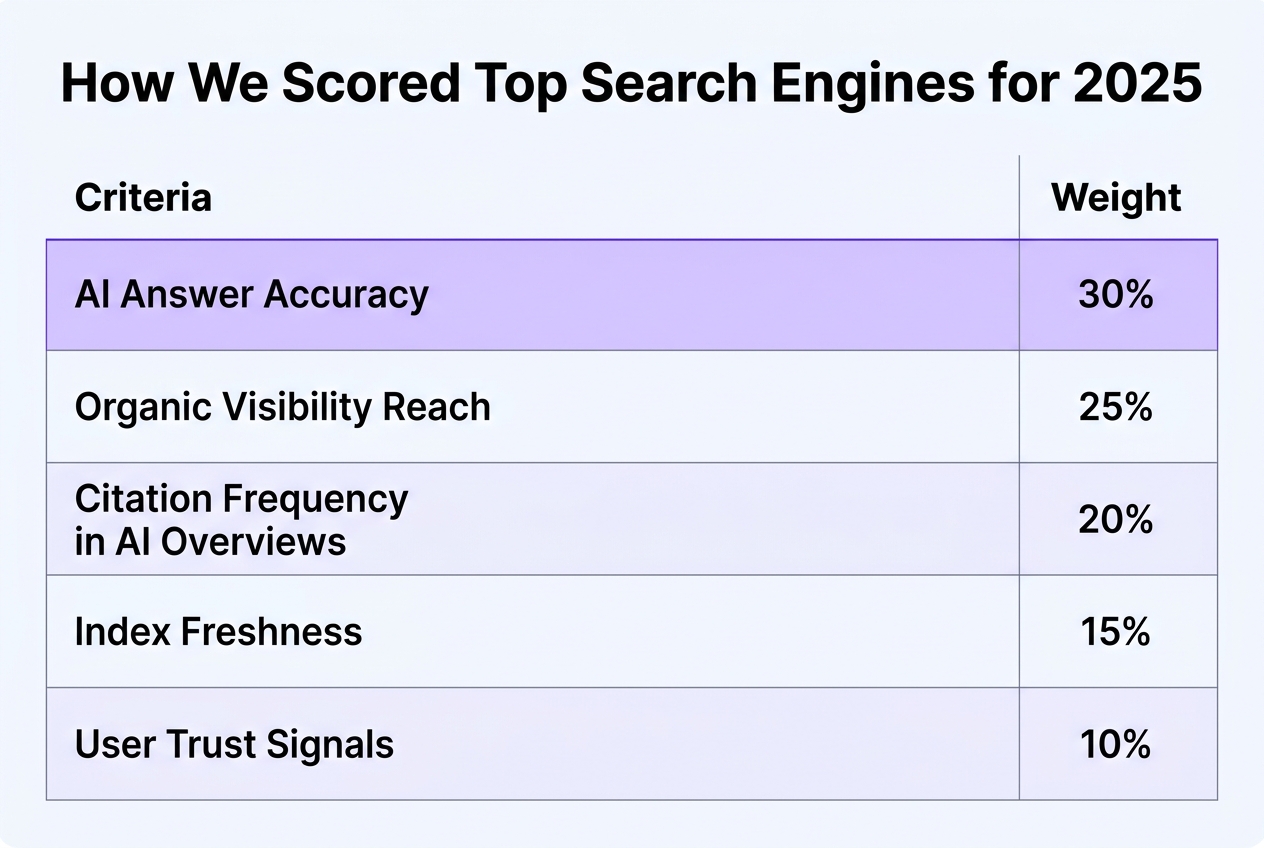
We didn't just type queries into a search bar and eyeball the results. Every engine on this list got tested across different query types: quick factual lookups, "near me" searches, product comparisons, and messy long-tail questions a real person would actually type at 11pm. Relevance isn't just "did it find a page." It's whether the top results actually answer the question, without you clicking through five tabs to confirm. Accuracy mattered more in 2025 than in past years, since more answers now show up as a direct snippet instead of a list of blue links.
Speed and interface sound boring until you lose thirty seconds to a laggy page or a cluttered layout stuffed with ads. We timed load speeds, counted how many clicks it took to reach a useful answer, and noted how much screen space went to the actual result versus everything else. We also dug into privacy practices, because data collection policies vary wildly between engines, and that's a real factor for anyone choosing a daily driver.
Integrations counted too. Maps, shopping results, video previews, flight and weather widgets — these aren't gimmicks, they're how most people actually use search now. And here's the part that's newer: we checked whether each engine's content gets cited by AI assistants like ChatGPT and Perplexity. A search engine that AI tools ignore when forming answers is quietly losing relevance, even if its own results page still looks fine.
1. Google: The Default Choice for Breadth and AI Overviews
Let's state the obvious first: Google still runs the show. It indexes more pages, crawls more often, and processes more queries than anything else on this list, by a wide margin. No other engine comes close to its breadth. That scale is exactly why most SEO budgets, including every strategy built by local roofers, med spas, and SaaS marketing teams, point here first. The ranking algorithm has had decades to mature, and it rewards depth, relevance, and freshness over shortcuts. Thin, outdated pages just don't compete anymore.
The bigger shift for 2026 is AI Overviews. They now show up on most informational searches, answering questions directly above the organic results. That's changed what "ranking" even means. Your content needs to be structured and specific enough for Google's AI to summarize and cite it, not just rank it. For businesses figuring out how to adapt, a solid seo automation guide is a useful starting point before building a content plan around this.
None of this works without consistency, though. Google still favors sites that publish real, useful content regularly, not once a quarter. A single great article won't move the needle; a steady stream of them, covering the questions your customers actually ask, is what builds the authority Google's algorithm looks for.
2-7: Bing, Yahoo, DuckDuckGo, Ecosia, Brave Search, and Yandex Compared
Not every search engine is trying to be Google. Some bet on privacy, some on ethics, some just run on borrowed infrastructure. Knowing which is which changes how you think about showing up in search results beyond the obvious one.
Privacy-first engines vs. mainstream engines
DuckDuckGo and Startpage built their whole pitch around zero-tracking search. No profiles, no ad targeting based on your history, no creepy follow-you-around retargeting. Ecosia takes a different angle: it's a mainstream-feeling engine that donates a chunk of its ad revenue to tree planting, over 200 million trees funded so far by its own count. Bing, Yahoo, and AOL sit firmly in the mainstream camp, optimizing for scale and ad revenue like Google does. If you're mapping out where your content actually needs to appear, a content scaling guide is a good place to see how publishing volume affects visibility across both types of engines, not just one.
Which ones actually have independent indexes
Here's the part most people get wrong: several of these "different" engines aren't actually running their own search index. They're reskinned results from someone else's crawler.
| Engine | Independent Index? | Backend Source | Known For |
|---|---|---|---|
| Bing | Yes | Own index | Powers Copilot and ChatGPT's web results |
| Yahoo / AOL | No | Bing | Legacy brand, Bing-powered results |
| DuckDuckGo | Partial | Bing + own crawler | Zero-tracking privacy search |
| Brave Search | Yes | Own index | Independent, not Bing or Google-based |
| Yandex | Yes | Own index | Dominant in Russian-language search |
Bing matters more than its market share suggests, since it quietly powers Copilot and feeds web results into ChatGPT. Brave Search is the real outlier here, running its own index built from scratch rather than leasing someone else's data. Yandex, meanwhile, barely registers outside Russia but dominates there completely. For SaaS teams or e-commerce brands targeting international markets, that's worth remembering before you assume Google's rules apply everywhere.
8-11: AI-Native and Niche Search Tools Gaining Ground
Not every search tool wants to hand you ten blue links and call it a day. A growing group skips the list entirely and just answers you, while others carve out a lane around privacy, aggregation, or geography. None of these will replace Google for most businesses. But they're worth knowing, because your content needs to hold up in places you're not actively watching.
Conversational answer engines
iAsk AI and Perplexity both treat search like a conversation instead of a results page. Ask a question, get a direct answer with sources cited underneath, no scrolling required. That's a real shift for SEO. If your content never gets cited in these answers, it doesn't matter how well it ranks on page one of Google.
Privacy-first and aggregator options
- Qwant and Swisscows lean hard on European data protection laws, appealing to users who don't want their queries logged or sold to advertisers.
- Dogpile pulls results from several engines at once, a throwback approach that still has a small but loyal user base.
- YouTube quietly remains the second-largest search engine by query volume, which is easy to forget when you're focused on text-based rankings.
- Baidu dominates search in China, where Google has limited reach.
- Naver leads in South Korea with its own distinct results format and content ecosystem.
- Seznam and Daum hold strong positions in the Czech Republic and South Korea respectively, proving search is still regional in ways a lot of marketers overlook.
If you sell internationally, these regional players matter more than any U.S. ranking report will tell you. A roofing company in New Jersey doesn't need Baidu. A SaaS brand expanding into Asia probably does. Know your audience before you chase every engine on this list.
12. Perplexity and the Rise of AI Answer Engines
Why being 'found' now means being quoted, not just ranked
Perplexity doesn't just list links and send you off to click. It reads them, synthesizes an answer, and drops the sources right inside the response. You get a paragraph, not ten blue links. For a business, that's a different game entirely. Ranking on page one means nothing if the answer engine never mentions you by name.
More people are swapping it in for Google on research-heavy questions: "best roofing material for humid climates," "what to ask before a med spa consultation," that kind of thing. It's fast, conversational, and skips the ten-tabs-open routine. That shift is quiet but real, and it's pulling research traffic away from traditional search results pages.
Getting cited inside those answers takes a specific kind of content: clearly structured, backed by real detail, and updated often enough that the engine trusts it's current. Stale pages from 2019 rarely make the cut. Fresh, well-organized articles do. That's why plenty of businesses now chase two goals at once — climbing Google's rankings and earning a line inside an AI-generated answer, which is a newer, harder target to hit.
Emerging Search Trends Reshaping 2026 Rankings
Search engines don't read keywords the way they used to. Natural language processing now reads intent. Type "my roof is leaking after the storm, who do I call" and the engine understands you want a local roofer, fast, not a dictionary definition of "leak." This shift matters more than any single ranking factor. Voice search pushes the trend further, since people talking to a phone or smart speaker ask full questions, not fragments. "What's the best med spa near me for Botox" sounds nothing like a typed query from five years ago, and content written for one often flops for the other.
Visual search is quietly booming too. Shoppers snap a photo of a product or a style they like and let the engine find matches, which changes how e-commerce listings and images need to be built. Meanwhile, results are getting personal. Location, past searches, even device type now shape what two people see for the identical query. A query in Tampa and the same query in Newark can surface completely different local businesses on page one.
Then there's the big one: AI Overviews and chat answers are cutting clicks. Google can answer a question right on the results page, and tools like ChatGPT or Perplexity skip the page entirely. Here's the blunt truth — fewer clicks doesn't mean less opportunity, it means a narrower one. The businesses that keep publishing clear, well-structured, question-answering content are the ones these systems actually cite. Everyone else just gets summarized out of the picture.
How to Track Your Rankings and Get Found Across Every Engine
Most rank trackers still only watch Google positions. That's a problem now. A customer might find you through an AI Overview, a ChatGPT answer, or a Perplexity citation, and a tool built for 2015-style SERPs won't catch any of it. You need two layers of visibility: where your domain stands overall, and where it's getting mentioned across AI answer engines. RankPush doesn't replace a traditional rank-tracking dashboard or build you client reports — but its domain tracking and AI visibility tracking cover the second layer directly, watching whether ChatGPT, Perplexity, Claude, and (soon) Google AI Overviews are actually citing you.
Steps to improve visibility across search and AI engines
Here's a practical sequence most small businesses can follow, whether you're a roofing company in New Jersey or a med spa in Florida.
| Step | What it does | What to watch |
|---|---|---|
| Track domain authority | Shows growth over months, not keyword-by-keyword noise | Steady upward trend, not single spikes |
| Monitor AI mentions | Checks if ChatGPT, Perplexity, Claude, and AI Overviews cite you | Brand name or site appearing in answers |
| Publish scored content daily | Each article gets an SEO/GEO score before it goes live | Scores improving as topics get covered |
| Build niche backlinks | Verified sites in your industry link back to you | Link count and relevance growing together |
| Review published archive | Shows topical depth building over weeks | Breadth of keywords, not just volume |
Why daily publishing compounds over months, not days
One article won't move a domain with zero authority. Thirty might start to. Ninety, with backlinks attached, usually changes the conversation entirely. Daily, SEO/GEO-scored publishing gives search engines and AI models more surface area to find, index, and cite you — and it gives your backlink profile room to grow alongside the content, not separately from it. This is exactly the lane RankPush runs in: daily AI-written articles, each scored before it goes live, with backlink building from verified niche sites working in the background. It connects to your existing WordPress, Shopify, Wix, Webflow, or webhook setup in about five minutes, so there's nothing to rebuild on your end.
This isn't a one-time fix you check off a list. It's closer to compound interest: small, boring, repeated. Skip a month and you don't lose everything, but you stall the curve right when it was about to bend upward.
FAQ: Search Engines, AI Answer Engines, and SEO in 2026
What exactly is a search engine, and how does it work?
A search engine crawls the web, stores pages in a massive index, then ranks that index against whatever someone typed in. Three jobs, really: crawl, index, rank. Google does it with bots and over 200 signals. Simple idea. Complicated execution.
How many search engines exist, and which ones matter?
Dozens are technically "live," but a handful carry almost all the traffic. Google still dominates globally, with Bing, Yahoo, and DuckDuckGo splitting the rest, plus regional players like Yandex. What's new is AI answer engines eating into that pie.
How do search engines actually rank pages today?
Ranking in 2026 isn't just keywords and backlinks anymore. A few things carry real weight now:
- Freshness and publishing frequency, since engines favor sites that add relevant content regularly instead of going quiet for months
- Topical depth, meaning a site that covers a subject thoroughly tends to outrank one with a single thin post
- Backlinks from relevant, verified sites in your niche, not just any link from anywhere
- Clear structure and answer-friendly formatting that both Google and AI tools can lift and cite easily
- Technical health, like site speed and mobile usability, which a developer or technical SEO specialist typically handles
Which engines are AI-powered now?
Google's AI Overviews, Bing's Copilot integration, and standalone tools like Perplexity all generate answers instead of just links. ChatGPT and Gemini increasingly act as discovery layers too. Getting cited there matters almost as much as ranking on page one now.
How can a small business improve visibility without hiring an SEO team?
You don't need an agency retainer to compete. Many local businesses lean on automation for the heavy lifting. RankPush is built around exactly this: keyword research, daily AI-written articles with brand voice customization, auto-publishing, and backlink building, all for $99/month per site. Here's what that actually covers:
- Automated keyword research to find low-competition terms worth targeting instead of guessing
- Daily long-form articles published automatically, which builds the content volume AI and Google both reward
- Verified backlink building from niche-relevant sites, without manual outreach or pitching
- AI visibility tracking across tools like ChatGPT and Perplexity, so you can see if you're actually being cited
None of that replaces technical fixes or local listing work — those still need a developer or a local SEO specialist. RankPush just handles the content engine, which is often the biggest gap.
Before committing to any approach, it helps to be honest about what's actually slowing growth down: is it a lack of fresh content reaching the right searches, or something deeper in the technical setup that needs a specialist's eyes first? Worth asking, too, how much ongoing publishing versus one-time fixes will matter six months from now, since those two needs rarely get solved by the same tool. Sitting with those questions tends to make the next step clearer than any feature list could.