
Staring at a blank page, you're hunting for blog entry examples for students that actually show the range of formats a real assignment might demand. Reflective journals, travel recaps, book reviews, opinion pieces — the structures differ more than most guides let on. This piece breaks down proven formats, ready-to-use templates, and fresh topic ideas for 2026, so you can see exactly how a strong student blog entry is built before you write your own.
Table of Contents
- What Makes a Strong Student Blog Entry
- blog entry examples for students by subject and purpose
- Comparing Blog Entry Formats Side by Side
- Step-by-Step: Writing a Blog Entry from Prompt to Publish
- Writing Prompts to Get Started Fast
- Formatting and Style Tips That Improve Any Entry
- Turning Student Blogging Into a Long-Term Skill (and Beyond the Classroom)
What Makes a Strong Student Blog Entry
Core elements every entry should include
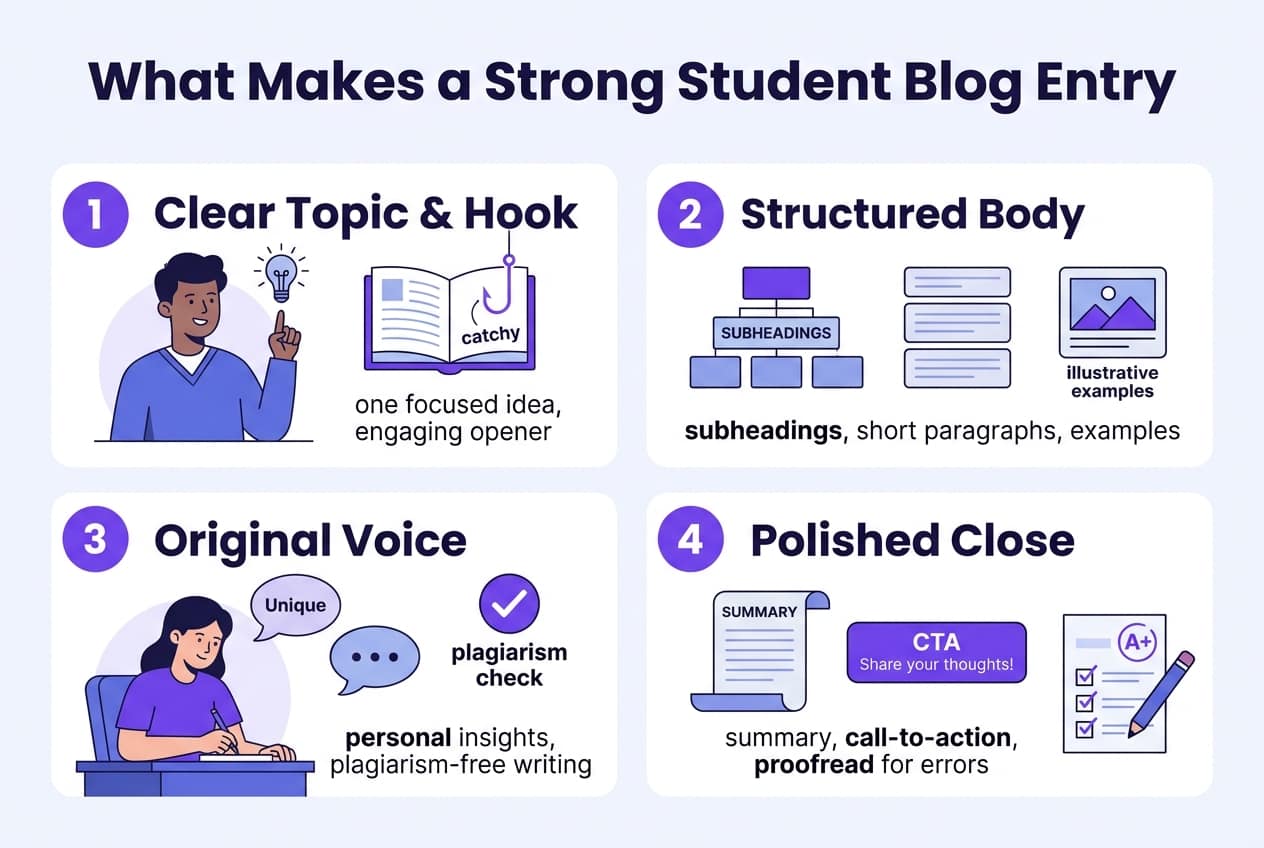
Every solid blog entry follows a shape. Doesn't matter if it's graded for English class or written just for fun. Start with a hook — a question, a strange fact, a quick scene. Then give context. Why does this topic matter, and why are you writing about it now? The body carries your main ideas, usually two or three, each backed by a detail or example instead of a vague claim. Skip the body and you're left with an opinion piece that proves nothing.
After the body, most strong entries add a reflection section. This is where you step back and ask what you learned, what surprised you, or what you'd do differently. Teachers love this part. It shows thinking, not just summarizing. It's also the easiest section to cut corners on, so don't rush it. Close with a short wrap-up that echoes your hook or points toward a next step. A flat ending makes even a great post feel unfinished.
This five-part shape — hook, context, body, reflection, close — works for a 400-word reaction post and a 1,200-word research entry alike. If you're aiming to turn blogging into a real habit beyond one assignment, a content scaling guide is useful reading, since it breaks down how consistent structure lets you publish more without losing quality. Keep that structure in your back pocket and every entry gets easier to start.
Common mistakes that weaken a post
The biggest mistake students make isn't bad grammar — it's trying too hard to sound smart. Overwritten sentences. Thesaurus words crammed in awkwardly. Vague statements that could apply to any topic. Clarity beats polish every time. A reader, or a teacher grading twenty-five of these, will take a clear, specific post over a flowery one that says nothing new. Specificity is what separates a forgettable entry from one people remember.
Another common weak spot: posting once, brilliantly, then vanishing for a month. A consistent habit, even messy weekly entries, builds more skill and more trust with readers than one perfect post ever will. Think of it like practicing an instrument. Daily reps matter more than one flawless recital. Teachers and readers alike judge posts on voice — does this sound like an actual person? — plus a clear takeaway they can repeat back in one sentence.
Honestly, a lot of weak entries just forget to land anywhere. They wander through facts, add a few opinions, and stop. No verdict, no lesson, no point. That's the fastest way to lose a reader's trust. Before you publish, ask yourself what one thing you want someone to remember. Then make sure it's stated plainly somewhere in the post, not buried under ten sentences of throat-clearing.
blog entry examples for students by subject and purpose
Academic vs. personal blog entries
Not every blog entry serves the same purpose, and that's the first thing to sort out before you write a word. Academic entries prove you learned something; personal entries show how you experienced something. Mixing the two without noticing usually produces a flat, confused piece that doesn't fully work as either. Once you know which lane you're in, the structure almost writes itself.
Here are six common types students actually get assigned, or choose to write on their own:
- A personal reflection entry that walks through a slice of daily life, a travel trip, or the messy, exciting chaos of a first-year experience on campus.
- A book or film review entry that states a clear rating, backs it up with two or three specific scenes or quotes, and ends with a direct recommendation.
- A research summary entry for a class project or lab, built around a question, a method, a result, and what it means in plain language.
- An opinion or persuasive entry on a current issue that states a position early, supports it with evidence, and addresses the strongest counterargument instead of ignoring it.
- A tutorial or how-to entry that explains a skill learned in class step by step, written so a classmate could actually follow along and succeed.
- A creative writing or short fiction entry that uses blogging as a low-pressure space to practice voice, dialogue, and pacing outside a formal assignment.
Notice the pattern. Academic entries — research summaries, tutorials, some reviews — lean on structure and evidence; personal entries — reflections, opinion pieces, fiction — lean on voice. A film review actually sits in the middle, which is why it's such a good practice format: half personal taste, half structured argument. If you're hunting for topic ideas, browsing a blog built around similar long-form, subject-driven posts can show you how professionals pace an argument or a narrative. And for creative-writing students specifically, following working writers online — profiles like Nels Armstrong alongside other writing blogs — is a quick way to study tone before you draft your own.
Comparing Blog Entry Formats Side by Side
Not every blog entry should look the same, and picking the wrong format for the job wastes time. A reflection entry about a field trip doesn't need the same structure as a persuasive essay arguing for a policy change. Before you assign (or write) anything, it helps to see the four common formats stacked against each other on length, tone, and skill level.
| Format | Typical Length | Tone | Difficulty | Best Grade Level |
|---|---|---|---|---|
| Reflection | 300–500 words | Personal, honest | Easy | Grades 4–8 |
| Review | 400–700 words | Evaluative, opinionated | Easy-Moderate | Grades 6–10 |
| How-To | 600–900 words | Instructional, clear | Moderate | Grades 7–11 |
| Persuasive | 700–1,000+ words | Confident, assertive | Hard | Grades 9–12 |
For a quick weekly post, go with reflection or review. Both can be drafted in one sitting and don't demand outside research. How-to entries work better as a short-term project spread over a few days, since they need accurate steps and sometimes photos or diagrams to make sense. Persuasive essays are the long-haul option: they need a thesis, evidence, and revision, which makes them a better fit for a two-week unit than a Monday-morning assignment.
If you're brand new to blogging, start with reflection. There's no wrong answer, just your own experience. Reviews come next because the structure (summary, opinion, recommendation) is forgiving and repeatable. Persuasive writing should wait until students are comfortable building an argument. Honestly, skipping straight to persuasive is where most beginners stall out — too many moving parts, not enough scaffolding yet. Teachers juggling multiple classes who want a repeatable system for planning these might find it useful to review a general seo automation guide, since the logic behind consistent, structured publishing schedules applies just as well to a classroom blog calendar as it does to a business one.
Step-by-Step: Writing a Blog Entry from Prompt to Publish
Most students treat a blog entry like a mystery box, poking at it until something comes out. It doesn't have to be that way. Break it into small steps, time each one, and the whole thing gets done in about an hour without the usual last-minute panic.
Here's a realistic breakdown for a typical homework-length post of 500 to 800 words. Times will stretch for longer assignments, but the order stays the same.
| Step | What you're doing | Estimated time |
|---|---|---|
| Choose a prompt | Pick a topic you can actually say something about | 5-10 minutes |
| Outline three main points | Jot down the three ideas that will each get a body paragraph | 10 minutes |
| Draft an intro hook | Write a question, fact, or short story to pull readers in | 10 minutes |
| Write body paragraphs | Expand each outline point with examples and detail | 20-25 minutes |
| Add a closing reflection and proofread | Wrap up your take, then read it aloud once | 10 minutes |
Notice the first row isn't even writing yet. It's deciding. Skip that step and you'll stall out halfway through the draft wondering what your point was. The outline step matters just as much; three points is a sweet spot, enough to feel thorough without sprawling into a research paper.
Images and links belong in specific spots, not scattered randomly. Drop a relevant image near the hook to anchor the post visually, and place one more inside a body paragraph if it illustrates a point. For external links, add one or two inside body paragraphs where you're citing a fact or pointing to further reading; a beginner's guide to blogging is a handy reference if you want more structure examples. Never bury a link in your conclusion; readers rarely click there.
One more thing: proofreading is not optional. Read the whole thing once, out loud if you can. It catches more than silent skimming ever will.
Writing Prompts to Get Started Fast
Staring at a blank page wastes more time than writing the actual post. A good prompt fixes that instantly. Here are prompts sorted by type, so you can grab one that fits your assignment without overthinking it.
- Personal: describe a challenge you overcame this semester, what made it hard, and what you'd tell your past self about it.
- Personal: write about a routine, habit, or small ritual that's quietly changed how you handle school or life outside it.
- Academic: explain a concept you struggled with until it clicked, walking the reader through the confusion and the moment it made sense.
- Academic: summarize a lecture or reading in your own words, then argue whether you agree with its main claim.
- Creative: review a book that changed your perspective, focusing on one idea or scene rather than the whole plot.
- Opinion: take a stance on a debate happening in your field of study and defend it with two solid reasons.
Notice none of these are vague. "Write about school" is a trap — too broad, too boring, too easy to stall on. A sharp prompt gives you a lane, and a lane is what gets words on the page.
Match the prompt to the assignment, not the other way around
A 400-word reflection and a 1,500-word analytical post need different starting points. Personal and opinion prompts tend to run short and punchy, which suits quick reflections. Academic prompts, especially ones asking you to explain or compare a concept, naturally stretch longer because you need space to unpack evidence. Before picking a prompt, check your word count and purpose first — then choose the one that can actually fill that space without padding.
Formatting and Style Tips That Improve Any Entry
Good formatting isn't decoration. It's the difference between a post someone reads and one they close after five seconds. Use short paragraphs, two or three sentences at most, along with subheadings and bullet points so the page looks scannable before anyone reads a word. Most readers skim first and decide later whether to commit.
Your title and opening line do the heaviest lifting in the whole post. A flat title like "My Weekend" gets ignored; something like "What a Rainy Saturday Taught Me About Patience" earns a click. Open with a question, a surprising fact, or a small confession, then get to the point fast. Readers decide in seconds whether to keep going, so don't bury the good stuff in paragraph three.
Tone matters more than most students realize. If you start casual and chatty, stay that way through the whole piece. Then proofread. Read it out loud once before posting. Grammar slips and tone whiplash are the fastest way to make a strong idea look sloppy.
Finally, break up long text blocks with one image or concrete example. A photo, a screenshot, or even a short anecdote gives the eye somewhere to rest. Dense walls of text, no matter how smart the content, tend to get skipped entirely.
Keeping a consistent voice across multiple posts
If you're writing a series, your voice needs to feel familiar from post to post, like the reader is catching up with the same person each time. That means picking a few traits early: formal or casual, first-person or more detached, humor or none. Write them down somewhere. It sounds basic, but it works.
Consistency breaks down fastest with vocabulary and sentence rhythm. If post one is breezy and full of contractions, and post four suddenly sounds like a textbook, readers notice the shift even if they can't name it. Keep a short style sheet, favorite phrases, words to avoid, preferred sign-off, and check new drafts against it before publishing.
This is exactly where many local businesses run into trouble too, just at a bigger scale. A med spa or roofing company publishing content daily needs that same voice discipline across dozens of posts, which is hard to maintain by hand. Tools built for ongoing content, including options with brand voice customization settings, exist precisely to keep that consistency intact once volume increases. The skill transfers directly: nail it now with five posts, and it's second nature with fifty.
Turning Student Blogging Into a Long-Term Skill (and Beyond the Classroom)
Why consistency matters more than perfection, for students and businesses alike
A student who writes one blog entry a week, every week, learns something a single polished essay never teaches: how to research fast, structure an argument, and get to the point. That's not an English class skill. It's a work habit. Writers who stick with a schedule get better at finding sources, citing them properly, and shaping a messy topic into something readable. Twelve okay entries beat one perfect one that never ships.
The same logic plays out in business, just with higher stakes. A search engine, or an AI assistant, doesn't reward the one brilliant article you wrote in March. It rewards the site that shows up week after week with clear, well-organized answers to real questions. Google and tools like ChatGPT and Perplexity both favor sites with depth and recency. One great post gets ignored. Fifty decent ones, published on schedule, start building real visibility.
Here's the blunt part: most businesses quit before the habit pays off. They write six posts, see no traffic bump, and stop. Students who abandon their blog after two entries learn the same lesson the hard way — consistency is the whole game, not a nice extra.
Automating the daily habit, so the skill still gets applied
Small businesses rarely have a student's luxury of practice time. A roofing company owner or med spa manager can't spend two hours a day researching keywords and drafting long-form posts. That's exactly the gap a tool like RankPush fills: automated keyword research, daily AI-written long-form articles, and auto-publishing straight to a site built on WordPress, Shopify, Wix, or Webflow. The daily-writing habit a student builds by hand gets replicated on a schedule, without someone on staff doing the typing. No developer, no manual setup headache — just a connection to your existing site.
It's the same discipline, different tool. Setup takes minutes, not a semester, and the article still goes out every 24 hours whether or not anyone remembers to write it.
Structure and voice, applied consistently at scale
Good student entries follow a format: a clear hook, organized body, a real conclusion. Businesses need that too, just measured differently — through SEO/GEO article scoring that checks structure, depth, and how well an article is likely to get cited by search engines and AI answer tools alike. Brand voice customization does for a company what a teacher's style guide does for a student: keeps tone consistent across dozens, even hundreds, of published pieces, so the writing sounds like one coherent voice instead of a patchwork.
Before committing to any path forward, it's worth asking honestly how much of the work you actually want to hand off versus keep hands-on, and whether what you need right now is deeper technical fixes or simply a steadier stream of content keeping your site active and visible. Some teams find that once the foundational issues are addressed elsewhere, the bigger challenge becomes consistency, and that's a different problem with a different kind of solution. Either way, the right choice usually comes down to being clear about the specific goal first, then matching the tool to it rather than the other way around.