
Your "About Us" page still reads like a résumé nobody asked for, and prospects bounce before they trust you. A strong company bio does the opposite. It builds credibility fast and turns casual visitors into leads. This guide breaks down exactly how to write one in 2026, step by step. No fluff.
Table of Contents
- Before you start: what you'll need
- Step 1: Define the goal and audience of your company bio
- Step 2: Open with your company name, category, and core value proposition
- Step 3: Structure the body with mission, milestones, and proof
- Step 4: Choose first-person vs third-person voice correctly
- Step 5: Add personality, then close with a clear call to action
- Step 6: Edit, format, and keep the bio updated over time
- Wrap-up: turning your company bio into ongoing content
Before you start: what you'll need
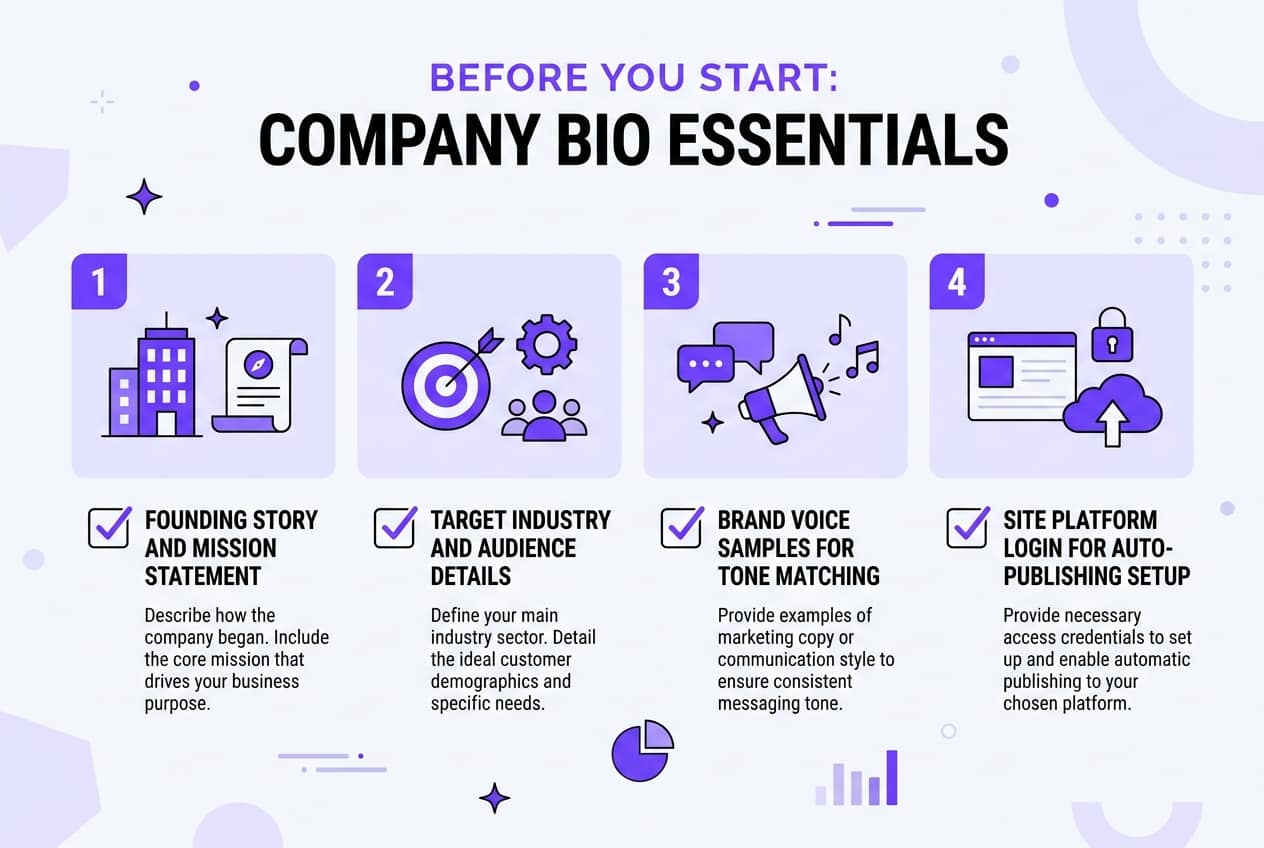
Before you type a single word, slow down for a minute. A rushed bio always reads rushed. The businesses that nail this on the first try are the ones who gather their facts and figure out the destination before they start drafting.
Information to gather first
Start by deciding why this bio exists. An About page, a press kit, and a guest post author box all demand different depths of detail. Then pull together the raw material you'll actually use. It helps to treat this like a research project, not a writing exercise.
- Your founding story: why the business started, what problem it was built to solve, and what the first year actually looked like
- A one or two sentence mission statement that explains what you do and who you do it for, stripped of jargon
- Hard numbers: years in business, team size, locations served, and any certifications or licenses that build trust
- Awards, media mentions, or partnerships that act as third-party proof you're legitimate, not just self-described
- Client or customer counts, including notable names if you're allowed to share them publicly
Once that's assembled, the actual writing takes a fraction of the time. Most people underestimate this step, then spend three hours stuck on a sentence because they're missing a basic fact.
Where your bio will appear
The platform decides the voice. A website About page usually reads better in first person, warm and direct, while a press kit or directory listing often calls for third person. Think hard about your reader too: a potential customer wants reassurance, an investor wants traction, a journalist wants a quick, quotable fact. If you're publishing across several channels, reviewing a solid automated content creation guide can help you keep tone and facts consistent without rewriting from scratch each time. Match the bio's length and formality to where it lives, every single time.
Step 1: Define the goal and audience of your company bio
Before you write a single line, decide where this bio is going to live. A homepage About page can breathe a little, running a few hundred words with room for history and personality. A press release bio gets maybe two sentences, squeezed between a quote and a boilerplate line. A directory listing is often capped at 150 characters, so you're forced to lead with the one fact that matters most. Writing the same version for all three is a mistake. Match the format to the placement, not the other way around.
Before you draft anything, ask what you want the reader to do next. Call? Book a free quote? Click through to a case study? Pick one action. A roofing company bio aimed at a homeowner who just searched "storm damage repair near me" should end in a request for a quote, not a vague mention of company values. A SaaS bio aimed at a potential investor should end with proof of traction, not a call to "learn more." One goal, every time. Trying to serve three outcomes in one paragraph usually means none of them land.
Matching bio length to platform.
Tone shifts with audience even when the facts stay the same. Investors want numbers: growth rate, retention, market size, momentum. Customers want warmth: who you serve, why you started, what it feels like to work with you. A med spa bio written for a funding deck would bore a walk-in client, and a med spa bio written for a client would bore an investor. If your business is covered in local press often, it's worth learning industry commentary on brand storytelling alongside standard press guidance, since both shape how outlets quote small businesses.
You'll likely need at least three versions sitting ready in a folder: a two-line LinkedIn summary, a 150-word website bio, and a half-page pitch deck version. A quick quiz can help you figure out which version your business is missing before you waste time polishing the wrong one. Keep all three consistent in fact and tone. Just not in length. Reusing one long bio everywhere forces readers to dig for the one line they actually came for.
Step 2: Open with your company name, category, and core value proposition
Your first sentence has one job: tell a stranger who you are and why they should care. Name your company, say what you do, and name who you do it for. "Harbor Roofing Co. helps homeowners in Tampa replace storm-damaged roofs without the usual runaround" tells a reader more in one line than three paragraphs of mission-speak ever will. Lead with specifics, not with a category you think sounds impressive.
Then state the problem you solve, in exactly one sentence. Not a bullet list of features, not five value props stacked together. Pick the single thing your customers hire you for and say it plainly. A med spa might write that it helps clients get rid of stubborn acne scarring without surgery. A SaaS company might say it helps finance teams close their books three days faster. Skip words like "innovative," "cutting-edge," or "best-in-class" unless you're ready to back them up with a number right after. If you can't prove it in the same breath, cut it. This is also a good place to read some well-written examples before you draft your own, and you'll find a range of them in this blog.
Finally, anchor it in place and time if it helps your credibility. "Founded in Jacksonville in 2014" does more work than "established business" ever could — it tells readers you've survived hurricane season, competitors, and a few algorithm updates. If you're brand new, say that too. Honesty reads better than vague confidence, every time.
Step 3: Structure the body with mission, milestones, and proof
Mission and values
Once your opening line hooks the reader, the body needs to answer a bigger question: why does this company exist beyond making money? A good mission paragraph names the problem you saw in your industry and the belief that pushed you to fix it. Skip the vague corporate language. Say what you actually stand for, whether that's honest pricing, faster response times, or treating every customer like a neighbor instead of a transaction.
Values only matter if they show up in how you work. If one of your values is transparency, say what that looks like in practice, not just the word itself. Readers, and increasingly AI answer engines pulling in business summaries, respond to specificity over slogans. One of the best professional bio examples we've seen tend to tie mission straight to a concrete customer outcome, not an abstract ideal.
Milestones worth including
Numbers build trust faster than adjectives. "Many happy clients" is forgettable. "3,000+ customers across Florida, New Jersey, and California" is proof. Include the milestones that actually signal credibility, not every award you've ever collected.
- The year you were founded and the specific gap in the market that prompted the launch
- A hard client or project number, such as customers served, policies written, or homes roofed
- Any licenses, certifications, or industry affiliations that a regulator or buyer would recognize on sight
- Measurable growth markers, like expanding from one location to several, or doubling staff in two years
- Awards or recognitions, but only ones tied to a credible third-party source, not self-issued badges
- A short origin detail, like the kitchen-table start or the first client who took a chance on you
That last one matters more than people think. A brief origin story makes the bio feel human instead of templated. Keep it to two or three sentences, though. No one needs your full career arc here. The goal isn't a memoir; it's enough texture that a stranger reading your site feels like they understand who's actually behind it.
Step 4: Choose first-person vs third-person voice correctly
Voice is one of those details people skip, then regret. Pick wrong and your bio reads stiff on a casual page, or too chatty on a formal one. The fix isn't complicated. It just takes a little matching.
Where each voice belongs
First-person ("we help homeowners find the right coverage") sounds warm and direct. It works great on your homepage, your About page, and social bios where people expect a human tone. Third-person ("the agency helps homeowners find the right coverage") sounds more formal and objective. That's what press kits, award submissions, and directory listings usually want.
| Placement | Recommended voice | Why it fits |
|---|---|---|
| Homepage / About page | First-person ("we") | Feels personal, builds trust fast |
| Press kit or media page | Third-person ("Company X") | Reads neutral, easy for journalists to quote |
| Directory or citation listing | Third-person | Matches the formal tone other listings use |
| Social media bio | First-person | Matches the platform's conversational norm |
| Team member bio on About page | Third-person, even if the rest is first-person | Describing a person in the third person reads naturally, regardless of company voice elsewhere |
Here's the one rule that actually matters: stay consistent within a single version of your bio. Don't flip from "we" to "the company" mid-paragraph. It's jarring, and it makes the writing feel unedited. You can absolutely keep a first-person version for your website and a third-person version for press use. Just don't blend them in the same block of text.
Step 5: Add personality, then close with a clear call to action
Adding personality without losing professionalism
A bio that's all facts reads like a tax form. One sentence of personality fixes that. Maybe you mention that your team starts every Monday with a 10-minute huddle over coffee, or that your lead roofer has climbed every roof in the county since 1998. It doesn't need to be clever. It just needs to be true and specific, so the reader sees people, not a logo.
Keep it to one or two lines, tucked near the end of the body. Too much personality and you lose the professional tone that makes a visitor trust you with their insurance policy or their skin. Too little, and nobody remembers you five minutes after closing the tab. The balance is simple: facts build credibility, one human detail builds memory.
Once that detail is in, don't drift into a second story. Say it, let it breathe, and move straight to the close. That's where most bios actually fall apart — not the writing, the ending. Readers finish a strong bio and think "okay, now what?" If there's no answer, they leave. End with a direct next step: visit your pricing page, request a quote, book a 15-minute call. Name the action and make it easy to find.
Avoid closing on a flat restatement of your company name, something like "that's who we are." It's a non-ending. It tells the reader nothing new and asks for nothing. Instead, write a line that points forward. Then read it out loud. If it sounds like a slogan on a truck door, rewrite it. If it sounds like something you'd actually say to a person standing in your lobby, you're done.
Step 6: Edit, format, and keep the bio updated over time
A good bio isn't done when you hit publish. It's done when it's been edited twice and formatted for a phone screen. Most first drafts carry too much throat-clearing. Cut the jargon, trim the adjectives, and read it out loud. If a sentence sounds like a brochure, it probably is one.
A quick pre-publish checklist
Before your bio goes live, run it through a few quick, concrete checks rather than just a vibe-based re-read. Here's a simple pass you can repeat every time you touch the page.
| Check | What to look for | Why it matters |
|---|---|---|
| Jargon and filler pass | Remove words like "innovative," "passionate," "best-in-class" | Readers trust plain language more than buzzwords |
| Readability scan | Paragraphs under 3-4 lines, no dense blocks of text | Most visitors read on mobile, not desktop |
| Plagiarism check | Run the text through a checker if a template or outside help was used | Duplicate content hurts credibility and rankings |
| Update review | Re-read every 6-12 months for new milestones, staff, or services | A stale bio undercuts a growing business |
| Site-wide freshness | Check whether the blog or resources section is still active | A bio claiming growth needs fresh content backing it up |
That last row matters more than people think. A bio can say you're a leader in your field. But if the rest of the site is quiet, nobody believes it. Google doesn't either. This is where many local businesses lean on daily AI-written SEO articles and auto-publishing to keep momentum going long after the bio page itself is finished and filed away.
Wrap-up: turning your company bio into ongoing content
Here's the uncomfortable truth: your company bio is a one-time asset. You publish it, people read it once, and then it mostly sits there. Google doesn't reward pages that never change, and AI answer engines don't cite businesses that went quiet after one good "About Us" page. Visibility in 2026 is earned daily, not once a year.
Quick recap of what you just built: you defined a clear goal and audience, opened strong with your name and value proposition, structured the body around mission and proof, picked the right voice, added personality, and set a schedule to edit and revisit it. That's a solid foundation. But a foundation isn't a house. Pair that bio with content published every single day, and your site starts building authority that a lone page never could.
This is where automated keyword research, daily long-form articles, and SEO/GEO scoring come in. Think of your bio as the handshake and the daily articles as the ongoing conversation that keeps customers, Google, and tools like ChatGPT or Perplexity paying attention. Many local businesses, from roofers to med spas to SaaS teams, use that combination instead of hiring a full content team. Domain tracking shows whether it's working. The bio opens the door. Daily publishing keeps it open.
Before committing to any approach, it helps to be clear about what you actually need more of: visibility in search results, consistent publishing without burning hours every week, or a steady trickle of relevant links pointing back to your site. Those are different problems with different fixes, and the right mix often depends on how much time you have versus how much you're willing to automate. Whatever you decide, it's worth testing on a smaller scale first and watching the actual traffic and ranking signals before expanding the budget.