
Hiring an agency for private label seo means waiting weeks for a proposal, paying retainer fees before you see a single article, and hoping some account manager actually understands your niche. That's not how growth works anymore. Whether you're a roofing company trying to outrank local competitors or a SaaS team chasing organic traffic, you need content shipping daily, not quarterly strategy decks. This article breaks down how automated, AI-driven publishing replaces the agency model entirely, for a fraction of the cost.
Table of Contents
- What Private Label SEO Means for a Growing Business
- The Core Pieces Any Private Label SEO Setup Needs
- Manual Agency Retainers vs Automated Content Platforms
- Where Technical Fixes and Link Outreach Still Fit In
- Getting Found by AI Assistants, Not Just Google
- Choosing a Content Automation Platform: What to Compare
- How to Build a Private Label SEO Workflow Step by Step
- Who Benefits Most From an Automated Private Label SEO Model
What Private Label SEO Means for a Growing Business
Private Label vs White Label SEO
People mix these terms up constantly. White label SEO usually describes an agency reselling someone else's work under its own name, often to a third client who never sees the original vendor. Private label is simpler: it's a single business buying SEO output and putting it directly under its own brand, with no resale layer in between. The roofing company publishing a daily blog post isn't reselling anything. It's just getting content made for itself, faster than any in-house team could manage.
That distinction matters because it changes what you're actually shopping for. You're not hiring writers, researchers, and a link-building specialist as separate line items. You're buying a system that handles keyword research, writing, and publishing on a loop, and you put your own name and voice on every piece it produces. A quick look at an automated content creation guide makes the workflow clear: research feeds the writing, writing feeds publishing, and nothing sits in a queue waiting on a human.
Agencies still use private label tools too, just dressed up differently. A marketing shop might run the same automated backend across a dozen client sites but present it as proprietary. For the solo business owner, though, there's no need to pretend. You use the tool, you own the output, full stop.
Why Small and Medium Businesses Are Adopting It
Most small businesses can't justify a full-time content hire. A med spa doesn't need an in-house SEO department; it needs articles published often enough to show up when someone searches "botox near me" at 11pm. Private label tools fill exactly that gap — daily output, consistent keyword targeting, and backlinks from verified niche sites, all without adding payroll. It's the difference between hoping word-of-mouth keeps working and actually building a channel that compounds.
Cost is the other driver. A single competent SEO hire runs well past $4,000 a month before benefits. An agency retainer often starts around $2,000 to $3,000 and locks you into contracts. Private label setups, by contrast, scale with the business — one site today, five sites next year, no new staff required either way. That math is hard to ignore once you've run it.
There's also an agency-side use case worth naming. Marketing shops white-label these same platforms to serve their own clients without markup headaches. But for a direct business, that's beside the point. You just want the output, consistently, without paying someone else's overhead on top of it.
The Core Pieces Any Private Label SEO Setup Needs
Research and Content Foundations
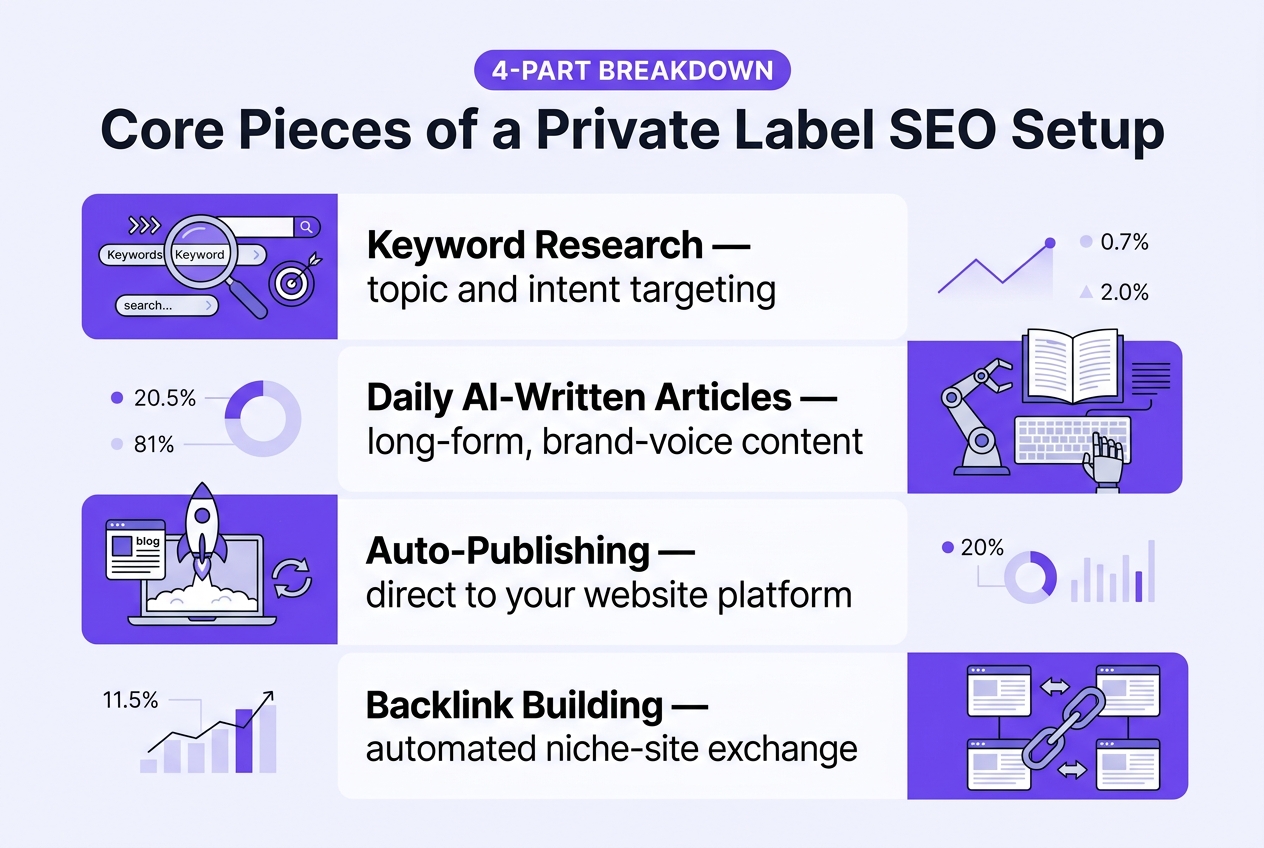
Strip away the branding and every setup like this rests on the same handful of moving parts. Get these wrong and nothing downstream works, no matter how slick the dashboard looks. Get them right and the rest is mostly maintenance.
Start with the research. A roofing company in Tampa and a med spa in New Jersey don't compete for the same words, and a tool that treats "best roofer" and "best roofer near Tampa" as the same search is wasting your time. Specificity is what separates traffic that converts from traffic that just looks good in a screenshot. From there, you need consistent output, a real pipeline, and some way to keep the writing from sounding like it came off an assembly line:
- Niche and location-specific keyword research that surfaces high-volume, low-competition terms instead of generic head terms everyone else is already chasing.
- Long-form articles of 3,000+ words built with images, internal links to your other pages, and outbound links to credible sources, since thin posts rarely hold rankings anymore.
- A direct publishing pipeline into WordPress, Shopify, Wix, or Webflow that removes manual copy-pasting entirely, so content goes live the moment it's ready.
- Backlink building from verified, niche-relevant sites to build domain authority gradually, rather than one-off links that vanish or get penalized.
- Brand voice controls so articles reflect how your business actually talks, not a flat, robotic tone readers learn to skim past.
Publishing and Authority Building
Once content is flowing, the real test is whether it keeps showing up — every day, without someone babysitting the process. A single great article won't move rankings much; consistent publishing volume is what search engines and AI models both reward over time. That's also, incidentally, where many well-intentioned DIY efforts quietly die around week three.
Authority building runs alongside publishing, not after it. Because backlinks still function as a trust signal, learning how backlink quality affects rankings alongside standard keyword guidance helps explain why automated, verified-site link building beats scattered, one-off placements. Before any of this starts, it's worth reading the terms of whatever platform you choose, since publishing frequency, revisions, and ownership of the content vary a lot between providers.

Manual Agency Retainers vs Automated Content Platforms
Let's talk numbers, because that's where this decision really gets made. A traditional SEO agency usually charges per article, per hour, or a flat monthly retainer. Either way, you're often locked into a six or twelve-month contract before the first article even goes live. Automated platforms flip that math entirely, trading long contracts and human overhead for speed and consistency at a fraction of the cost.
Here's how the two models stack up when you put them side by side.
| Factor | Traditional Agency | Automated Content Platform |
|---|---|---|
| Typical cost | $1,500–$10,000+/month | From $99/month per website |
| Contract terms | 3–12 month minimums | Cancel anytime |
| Onboarding time | 2–6 weeks of calls and strategy docs | About 5 minutes to connect your site |
| Publishing cadence | 2–8 articles/month, human-paced | One article every 24 hours |
| Who's doing the work | Dedicated strategist or account manager | Automated research, writing, and publishing |
That human strategist isn't nothing. A good one brings judgment, nuance, and someone to argue with about strategy. But that attention costs money and moves slow. If you're a roofing company watching a competitor publish daily while your agency is still drafting a content calendar, slow and thoughtful loses. For readers weighing the broader shift, this seo automation guide lays out why speed has become its own ranking advantage. Many local businesses just need volume and consistency, not a quarterly strategy deck.
Where Technical Fixes and Link Outreach Still Fit In
Technical SEO as a Prerequisite
Daily articles won't save a site that loads in nine seconds or throws crawl errors on half its pages. That's just reality. Content automation works on top of a healthy site, not instead of one. If your pages are slow, your schema markup is missing, or Google can't crawl key sections, those are developer problems first, writing problems second.
A good automated content platform isn't a technical audit tool, and it shouldn't pretend to be one. Its job is keyword research, daily long-form articles, and SEO/GEO scoring that tells you how a piece performs against search and AI answer engines alike. Get a specialist to fix core web vitals and structured data. Then let the publishing engine run daily on a foundation that can actually hold rankings.
Backlink Exchange vs Manual Outreach
Guest posts, HARO pitches, journalist relationships — that's digital PR, and it's a full discipline on its own. Manual outreach takes weeks of cold emails, follow-ups, and relationship-building just to land a handful of links. Some agencies charge thousands a month for exactly that grind.
Automated backlink exchange gets you to roughly the same place without the pitching. Verified sites in your niche get matched and linked automatically, which covers the same link-earning goal with far less manual legwork. It's not a replacement for a dedicated PR campaign chasing a feature in a major outlet. For steady, ongoing link equity though, automated matching holds its own.
One more thing local businesses shouldn't skip: Google Business Profile and citation consistency. That's separate work — NAP accuracy, review replies, map pack positioning — and it needs its own attention. Daily localized articles strengthen your broader rankings and feed AI visibility, but they don't manage your map pack listing. Treat them as two different jobs, run side by side.
Getting Found by AI Assistants, Not Just Google
Why Daily Content Helps AI Citations
Google isn't the only front door anymore. ChatGPT, Perplexity, Gemini, and Google's own AI Overviews pull answers from content that's well-structured, clearly written, and current. Stale pages get skipped. These systems favor sources that keep showing up with fresh, specific answers to real questions, which is exactly what daily publishing builds over time.
Think about how many small variations exist on a single question. A roofing company doesn't just get asked "best roofer near me." It's "how much does a roof replacement cost after hail damage in Tampa," or "do I need a permit to re-roof in New Jersey." Each article published daily covers another one of these long-tail angles, widening the surface area an AI engine has to pull from when matching a user's exact phrasing.
Here's the honest part: you can't just publish and hope. AI visibility tracking across ChatGPT, Perplexity, Claude, and Google AI Overviews, a feature rolling out soon in some platforms, actually shows whether a brand gets mentioned by name. Without that, you're guessing. With it, you know if the strategy's working or just adding word count.
Structure matters as much as volume. Content written in a consistent brand voice, with clear headers, direct answers up top, and well-organized sections, is simply easier for an AI model to extract and quote accurately. Messy, rambling articles get ignored even if the information inside is correct.
And this isn't just an English-language game. Support for content in 100+ languages means one setup can target international AI search queries the same way it targets domestic Google traffic, which matters more each year as assistants serve global users in their native language.
Choosing a Content Automation Platform: What to Compare
Not every automation tool does the same job. Some publish once a week and call it done. Others dress up thin content with a nice dashboard. Before you commit a budget, run any provider through the same checklist you'd use for a hire.
Must-Have Features Checklist
A few features separate a real content engine from a glorified writing assistant. Here's what actually matters:
- Publishing frequency — daily output compounds authority far faster than weekly or monthly posting, since Google and AI engines reward sites that show consistent, ongoing activity rather than occasional bursts.
- Direct platform integrations — look for native connections to WordPress, Shopify, Wix, Webflow, or a webhook option, so setup takes minutes instead of a week of back-and-forth with a developer.
- Backlink inclusion — check whether verified dofollow links are built into the plan itself or sold as a costly add-on, because that difference can double your real monthly spend.
- Content depth and originality — ask about long-form word counts, built-in plagiarism checks, and whether you get an editor to tweak anything that reads off-brand before it goes live.
- Pricing transparency — flat per-site pricing, something like $99 a month, is far easier to budget against than a scoped agency quote that changes every quarter.
- Reporting on real outcomes — insist on seeing actual Google Search Console and Analytics growth data, ideally from brand-new domains, not just a demo with cherry-picked screenshots.
Miss any one of these and you're probably paying for a tool that looks busy without moving the needle.
Red Flags to Avoid
Watch for vague word counts, no sample articles, or pricing that only appears after a sales call. If a provider won't show real traffic data from an actual customer site, assume there isn't any. And if "daily publishing" turns out to mean "weekly, sometimes," that's not automation. That's just slow.

How to Build a Private Label SEO Workflow Step by Step
Setup in Under 10 Minutes
Most of the work happens before you ever see an article. You connect your website platform, the system pulls competitor and niche data, and it builds a growth plan from that. From there, you review the content calendar it generates and tweak the brand voice instructions so a roofing company doesn't sound like a med spa. Once that's set, articles start publishing daily on their own, with backlink exchange running quietly in the background. No contracts, no SEO background needed.
Here's roughly how that first setup day breaks down:
| Step | What Happens | Time Required |
|---|---|---|
| Connect platform | Link WordPress, Shopify, Wix, Webflow, or a webhook | ~5 minutes |
| Niche and competitor scan | System analyzes your market and builds a growth plan | Automatic |
| Review content calendar | Check topics, adjust brand voice instructions | ~5 minutes |
| Articles go live | Daily publishing begins, backlink exchange starts | Ongoing |
Monitoring and Scaling Over Time
Once articles are rolling, your job shifts from building to watching. Domain tracking and AI visibility tracking show whether you're gaining ground on Google and getting picked up by ChatGPT, Perplexity, or Gemini. That's the real signal, not just publish counts. You can also promote specific products or services directly inside relevant articles. No need to rewrite product pages or collection copy to do it.
As traffic builds, scaling is simple: add sites or team members and lean on volume discounts instead of starting over with a new setup each time. One insurance agent running this across two cities isn't managing two workflows, just one dashboard with more output. That's the whole point, honestly. Less babysitting, more compounding.
Who Benefits Most From an Automated Private Label SEO Model
Service Businesses
If you're a solo insurance or legal agent, you already know the problem. You need fresh local content constantly, but you can't justify a full-time writer for one blog. Same story for a med spa or roofing company fighting national chains for the same local keywords. These businesses don't need a bigger marketing department. They need a steady drip of content that keeps showing up.
- A one-person agency can publish daily blog posts about coverage questions and local topics without ever writing a word themselves.
- A med spa competing against franchise locations can target specific treatments and neighborhoods that bigger players ignore.
- A roofing company can target storm-damage searches and suburb names the same week they become relevant.
- Any business with a brand-new domain can pair daily publishing with built-in backlinks to build trust faster than organic growth alone.
- A team that's only ever gotten customers through referrals finally gets a second channel that keeps working after the phone stops ringing.
E-commerce and SaaS Teams
SaaS marketing managers run into a ceiling fast. One writer can produce maybe two or three solid articles a week, tops. That's not enough to out-publish competitors who treat content like a volume game. Daily output changes the math entirely, giving you a steady stream of comparison posts, use-case articles, and how-tos without hiring again.
E-commerce owners face a different version of the same problem: no time to plan an editorial calendar, let alone execute it. Automated publishing fills that gap with product-adjacent articles that link back to your store, running quietly in the background every day. It won't rewrite your product pages, but it will send more people to them.
Before committing to any approach, it helps to be honest about what's actually slowing growth down: is it a lack of fresh, consistent content, or a technical and structural issue that no amount of publishing will fix? If the foundation is sound, the question becomes whether a steady stream of optimized articles can build the authority and visibility you're after, versus relying on scattered, occasional writing. Either way, it's worth asking what you're optimizing for and whether your current plan actually produces something measurable month over month.