
Your menu's packed, your dining room's full on weekends, but your website is nowhere to be found when hungry locals search "best tacos near me." Hiring an seo agency for restaurant growth sounds like the obvious fix, until you're staring down a retainer that covers everything from Google Business Profile tweaks to technical audits you don't fully understand. Not every piece of that work needs a human agency on payroll. This article breaks down exactly what to hire out, what to automate, and where a tool like RankPush fits into the mix in 2026.
Table of Contents
- Why most restaurants lose the online visibility battle
- What a full-service seo agency for restaurant marketing typically includes
- The parts of restaurant SEO agencies handle best left to specialists
- Agency retainer vs. daily automated content: a side-by-side look
- How daily AI-written content fills the restaurant content gap
- Getting recommended by ChatGPT, Perplexity, and Google AI Overviews
- Building an SEO system that fits a restaurant's budget and timeline
- Questions restaurant owners ask before committing to an SEO plan
Why most restaurants lose the online visibility battle
How diners actually search in 2026
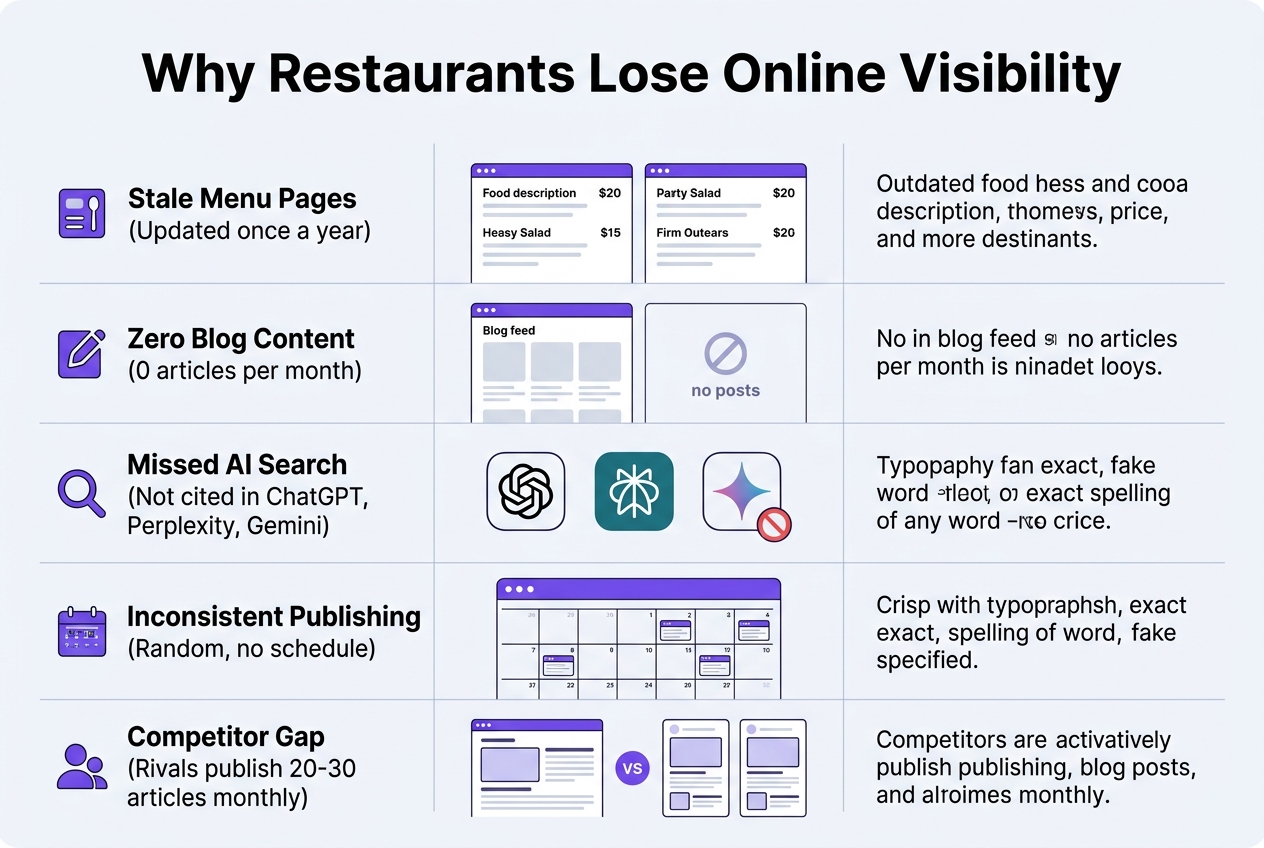
Your food might be outstanding. Your Google ranking doesn't know that. Search engines reward sites that publish relevant content consistently, not places with the best reviews from regulars who already know where to find you. That's the disconnect most owners miss: offline reputation and online visibility are two separate games. You have to actually play the second one to win it.
Think about the last time you tried a new restaurant. You probably typed "best tacos near me" or asked ChatGPT for a dinner spot before you ever drove past a sign. That's just how people find places now. A solid keyword research process reveals exactly what diners in your city are typing into search bars and AI assistants right now, and most restaurants never bother looking. Meanwhile, a spot three blocks away with a shorter menu keeps showing up because they publish new content on a schedule. It's not fair. It's also not complicated to fix once you understand the pattern.
The cost of staying invisible on page 2
Page 2 of Google might as well be page 200. Almost nobody scrolls that far, and your competitors with weaker food keep eating your potential customers simply because they show up first. Word-of-mouth got you this far, but it has a ceiling: it only reaches people already in your circle. It doesn't touch the tourist searching "brunch spots open now" or the new resident asking an AI assistant for dinner recommendations.
That's a real revenue leak, not a minor inconvenience. Many local businesses sit on strong reputations and zero organic traffic, which means every new customer still comes from luck or referral instead of a repeatable channel. Reading a thorough seo automation guide makes it clear why consistency, not perfection, is what search engines and AI answer engines actually reward. Staying invisible on page 2 doesn't just cost clicks. It quietly caps your growth at whatever word-of-mouth can carry.
What a full-service seo agency for restaurant marketing typically includes
Discovery, research, and strategy phases
A real engagement doesn't start with content. It starts with questions. Who's your actual competitor in the map pack? What's your weekend brunch crowd searching for versus your weekday lunch crowd? The agency should pull technical data, local ranking data, and a competitor gap analysis before writing a single word. If they skip this step, they're guessing. And guessing is expensive when you're paying agency rates for it.
Where agency retainers usually start
Most full-service restaurant SEO retainers start somewhere between $1,500 and $5,000 a month, depending on market size and how aggressive the link building and PR work is. That's not a fixed fee for a fixed task list, either — it usually scales up as more deliverables get added. Here's what typically sits inside that monthly scope:
- Technical SEO audits that check Core Web Vitals, mobile load speed, and crawl errors, since a slow menu page loses hungry visitors before they ever see a dish photo;
- Local SEO management covering Google Business Profile optimization, citation consistency across directories, review response workflows, and map pack ranking strategy;
- Link building and digital PR outreach to food bloggers, local press, and tourism sites to earn backlinks that build domain trust;
- On-page optimization and ongoing blog or landing page content tied to seasonal menus, events, and location-specific keywords;
- Analytics dashboards and monthly reporting that tie rankings and traffic back to reservations or online orders.
Many agencies also bundle in PPC management, website redesigns, or conversion rate optimization as paid add-ons. That's fine if you need all of it. Before committing, though, it's worth reading up on how to choose the right SEO partner, since not every bundle fits every restaurant's size or budget. Some owners need the technical and local pieces handled by specialists, then want the content engine running separately and daily rather than monthly — which is where automated, consistent publishing earns its keep without the retainer markup.
The parts of restaurant SEO agencies handle best left to specialists
Some jobs just need a human with specific tools and credentials behind them. Technical fixes fall into that bucket. Crawl errors, broken schema markup, and slow page speed are things a developer or a technical audit specialist needs to diagnose directly in your site's code, not something content can patch over. If your restaurant site takes six seconds to load on mobile, no amount of writing will fix that. Get the technical side handled first. Then let daily publishing do what it's built for: keeping the site active and relevant once the foundation is solid.
Google Business Profile optimization, local citation cleanup, and review management are their own discipline too. A local SEO specialist who knows how to keep your name, address, and phone number consistent across directories, and who actively manages your review responses, plays a different role than content does. Restaurants chasing map pack rankings often assume articles alone will get them there; they won't. Likewise, a full redesign or rebuild of your website is a web design and development job, not something to bolt onto an SEO plan. And if a restaurant's domain has taken a manual action hit or needs disavow work, that calls for a dedicated specialist to diagnose the penalty before anything else happens, including before you try the quiz to figure out your content gaps. These are foundational, mostly one-time or periodic needs. They're not what keeps you visible day to day, which is a separate, ongoing job entirely.
Agency retainer vs. daily automated content: a side-by-side look
Numbers settle arguments faster than opinions do. So before you sign anything, put the two models next to each other and look at what you actually get for the money.
Where each model wins
A traditional retainer buys you a human team, strategy calls, and bundled services. Daily automated content buys you volume, speed, and a much smaller bill. Neither is wrong. They're just built for different jobs, and the gap shows up fastest in cost and output.
| Factor | Agency retainer | Daily automated content |
|---|---|---|
| Monthly cost | $1,500–$5,000+ | $99 per website |
| Content output | 2–4 posts per month | One 3,000+ word article every 24 hours |
| Setup time | Weeks of onboarding, strategy docs, calls | About 5 minutes, no code needed |
| Contract terms | Often locked in for 6–12 months | Cancel anytime |
| Scope | Bundles technical audits, GBP, link outreach, reporting | Content, backlink building, and AI visibility tracking only |
Here's the blunt part: paying $3,000 a month for four blog posts is a rough trade when a restaurant down the street is publishing thirty. Volume compounds in Google's eyes. It's hard to out-publish with a quarter of the output.
That said, scope matters. If your site needs a technical SEO audit, core web vitals fixes, or Google Business Profile management, that's agency or specialist territory, not something daily articles touch. Many owners run both: a specialist handles the technical and local foundation, while automated publishing keeps the content engine running underneath it, every single day.
How daily AI-written content fills the restaurant content gap
From keyword research to published post
Most restaurant sites go quiet after the launch page. No new content, no reason for Google to come back. Automated keyword research fixes that by surfacing low-competition searches you'd never think to target yourself — "best brunch spot in Tampa," "gluten-free menu near me," "late night food downtown." These are exactly the kind of long-tail phrases hungry people type right before they book a table.
From there, a daily long-form article gets written and published, often 3,000+ words, complete with images, internal links to your menu pages, and outbound links that add credibility. That steady drip keeps the site looking active to Google, which matters more than most owners realize. A stale site reads as a closed kitchen, even when yours is packed every Friday night.
Brand voice customization keeps those posts sounding like your restaurant wrote them, not some generic food blog. You set the tone once — casual and fun, or upscale and polished — and every article follows it. Plagiarism checks and SEO/GEO article scoring run on each post too, so nothing goes live unoriginal or under-optimized.
Publishing without hiring a writer
Hiring a food writer, paying an agency retainer, or doing it yourself at midnight isn't realistic for most restaurant owners. Automation closes that gap without adding payroll. There's no assigned human editor here — it's AI-generated content with brand voice settings and an editor tool for manual tweaks, running for a flat monthly rate instead of a writer's salary.
Setup connects directly to WordPress, Shopify, Wix, Webflow, or via webhook in about five minutes. No developer needed, no waiting on a redesign. If your site already exists, this just plugs into it and starts publishing the next day.
For restaurants in tourist corridors or diverse neighborhoods, content generation in 100+ languages opens the door to searchers who'd otherwise scroll past an English-only site. A taqueria near a beach boardwalk or a noodle shop in a multilingual suburb can reach diners in their own language, automatically, without hiring a translator for every post.
Getting recommended by ChatGPT, Perplexity, and Google AI Overviews
Search isn't just Google anymore. Diners ask ChatGPT where to eat Saturday night. They ask Perplexity for "best brunch spots near me" and get a short list with sources attached. If your restaurant's name never shows up in those sources, you're invisible to a whole new discovery channel. That's a real problem, and it's growing fast.
The fix isn't mysterious. Daily, well-structured content gives AI engines more material to pull from and more reasons to cite your site over a competitor's. Think detailed menu breakdowns, neighborhood dining guides, answers to questions like "what's the best steakhouse in [city] for a date night." AI visibility tracking across ChatGPT, Perplexity, Claude, and Google AI Overviews (coming soon) helps you see where you're already getting mentioned, so you know what's working instead of guessing. Reddit marketing with drafted replies on threads where people actually ask for recommendations adds another surface AI engines scrape for answers — it's one of their favorite sources, honestly.
None of this replaces ranking on Google. It runs alongside it. A restaurant chasing AI citations while ignoring traditional search is optimizing for a smaller slice of the pie. Do both, and you show up wherever people are actually looking.

Building an SEO system that fits a restaurant's budget and timeline
A restaurant doesn't need a six-figure marketing plan to start showing up on Google. It needs a sequence, done in the right order, with realistic checkpoints. Skip steps and you waste money. Follow them and even a brand-new site can climb.
A realistic 90-day rollout
Technical fixes come first. Before anything else, a specialist should clean up site speed, broken links, and Google Business Profile setup — that's foundation work, not content work. Once the site is healthy, you connect your platform (WordPress, Shopify, Wix, Webflow, or a webhook) and let automated keyword research map out a content calendar built around your menu, your neighborhood, and your competitors.
| Phase | Timeframe | Main focus | What happens |
|---|---|---|---|
| Step 1 | Days 1-10 | Technical + GBP | Specialist fixes site health and local listing basics |
| Step 2 | Days 10-14 | Platform connection | Site linked, keyword research builds a content calendar |
| Step 3 | Days 14-90 | Daily publishing | Long-form articles targeting local, menu, occasion terms |
| Step 4 | Ongoing from day 30 | Backlinks | Verified niche sites build domain authority |
| Step 5 | Day 60+ | Measurement | Domain tracking and AI visibility checks guide adjustments |
By day 90, you should have roughly 50-plus published articles covering things like "best birthday dinner spot in [city]" or "gluten-free menu near me." Step 6 — reviews, Google Business posts, and paid ads — layers in separately, with its own specialists, once budget allows.
Signs it's working: traffic, rankings, and citations
Early wins look boring: impressions rising in Search Console before clicks do. That's normal. Next comes ranking movement for long-tail, occasion-based phrases, then branded searches increasing as word spreads. The real 2026 signal? Getting mentioned when someone asks ChatGPT or Perplexity for a dinner recommendation nearby. That's the citation economy now — and most restaurants aren't even playing yet.
Questions restaurant owners ask before committing to an SEO plan
Before signing anything, most restaurant owners run through the same list of doubts. Fair enough. Here's what actually matters, answered straight.
- Do I need SEO if I'm in a small town? Yes — people still search "best brunch near me" even in towns of 5,000 people, and chances are a competitor down the street is already showing up for it while you aren't.
- Does SEO work alongside billboards, radio, or TV ads? It does, and it's actually the missing half of those campaigns — the ad creates the craving, SEO makes sure your website is what shows up when someone searches your name that night.
- How long until I see real results? Plan on 2-4 months of consistent publishing before growth really compounds; anyone promising overnight rankings is selling you something.
- Can a brand-new restaurant site with zero authority actually rank? Yes — new domains with no backlink history have climbed into organic visibility through steady publishing and earned links over time, though it takes patience, not a miracle.
- What's included for roughly $99/month per site with a daily content platform? Typically a new long-form article every day, featured images, meta descriptions, backlink building from niche-relevant sites, and visibility tracking across both Google and AI assistants.
- Will this replace my need for a web developer or local listings work? No — technical fixes and Google Business Profile management stay separate tasks; daily content is the engine that runs once those foundations are in place.
One blunt truth: nobody can promise a date you'll outrank the steakhouse with ten years of reviews. What a dedicated content system can promise is steady, visible progress — the kind you can actually watch in your analytics, week over week.
Before committing to any approach, it helps to be honest about what's actually causing the bottleneck right now—thin content and inconsistent publishing call for a different fix than broken links or a sluggish backend. The right move often involves pairing specialists who handle the technical and structural pieces with a steady system for producing optimized content week after week. Whichever path you choose, ask whether the solution addresses the root problem or just adds another tool to a pile that still needs someone tying it all together.