
You've stared at a blinking cursor, knowing the perfect opening paragraph sits just out of reach while your publishing deadline creeps closer. That friction point is exactly why an ai introduction generator has quietly become part of daily SEO workflows for 2026 — it solves the blank-page problem before it stalls your content calendar. No magic involved. Just a faster, more consistent way to hook readers and search engines alike, so your blog can publish on schedule instead of waiting on inspiration.
Table of Contents
- What an AI Introduction Generator Actually Does
- Why a Strong Opening Paragraph Matters for SEO and AI Search
- Standalone AI Intro Tools vs. Full Daily SEO Articles
- What Makes a Good Introduction Paragraph
- Step-by-Step: Generating and Refining an AI-Written Introduction
- Where Intro Generation Fits Into a Full Content Workflow
- Common Mistakes When Using AI to Write Openings
- Choosing Between a Free Tool and an Automated Content System
What an AI Introduction Generator Actually Does
At its core, this kind of tool is software that drafts the opening paragraph of a blog post using a topic, a keyword, or a rough outline as input. You feed it a few words — "roof replacement cost Tampa" or "best Botox aftercare tips" — and it hands back a paragraph meant to open the piece. The goal isn't just filling space. A good opening hooks the reader fast, states the angle plainly, and sets up the thesis without the throat-clearing filler that padded so many 2020-era blog posts.
That last part matters more than people think. Generic openers ("In today's fast-paced world, businesses are looking for...") don't earn a click. They don't earn a citation from an AI answer engine either. The best tools skip that and get to the point: a specific claim, a specific number, a reason to keep reading. Nail that, and the rest of the article has a fighting chance.
Why Introductions Are Hard to Write at Scale
Writing one good intro isn't hard. Writing fifty, every month, without repeating yourself, is a different problem entirely. A solo insurance agent trying to post daily local content runs out of fresh hooks by week two. Every opening starts to sound the same — same rhythm, same three sentence structure, same vague promise. Readers notice. So do search engines, oddly enough, since repetitive phrasing patterns across a site can read as thin or templated content.
Scale also exposes tone drift. A med spa owner might nail a warm, reassuring voice in post one, then slip into clinical jargon by post twelve because they're rushing. There's a quality ceiling to doing this manually at volume — most people hit it fast. That's the real argument for automation here: not that a human can't write a good intro, but that doing it consistently, daily, across dozens of topics, is a grind nobody has time for.
Standalone Tool vs. Full-Article Automation
There's a meaningful split in this space. A standalone intro generator does one job: it writes the opening paragraph and hands it back to you, leaving the body, the research, the links, and the formatting entirely in your hands. It's quick, often free or cheap, and fine for a single post. But it solves maybe 5% of the actual workload behind a published article.
Full-article automation writes the intro as one piece of a complete 3,000+ word article, already paired with the keyword research, supporting sections, images, and internal links that back up the opening claim. That's a different category of tool entirely. If you're publishing daily, chaining a standalone intro generator to a separate body-writing workflow just adds friction you don't need. Many local businesses — roofing contractors, SaaS teams, e-commerce brands — eventually realize the intro was never the bottleneck. The whole article was.
Either way, don't expect to publish the output untouched. Most writers still need to adjust tone so it sounds like their brand, add a proof point or local detail an algorithm wouldn't know, and connect the hook to something only their business can claim. For SaaS teams especially, tracking whether that opening line ever gets pulled into an AI-generated answer is worth doing; a llm visibility checker can show whether your phrasing is actually surfacing in tools like ChatGPT or Perplexity, not just ranking on page one of Google.
Why a Strong Opening Paragraph Matters for SEO and AI Search
How AI Overviews and Chatbots Read Your First Paragraph
Here's the blunt truth: nobody waits around for your point. Google tracks how fast readers bounce back to the results page, and a vague opening sends them running in seconds. That hurts dwell time, and dwell time feeds rankings. The same thing happens with human readers scanning on their phones between errands. If your first few lines don't say anything specific, they're gone before paragraph two. A clear thesis statement in the first 100 words fixes this for both audiences at once, giving skimmers a reason to stay and giving AI models a clean sentence to extract.
Tools like ChatGPT, Perplexity, and Gemini don't read your whole article before deciding whether to cite it. They scan the opening, weigh how directly it answers the implied question, then decide if your page earns a place in the summary. Vague throat-clearing like "in today's world" or "many people wonder" gives these systems nothing to grab onto. A specific, confident opening sentence — one that states a claim, a number, or a concrete outcome — is far more likely to get lifted into an AI answer, especially since Google's spam policies explicitly list excessive link exchanges and other manipulative shortcuts as red flags, which means genuinely useful openings matter more than ever for staying on the safe side of ranking.
Across an entire blog, weak intros compound into a quality signal problem. If every post opens with filler, search engines start reading your whole site as thin and low-effort, which can quietly suppress visibility across every page, not just the bad ones. One sloppy intro is forgivable. Fifty of them start to look like a pattern, and pay close attention, because that pattern is exactly what scanning algorithms are built to catch.
Standalone AI Intro Tools vs. Full Daily SEO Articles
A free intro generator gives you one paragraph. That's it. No keyword research, no body content, no images, nowhere to publish it. You're left copying that paragraph into a doc and starting the real work from scratch. A full daily article service treats the intro as one small piece of a bigger, already-finished product. The difference shows up fastest when you line up what each actually hands you at the end of the process.
| Task | Standalone Intro Tool | Full Daily SEO Article Workflow |
|---|---|---|
| Keyword research | None; you supply the topic | Automated, based on niche and competitors |
| Content produced | One paragraph (~50-100 words) | Full article, 3,000+ words with intro and conclusion |
| Images | None | Auto-generated featured and in-body images |
| Meta description | Separate manual step | Generated alongside the article |
| Publishing | Manual copy-paste into your CMS | Auto-published to your site daily |
Notice the pattern? Every row the standalone tool skips becomes a task you have to do yourself, by hand, every single day. For a business posting daily, that adds up fast — meta tags, internal links, formatting, uploading, scheduling. None of it is hard, exactly. It's just slow, repetitive, and easy to put off until "next week." If you're trying to scale output rather than publish one post a month, a content scaling guide will usually point you toward combining the two rather than stacking separate tools. Pairing research, writing, formatting, and publishing into one pass just saves more time than generating fragments one at a time, over and over, forever.
What Makes a Good Introduction Paragraph
A good opening doesn't announce itself. It just solves a problem fast, then gets out of the way. Think about the last time you searched "how much does a new roof cost in my area" or "best med spa treatment for sun damage." You didn't want a history lesson. You wanted the writer to know exactly why you clicked.
That's the bar every opening paragraph has to clear, whether it's written by a person or a machine. A strong intro earns the next sentence, not just the click. A few things separate the ones that work from the ones readers bounce off of:
- It opens with a specific hook tied to the reader's actual situation, like a homeowner noticing a leak after a storm, not a vague line about "the importance of home maintenance."
- It states a clear promise early on, so the reader knows within one sentence what they'll walk away with.
- It matches the brand's register — a law firm's intro should sound measured and precise, while an e-commerce product post can be breezy and direct.
- It moves into the first body section without circling back and restating the headline, which just wastes the reader's time.
- It stays tight, usually three to five sentences, because readers skim before they commit.
- It avoids filler phrases like "in today's fast-paced world," which signal low effort before the reader even reaches the point.
Get those right and the rest of the article has a fighting chance. Get them wrong, and no amount of keyword research saves it.
Step-by-Step: Generating and Refining an AI-Written Introduction
Writing a good opening isn't magic. It's a checklist. Follow the same five steps every time and quality stops being a gamble. Here's the workflow, broken down the way you'd actually run it before an article goes live.
| Step | What You Do | Why It Matters |
|---|---|---|
| 1. Set the input | Give the keyword, target reader, and angle (e.g., "roof replacement cost, homeowners, local pricing guide") | Vague input produces a vague intro. Specifics produce something usable |
| 2. Generate and review | Produce a draft opening, then check facts, numbers, and claims | Catches hallucinated stats before they embarrass you in front of Google |
| 3. Match the voice | Apply custom instructions for tone, reading level, and phrasing | Keeps every article sounding like one business, not a rotating cast of writers |
| 4. Plagiarism check | Run the draft through an originality scan | Protects rankings; duplicate content gets filtered, not featured |
| 5. Pair with conclusion | Write a closing that restates the thesis and adds a clear call to action | Bookends the article so readers (and AI engines) grasp the point fast |
Keeping Brand Voice Consistent Across Every Article
Step three deserves its own moment. Voice drift is the quiet killer of daily content. One article sounds formal, the next sounds chatty, and suddenly your blog reads like three different companies. Custom instructions fix this by locking in tone, vocabulary, and sentence rhythm before generation even starts.
A med spa might want warm and reassuring. A roofing company might want direct and no-nonsense. Set it once, and every daily article — openings included — inherits that same personality, no manual rewriting required.
Where Intro Generation Fits Into a Full Content Workflow
From Keyword to Published Article Without Manual Steps
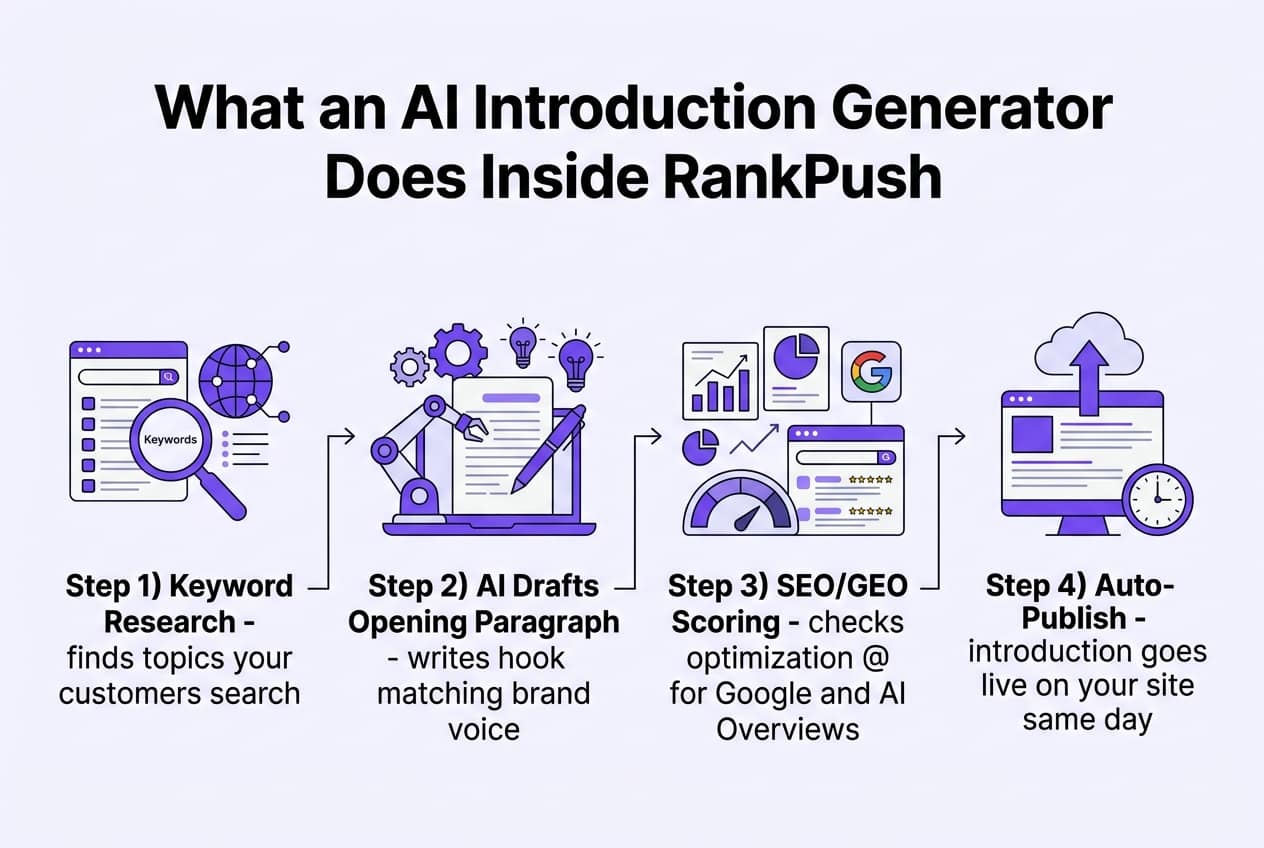
An intro doesn't come from nowhere. It starts with keyword research that figures out what a roofing company's next customer is actually typing into Google, and what angle will make them keep reading. A good system identifies the topic, the search intent, and the gap competitors left open, then hands that brief to the writing engine before a single sentence gets drafted. Skip this step and your opening paragraph is just a guess dressed up in confident language.
Once the topic's locked in, brand voice customization keeps things consistent. Custom instructions tell the system how a med spa should sound versus a law firm — warm and reassuring, or precise and authoritative. That matters more than people think. Across hundreds of articles, a voice that drifts feels like it was written by five different interns.
Then come the finishing touches: AI image generation builds a featured image so the intro has something to sit next to, not just a wall of text. SEO/GEO article scoring checks whether that opening paragraph — and the full piece — is structured in a way Google and AI answer engines like ChatGPT or Perplexity can actually parse and cite. Finally, auto-publishing sends the finished article straight to WordPress, Shopify, Wix, Webflow, or a webhook. No copy-paste, no waiting on a developer. For a solo agent or a one-person e-commerce shop, that last step is the whole point — the article just shows up on the site, every single day, intro and all.
Common Mistakes When Using AI to Write Openings
Why Generic Openings Hurt AI Citation Chances
Most AI writing tools work fine. The problem is how people use them. Rush the process and you end up with an opening that reads like every other opening on the internet. That's a real cost, not a style nitpick. AI answer engines and Google both favor content that sounds specific and earned, not templated.
A few habits show up again and again on blogs that never gain traction, whether it's a solo agent in Tampa or an e-commerce store shipping nationwide:
- Keyword stuffing in sentence one: letting the AI cram the exact keyword phrase into the first sentence in an unnatural way, which reads as spam to both a human reader and a search algorithm scanning for intent.
- Zero localization: publishing an intro that could describe a roofing company in Ohio or a med spa in California with equal (lack of) accuracy, instead of naming the city, neighborhood, or specific service up front.
- Skipping the plagiarism check: pushing AI text live without confirming it's original, which risks duplicate-content flags and quietly tanks your rankings before the article even gets a chance.
- Copy-paste structure across posts: reusing the same opening formula on 50-plus articles until the whole blog feels like it rolled off an assembly line — readers notice, and so does AI pattern-matching.
- An intro with nothing behind it: a sharp opening paragraph sitting on top of a thin, unsupported body won't hold a reader's attention or earn a citation from an AI engine looking for depth.
Here's the blunt version: a clever first line can't save a lazy article. Fix the structure, not just the sentence.
Choosing Between a Free Tool and an Automated Content System
When Manual Intro Writing Still Makes Sense
Let's be honest about what free intro generators are actually good for. A one-off blog post for a side project. A school paper. A single LinkedIn article you're writing this weekend with no plan to publish again next week. In those cases, a quick free intro tool does the job fine. There's no SEO strategy to protect, no ranking goal, no reason to overthink it.
But that's not the situation most small businesses are actually in. A solo insurance agent, a roofing company fighting for local visibility, a med spa trying to attract bookings, a SaaS team chasing organic traffic, an e-commerce store with hundreds of products to write about — none of these need one good paragraph. They need daily, complete articles: researched, written, scored, and published without someone babysitting the process every morning.
That's the real fork in the road. One tool writes an opening line. The other writes, scores, and ships a full 3,000-word article with images, while you're doing literally anything else. A platform built for daily output handles the keyword research, the drafting, the image generation, and the publishing for around $99 a month per site — a fraction of what hiring a writer or an agency retainer would cost, and without the back-and-forth emails. Setup usually takes about five minutes: connect your existing WordPress, Shopify, Wix, or Webflow site, and it starts publishing. No contract locks you in, either. You can cancel whenever you want, which says something about how these systems are built to earn renewal rather than demand it.
Before committing to any content strategy, it helps to be honest about what's actually eating your time versus what's easy to automate—daily writing and keyword research often fall into the second category once you look closely. The real question is whether your bottleneck is producing enough content consistently, or something else entirely like technical fixes, local listings, or conversion work that no amount of fresh articles will solve. Getting clear on that distinction first will save you from throwing solutions at the wrong problem.