
Your customers aren't just Googling anymore — they're asking ChatGPT, Gemini, and AI Overviews who the best insurance agent, roofer, med spa, or SaaS tool is, and you have no idea what those answers say about you. It's a blind spot. A good llm visibility checker fixes that by showing exactly how and where your brand shows up in AI-generated responses, so you're not guessing anymore. This article breaks down how to check your LLM visibility today and turn those insights into content that actually gets you cited.
Table of Contents
- What Is an LLM Visibility Checker and Why It Matters Now
- How a LLM Visibility Checker Actually Analyzes Your Site
- What You Can See Once You Start Monitoring AI Visibility
- The Stages of Building and Growing AI Search Visibility
- Why AI Engines Won't Cite Content They Can't Trust
- Who Should Be Using an LLM Visibility Checker
- Turning LLM Visibility Insights Into Daily Content That Gets Cited
What Is an LLM Visibility Checker and Why It Matters Now
Why Traditional Rank Tracking No Longer Tells the Full Story
For years, "visibility" meant one thing: where you sat on a Google results page. That's no longer the whole picture. LLM visibility asks a different question — does ChatGPT, Perplexity, Gemini, Claude, or Google's AI Overviews actually mention your brand, cite your content, or recommend you by name when someone asks for help. Rank trackers can't see any of that. They're watching a page fewer buyers even open anymore.
Here's the shift driving all this. Roughly 40% of people now start research queries inside ChatGPT instead of typing into Google first. That's not a niche behavior anymore — it's mainstream. A med spa customer asking "best Botox provider near me" or a homeowner typing "reliable roofer in my area" might get an answer straight from an AI, with zero clicks to a search results page at all. If you're not in that answer, you're invisible to a huge chunk of buying decisions before they even begin.
Position matters more than ever, too. Early movers who optimize for AI citation now are building a lasting advantage, since these models tend to keep citing sources they've already trusted once. And the payoff is real: leads who arrive after an AI has already vetted and recommended you tend to convert faster, because the trust-building work is already done. That's a shortcut most competitors haven't noticed yet. Businesses ready to move fast should start by reading a practical content scaling guide before competitors catch on and the advantage disappears.

How a LLM Visibility Checker Actually Analyzes Your Site
Enter Your URL and Get a Baseline Score
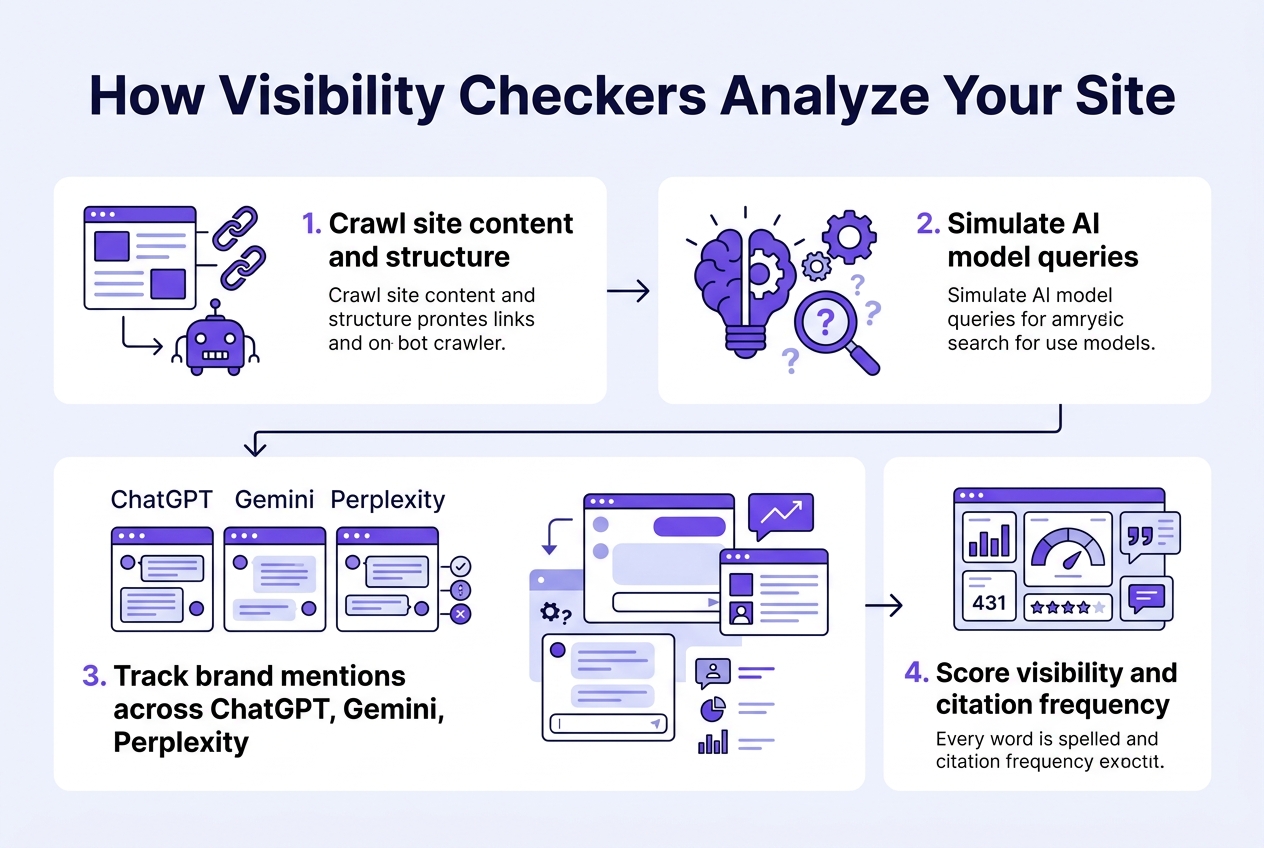
Most tools work the same way at the start. You paste in a URL, hit run, and wait a minute or two. Behind the scenes, the checker crawls a set number of pages — usually somewhere between 10 and 15 — along with your robots.txt file and your sitemap. That's how it figures out what's actually indexable and what's blocked. It's not scanning your whole site. It's sampling enough to judge how machine-friendly your structure is, then building a baseline score from there.
Think of that first score as a starting line, not a verdict. If you want a wider view of how tools handle this stage, reading a comparison of Top 12 LLM Tracking Tools for AI Visibility in 2026 shows how differently platforms weigh crawl depth versus content quality.
The Core Factors AI Evaluates
Once the crawl finishes, the checker digs into a handful of specific signals. It looks at structured data and schema markup, checks whether meta tags are actually descriptive, and reviews how your content is organized — headings, answer-first paragraphs, FAQ blocks. These are the pieces that make a page easy for a language model to lift and cite. Sloppy structure doesn't get punished exactly. It just gets skipped.
| Factor | What It Checks | Why It Matters for AI |
|---|---|---|
| Schema markup | Presence of FAQ, Product, LocalBusiness schema | Gives models a labeled data source |
| Meta tags | Title and description accuracy, length | Helps AI summarize page intent quickly |
| Heading structure | Logical H1-H3 hierarchy, one topic per section | Makes content easier to extract cleanly |
| Answer-first paragraphs | Direct answers before supporting detail | Matches how AI pulls quotable snippets |
| FAQ blocks | Clear question-and-answer formatting | Frequently reused verbatim in AI answers |
After scoring those factors, most tools generate a report that stacks your site against competitors in the same niche. Many local businesses discover their headings are fine but their schema is missing entirely, or their FAQs exist but read like marketing copy instead of real answers. A solid automated content creation guide can help you fix the gaps the report flags. For a broader look at how structure influences discovery beyond SEO alone, browsing RankPush Test Blog offers some useful adjacent thinking on content clarity.
What You Can See Once You Start Monitoring AI Visibility
From an Unanswered Prompt to a Cited Brand
Before you start tracking any of this, your brand is probably just a gap. Someone asks ChatGPT for a "roofer near me" or a "med spa for Botox in my city," and you're simply not in the answer. Monitoring turns that silence into something measurable. Often the first surprise is how much is already happening quietly behind the scenes.
Once you're watching consistently, a few specific things come into view fast:
- Brand mentions surfaced inside live answers from ChatGPT, Perplexity, Gemini, and Google AI Overviews, so you know exactly which engines already recognize you and which ones don't.
- Real-time sentiment analysis showing whether an engine describes your business warmly, neutrally, or with outdated and even negative framing pulled from an old review or a stale directory listing.
- Share of voice against named competitors in the exact same prompt, revealing whether you're mentioned alongside three rivals or left out entirely while they get named.
- Placement and prominence data — are you the first business named, a footnote at the bottom of a list, or missing from the answer altogether.
- Pattern tracking across weeks, so you can tell if a new article or updated page actually moved the needle or if the mention was a one-off fluke.
Here's the blunt part: being "mentioned" isn't the same as being recommended. An engine can name you third, sandwiched between two competitors, and technically you're "visible" — just not winning. That distinction is exactly why prominence matters as much as presence. If you want the fuller picture, a solid seo automation guide explains how consistent publishing feeds these mentions over time, and comparing notes with a broader Feature checklist helps you spot gaps a single tool might miss.

The Stages of Building and Growing AI Search Visibility
Visibility work moves through five stages, and skipping ahead rarely works. Stage one is a baseline audit: what do ChatGPT, Perplexity, and Gemini say about your brand today, and is your schema markup even readable? Stage two benchmarks the same query set against your top three competitors. Stage three tracks that data over weeks and months, because one good week means nothing on its own.
Cross-LLM Monitoring Explained
Here's the part that surprises most business owners: the models don't agree with each other. ChatGPT might cite your med spa for "botox near me," while Gemini pulls a competitor two towns over. That's stage four, and it's not optional anymore. A free browser tool like AI Content Visibility Checker gives a quick snapshot of how one page reads to AI crawlers, though serious tracking means running identical prompts across each engine on a schedule.
| Stage | What You're Checking | Typical Frequency | Signal It Reveals |
|---|---|---|---|
| 1. Baseline audit | Current citations, schema, NAP data | Once, then quarterly | Starting point |
| 2. Competitor benchmarking | Same queries against rival brands | Monthly | Relative standing |
| 3. Trend tracking | Citation frequency over time | Weekly | Rising or falling |
| 4. Cross-LLM comparison | ChatGPT vs. Perplexity vs. Gemini | Weekly | Platform gaps |
| 5. Sentiment + action | Tone of mentions, missing facts | Monthly | What to rewrite |
Turning Alerts Into Growth Actions
Stage five is where the data earns its keep. Sentiment analysis tells you not just whether you're mentioned, but how. An outdated review snippet or a wrong price range can quietly sink referrals. When an engine gets your service area wrong, that's your cue to rewrite the page, add clearer facts, and republish. No alert should sit unanswered for long. Many local businesses treat this as a monthly habit, not a one-time fix.
Why AI Engines Won't Cite Content They Can't Trust
The Helpful Content System Grades the Whole Site.
Google's helpful content system doesn't judge one blog post in isolation. It scores your entire domain for depth, originality, and usefulness, and AI answer engines lean on similar signals when deciding what to surface. Thin pages padded with fluff, generic advice copied from ten other sites, or duplicate variations of the same topic rarely make it into a cited answer. Trust is earned at the site level, not the paragraph level. That's the uncomfortable part for a lot of small business owners who've been publishing sporadically for years.
Content that gets pulled into AI answers usually leads with the answer, then backs it up. A roofing company that opens with "the average shingle roof replacement in Tampa costs $9,000 to $14,000" gives a model something concrete to quote. Original data, real pricing, first-hand examples — that's what separates citable content from filler. Publishing consistently matters too, because a single great article surrounded by stale, outdated pages still signals an unreliable site overall.
Here's the thing: SEO, AEO, and raw content quality aren't separate scorecards. They compound, or they collapse together. Weak writing tanks your SEO rankings, which means fewer crawls, which means AI models see less of your content to begin with. Improve one and the other two tend to follow, which is exactly why teams building visibility strategies find that understanding how AI models evaluate content trustworthiness changes how they prioritize what to fix first.
None of this requires an old, authoritative domain. A brand-new site with zero backlinks can still earn citations if it publishes structured, answer-first content consistently for months. Authority builds slower without history behind it — but it does build. Many local businesses have gone from invisible to cited in AI Overviews within a few months, simply by treating every article like it needs to stand alone as a trustworthy source.
Who Should Be Using an LLM Visibility Checker
Not everyone needs the same depth of monitoring. A solo insurance agent and a ten-person marketing team are asking very different questions, even if the underlying tool is the same. The right level of tracking depends on how much is riding on the answer.
Comparing Needs: Solo Business vs Marketing Team vs Agency
A solo agent or roofing contractor mostly wants a yes-or-no: does ChatGPT mention my business when someone asks for help nearby? A SaaS marketing manager needs more nuance — share of voice against three or four named competitors, tracked over weeks, not a single snapshot. Agencies and enterprise teams sit at the top of the pyramid, watching dozens of brands at once for sudden drops that might signal a reputation problem brewing in AI answers.
Here's who benefits most, and why the use case shifts the priorities:
- Solo agents and local service owners who mainly want confirmation that AI tools recommend them when someone nearby types "best roofer" or "insurance agent near me" into a chat window.
- SaaS marketing managers benchmarking their share of voice against two or three direct competitors, checking whether their product gets mentioned first, last, or not at all.
- Agencies and enterprise brand teams running ongoing crisis and reputation monitoring, since an AI model repeating outdated or false claims can spread faster than a bad review ever did.
- SEO and PR professionals who need documented proof of AI citations to show clients or leadership that campaigns are actually working beyond rankings pages.
- E-commerce and med spa owners tracking whether specific product or treatment pages get surfaced when shoppers ask AI tools for recommendations, not just whether the homepage gets a mention.
Whatever bucket you fall into, an AI search engine optimization tool gives you the baseline data to act on, rather than guessing. Skip that step and you're optimizing blind — which is fine, if you enjoy wasting a quarter.
Turning LLM Visibility Insights Into Daily Content That Gets Cited
Closing the Loop Between Tracking and Action
Checking your scores feels productive. It isn't, by itself. A monitoring dashboard can tell you that ChatGPT never mentions your roofing company or your med spa, but it won't fix that. Sustained visibility comes from continuous, structured publishing — not a one-time audit you glance at and forget. Tools like the one described in LLM Visibility Tracker: See How AI Search Ranks Your Brand are useful for spotting the gap, but someone still has to fill it with content week after week.
That's where automated platforms earn their keep. They research keywords by niche, write long-form articles daily, and publish straight to WordPress, Shopify, Wix, or Webflow without you touching a plugin. No writer, no agency retainer, no missed weeks. For a solo insurance agent or a one-location med spa, that's the difference between hoping for visibility and actually building it.
Built-in SEO/GEO scoring and schema-friendly formatting matter more than most owners realize. AI engines favor content that's structured, well-sourced, and easy to parse — verified backlinks add the trust signal that ties it together. Skip that step and you're just adding noise to the internet.
Daily publishing, especially across 100+ languages, helps brand-new domains build authority fast. Many local businesses launch with zero prior traffic and watch real Google Search Console data climb within months, not years. That's not a fluke — it's compounding.
Setup for most of these systems takes about five minutes, no SEO background required. You connect your site, set a tone, and let it run. That's the real payoff: closing the loop between checking your visibility and actually improving it, every single day.
Before you commit to a direction, it's worth being honest about which problem you're actually solving: a site that can't be crawled properly needs a developer or a technical specialist, and no amount of publishing will paper over that. Once the foundation is sound, the question shifts to whether you can sustain the pace — asking how many pieces you can realistically ship each month, who owns the keyword research behind them, and how you'll know if any of it is showing up in search or in AI answers. Those are quieter questions than the ones agencies tend to lead with, but they're usually the ones that determine whether the work compounds or just accumulates.