
You're a chiropractor watching competitors fill their schedules while your practice sits halfway down page two. You're stuck deciding whether a chiropractor seo expert, a full-service agency, or some new AI content tool is worth your money in 2026. Each option promises rankings. Few explain what actually keeps your site climbing month after month without draining your budget on retainers or contracts. This article breaks down what a freelance expert, a traditional agency, and AI content automation like RankPush each actually deliver, so you can pick the path that gets your practice found by patients searching for relief right now.
Table of Contents
- Hiring a Chiropractor SEO Expert vs. Going It Alone: What's Actually at Stake
- Freelance Chiropractor SEO Expert vs. Marketing Agency vs. AI Content Automation
- Cost and Contracts: Comparing What You Pay and What You're Locked Into
- Content Output: Manual Blog Posts vs. Daily Automated Articles
- Local Visibility and Google Maps: Who Handles What
- Getting Cited by AI Assistants: ChatGPT, Perplexity, and Google AI Overviews
- Setup Speed, Multi-Location Support, and Backlinks Compared
- Final Verdict: Which Approach Fits Your Chiropractic Practice
Hiring a Chiropractor SEO Expert vs. Going It Alone: What's Actually at Stake
Why 'ranking on Google' means different things to different providers
Most solo chiropractic practices built their reputation the old-fashioned way: patient referrals, a few community flyers, maybe a Facebook page nobody updates. Google barely knows you exist. Search your own clinic name plus "chiropractor near me" and you might not even crack page two, despite years of good adjustments and happy patients. That gap between offline trust and online invisibility is the whole problem this comparison is built around.
Bring in a freelance expert or an agency, and the pitch usually sounds great: dedicated local SEO work, Google Business Profile attention, a content calendar tailored to your clinic. Some of that's real. But "ranking" means different things to different providers. To one it means citations and map pack tweaks. To another it means blog posts. To a third, backlinks. Nobody defines it the same way, and that makes comparing quotes genuinely confusing for a practice owner who just wants more new-patient calls.
Here's the catch: freelancers charge by the hour, and hours add up fast when content is involved. A single well-researched article can eat three or four hours of a specialist's time. Most clinics need dozens before anything moves. Delivery slows, invoices climb, and momentum stalls — exactly when consistency matters most. Reviewing broader seo automation guide material helps explain why output speed, not just skill, decides who actually shows up on page one. The rest of this breakdown weighs experts, agencies, and automated options against the criteria clinic owners actually care about: cost, speed, content volume, and whether patients searching nearby can even find you.
Freelance Chiropractor SEO Expert vs. Marketing Agency vs. AI Content Automation
Where each option spends its time and your budget
A freelance expert is one person wearing every hat: strategy, technical fixes, content writing, and Google Business Profile upkeep. That's fine until they get busy. One practitioner can only produce so many pages a month, and something always slips — usually content, since it's the most time-consuming piece. An agency fixes the bandwidth problem by throwing a team at it: link outreach, GBP management, conversion work, reporting dashboards. But that team costs real money, and you're paying for people, not just output.
Automated content tools take a narrower slice: daily long-form articles, keyword research, and backlink exchange, published without a person touching it. No strategist, no technical audit, no GBP posting. Just content, every day, on autopilot. Here's how the time and money actually break down:
| Option | Who does the work | Typical monthly cost | Main limitation |
|---|---|---|---|
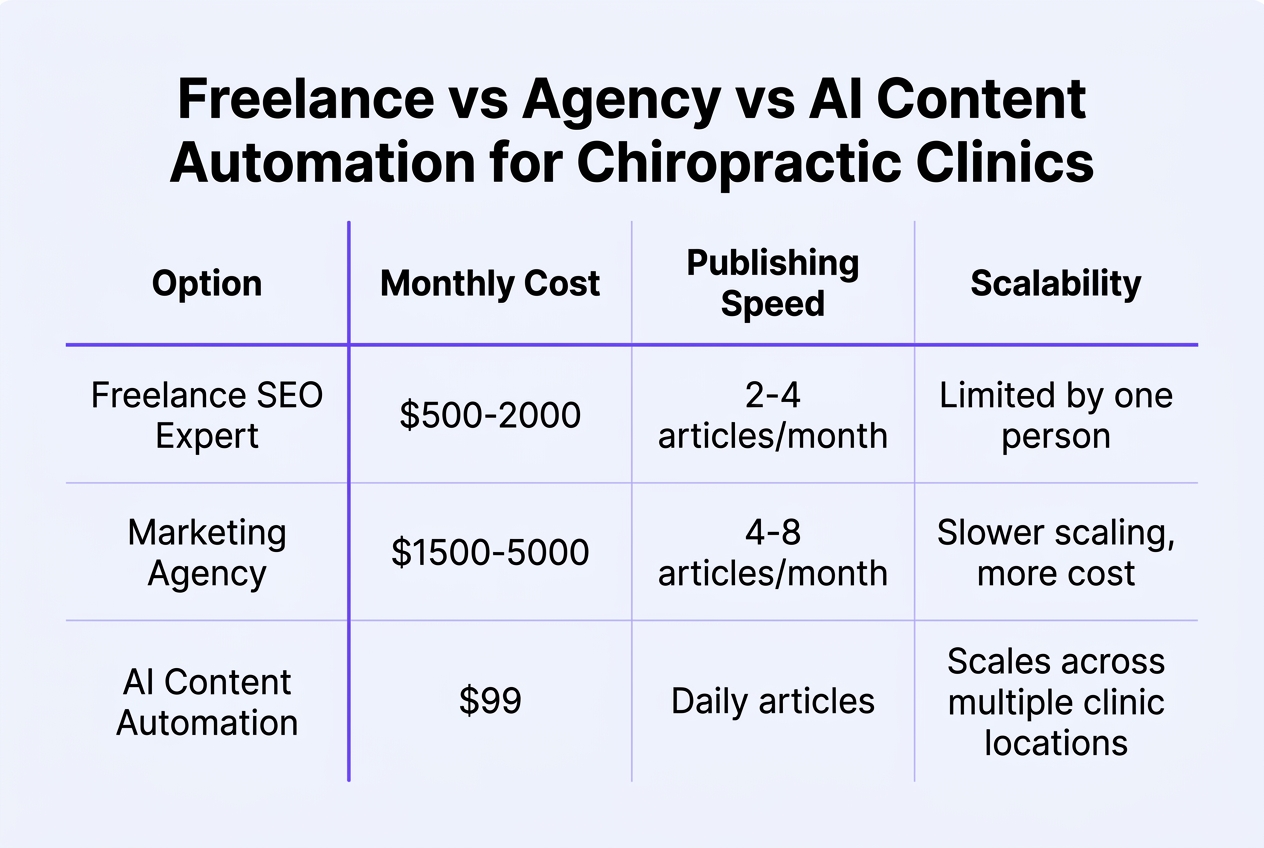
| Freelance chiropractor SEO expert | One person, part-time attention | $800–$2,500 | Limited output; content often deprioritized |
| Marketing agency | Full team with specialists | $2,000–$6,000+ | Contracts; overhead you pay for even when idle |
| AI content automation | Automated system, no staff | $99 per site | No technical fixes or GBP management |
| In-house hire | One employee, full-time | $3,500–$5,500+ | Salary, training, and turnover risk |
None of these fully replaces the others — that's the honest answer. An agency might still outsource your backlinks. In fact, Google's spam policies explicitly list excessive link exchanges as something to watch when evaluating any outreach partner, automated or manual. A freelancer might lean on a tool for daily drafts. The smart move is figuring out which slice of the problem — strategy, technical health, or raw content volume — is actually costing you traffic, then matching the budget to that gap instead of buying the whole stack at once.

Cost and Contracts: Comparing What You Pay and What You're Locked Into
Money talks, and so do contract terms. Before you sign anything, it helps to see the real numbers side by side instead of guessing from a sales call.
Monthly cost comparison at a glance
A freelancer's rate depends entirely on who you hire and how much they do. Hourly billing sounds cheap at first, then scope creep sets in: one blog post becomes a blog post plus edits, plus keyword research, plus "can you also fix my meta titles." Agencies solve that chaos by bundling technical audits, Google Business Profile management, and monthly reporting into tiered packages, often labeled something like Local Visibility, Market Authority, or Regional Dominance. The catch is the contract. Most run six to twelve months, and breaking one early usually costs you.
| Option | Typical monthly cost | Contract length | What's usually bundled |
|---|---|---|---|
| Freelancer | $300 - $2,000+ | None, but scope grows informally | Writing only, sometimes basic keyword picks |
| Local SEO agency | $750 - $5,000+ | 6-12 months | Audits, GBP work, reporting dashboards, content |
| Daily content automation | $99 per website | None, cancel anytime | Daily articles, backlinks, image generation, scoring |
Watch the fine print everywhere else, too. Agencies often charge setup fees before work even starts, then upcharge for "extra" content beyond the package minimum or for access to their reporting dashboard. Freelancers can do the same with rush fees. A flat $99-per-month structure, with volume discounts for practices running multiple locations, sidesteps most of that. And since it's organic, not paid, the traffic doesn't vanish the moment you stop spending, the way it would with search ads. If you want to see how content gets factored into AI answers rather than just search rankings, learning about an llm visibility checker is a useful next step before comparing tools further.
Content Output: Manual Blog Posts vs. Daily Automated Articles
Why publishing frequency compounds organic growth over time.
Here's the math most chiropractic practices never run. A freelancer or small agency typically turns out 2-4 blog posts a month. That's a reasonable pace for a human writer juggling research, drafting, and edits. But it means roughly 36 articles a year, if everything stays on schedule. Daily automated publishing produces that same 36-article output in about five weeks.
Google rewards sites that keep showing up with fresh, relevant content. One post a week barely registers against a competitor publishing new, optimized pages every single day, each one targeting a different local or condition-specific keyword. Over a year, that's one approach with a few dozen chances to rank and another with 365. The gap isn't subtle. It's the difference between a trickle of traffic and a real channel.
Each daily article runs 3,000-plus words, researched and built around a specific keyword opportunity in the chiropractic niche. It arrives with images, internal and external links, a meta description, and a plagiarism check, with no writer assigned and no editorial back-and-forth needed. That's not a replacement for human judgment, though. Brand voice customization lets a practice set its tone upfront, and an AI editor allows manual rewrites whenever something needs a more personal touch. Set it, shape it, let it run.
Local Visibility and Google Maps: Who Handles What
Map pack ranking vs. organic blog ranking — not the same fight
Here's something a lot of chiropractors mix up: ranking in the Google Maps pack and ranking in organic search results are two different games. The map pack runs on Google Business Profile signals — your categories, your posting activity, your review count and velocity, and how consistent your name, address, and phone number are across directories. None of that is content work. You could publish the best article on the internet and it still wouldn't move your pin on the map.
This is the piece a chiropractor SEO expert or local agency usually owns. They'll log into your GBP weekly, post updates, chase reviews, fix mismatched citations on Yelp or Healthgrades, and make sure your NAP data matches everywhere it appears. It's hands-on, account-specific work that an automated tool simply isn't built to touch.
Daily long-form articles play a different role: building topical authority and organic rankings for the blog and service pages sitting next to your GBP listing. A clinic in Tampa, say, might have a specialist handling citations and reviews while separate automated content covers "best stretches for sciatica" or "chiropractic care after car accidents" week after week. Run both, and you're covering two ranking systems instead of betting everything on one.
Getting Cited by AI Assistants: ChatGPT, Perplexity, and Google AI Overviews
Here's the shift nobody's pricing in yet. A patient with back pain doesn't always type "chiropractor near me" into Google anymore. They ask ChatGPT, or Perplexity, to just tell them who's good. The answer that comes back came from somewhere. If your site isn't that somewhere, you're invisible in a conversation where your competitor got mentioned by name.
Most traditional agencies haven't caught up. They're still optimizing purely for blue links, not for being quoted inside an AI-generated answer. That's not a knock on them — the playbook is just newer than their contracts.
Why daily publishing matters for AI citation odds
AI answer engines favor sources that look current, specific, and structured — not a single cornerstone page from 2019. Publishing fresh, long-form content every day gives these tools far more material to pull from when they're deciding who to cite for a local chiropractic query. A few things matter most here:
- Volume of indexed content, since more well-structured pages means more chances for an AI crawler to find a relevant, quotable passage
- Freshness signals, because AI Overviews and chat tools tend to lean on recently published pages over stale ones
- Clear structure with headers and direct answers, which makes it easier for a model to lift a usable snippet
- Topical depth across many related questions, not just one "best chiropractor" page trying to do everything
- Visibility tracking across ChatGPT, Perplexity, Claude, and Google AI Overviews, so you can actually see whether the citations are starting to happen, with Google AI Overviews tracking coming soon
No tool can promise a citation. But showing up daily, in a format AI models can actually parse, puts you in the running instead of out of it entirely.

Setup Speed, Multi-Location Support, and Backlinks Compared
Here's where the practical differences really show up. A freelancer or agency usually starts with a discovery call, then a site audit, then a strategy document. Weeks can pass before a single article gets published. That process has value, but if you're a solo chiropractor losing patients to the clinic down the street, waiting a month to start feels brutal.
Compare that to a setup process built for speed. Connecting a site to an automated content platform takes about 5 minutes, whether you run WordPress, Shopify, Wix, Webflow, or a custom build via webhook. No SEO background needed. You link the site, set a brand voice, and the content calendar takes it from there.
Multi-location groups have different needs than a solo practitioner, and that's worth planning for. Before you sign with anyone, confirm these basics:
- Ask whether the provider supports multiple locations under one dashboard, with team member access and permissions managed in one place rather than juggling separate logins per clinic.
- Check if volume pricing exists for multi-site accounts, since paying full freelance or agency rates per location adds up fast for a five-clinic group.
- Find out exactly how backlinks get built, automated matching from verified niche sites versus manual pitching, and how long that typically takes to show results.
- Confirm whether technical fixes, like site speed or schema markup, are included or need a separate developer, since content alone won't fix a broken site.
- Ask how content gets localized for each clinic address without duplicating the same article across every location page.
Manual backlink outreach means cold emails, pitching, and waiting on replies that may never come. Automated backlink exchange from verified sites in your niche skips that grind entirely, building links in the background while content keeps publishing. It's not glamorous. It just works quietly, month after month.
Final Verdict: Which Approach Fits Your Chiropractic Practice
Quick decision guide by practice size and goal
If you're a solo practitioner and the map pack is your lifeline, don't skip the specialist. A local SEO specialist or agency still has to handle your Google Business Profile, review generation, and citation cleanup. No amount of daily blog content replaces that work. Patients searching "chiropractor near me" are clicking the three-pack first, and that's a separate skill set from article writing.
Running a multi-location group? The math changes fast. Paying full agency retainers across five or ten clinics gets expensive, and most of that spend covers writing you could automate. A smarter setup: let a content engine publish daily articles for each location page while a technical or local specialist handles the GBP and schema side. That split keeps costs sane without sacrificing either channel.
Budget-conscious practices chasing both Google rankings and AI citations should start with the lowest-friction option available. A $99-a-month daily publishing tool gets content moving immediately, no contract required. It won't touch your map pack, but it builds the organic and AI-visibility layer underneath everything else.
Honestly, the best results rarely come from picking just one lane. Pair a technical or local specialist for the on-page and map work with a continuous AI content engine running in the background. One handles precision, the other handles volume. Together, they cover more ground than either does alone — and your practice shows up where patients, and increasingly AI assistants, are actually looking.
Before committing to any path forward, it helps to be honest about what you're actually optimizing for: a healthier site foundation, more content feeding the pages that already work, or both at once. Technical fixes and ongoing content production solve different problems, and the businesses that see steady gains tend to treat them as sequential rather than competing priorities. So the real question isn't which one matters more, but which one your site is missing right now.