
You need content published every day — not someday, not "when we find time," but daily. Hiring a full-time writer or agency feels like overkill for what you actually need. Enter the content engineer: part strategist, part systems builder, someone who treats content like a repeatable, scalable process instead of a one-off creative project. It's a real role, and understanding what a content engineer does will change how you think about growing organic traffic. But here's the good news: you don't need to hire one to get the results.
Table of Contents
- What Is a Content Engineer?
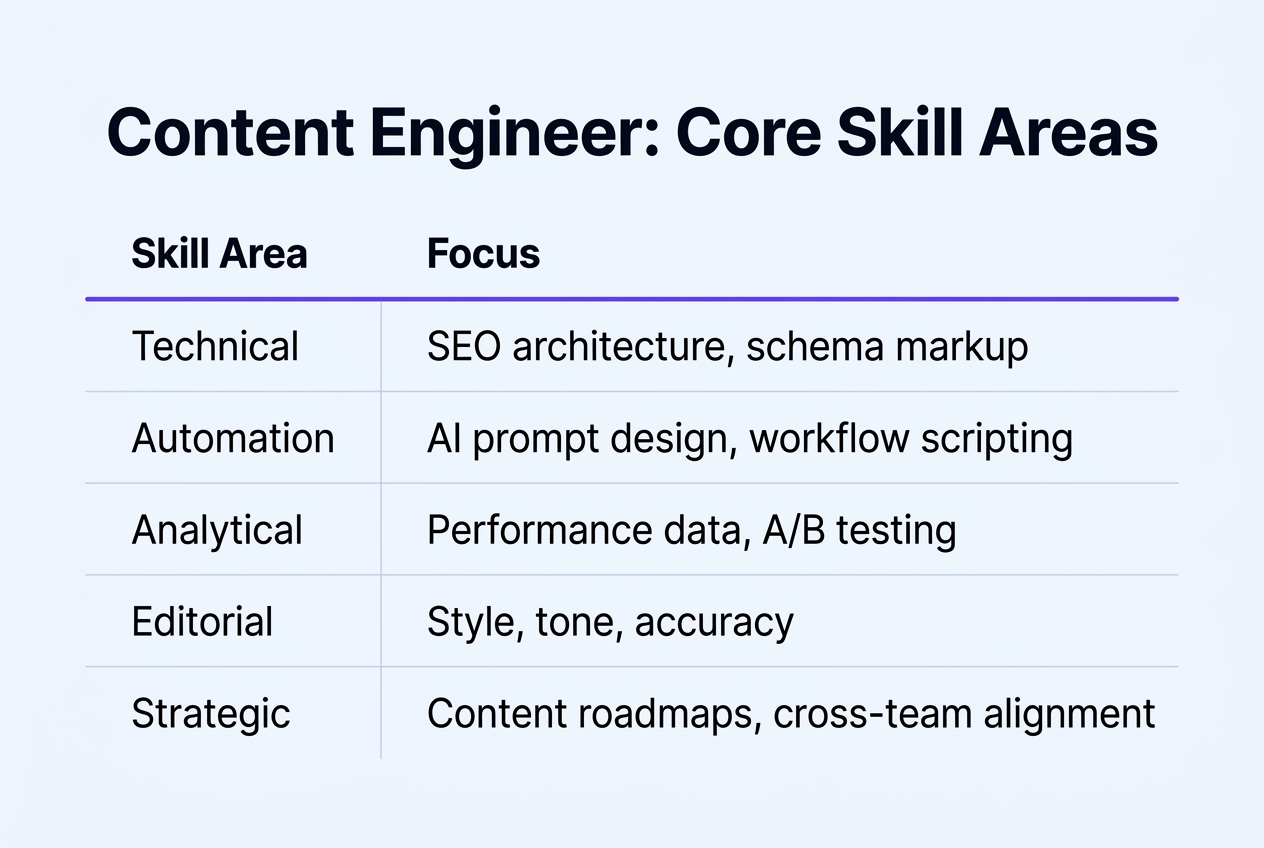
- Core Skills and Responsibilities of a Content Engineer
- Content Engineer vs. Traditional Content Roles
- Why Businesses Need Content Engineering Now
- Building a Content Engineering System: Manual Hire vs. Automated Platform
- How Automation Platforms Apply Content Engineering Principles
- Real-World Examples: Content Engineering in Action for Small Businesses
- How to Get Started With Content Engineering for Your Website
What Is a Content Engineer?
A content engineer is someone who treats content like a system, not a series of one-off writing projects. Think content models, taxonomy, tagging rules, and publishing workflows that make sure every article gets built, labeled, and delivered the same way, every time. It's less about a single great sentence and more about a machine that produces hundreds of good-enough sentences on schedule, without falling apart at scale.
The role showed up because businesses now need content everywhere at once — their own website, Google, AI chat tools, social threads, sometimes translated into a dozen languages. That's a distribution problem as much as a writing one. If you're curious how these workflows actually get built, an automated content creation guide will walk through the pipeline from research to publishing in more technical detail than most job descriptions bother with.
How this differs from a content strategist or copywriter
A copywriter's job is the sentence. A strategist's job is the plan. A content engineer's job is the pipeline connecting both — the templates, the schema markup, the rules that decide how a draft becomes a published, tagged, internally-linked page. They're closer to a systems builder than a wordsmith, even though good ones understand both worlds well.
This distinction matters more than the job titles suggest. Demand for it is real, too. A quick search turns up listings like Now Hiring: 900 Content Engineer Jobs, mostly at companies drowning in content needs and short on repeatable process. Hire a great writer and you get great paragraphs. Build a content engineering system and you get output that stays consistent whether you publish once a week or once a day.
The end goal is repeatability: content that's on-brand, structured cleanly for search engines and AI answer tools, and doesn't require reinventing the process every single time.
Core Skills and Responsibilities of a Content Engineer
This role blends writing instincts with systems thinking. It's less about crafting the perfect sentence and more about building a machine that produces good sentences on schedule, forever. If that sounds more like engineering than writing, good. That's the point.
- Content modeling and information architecture: mapping how topics, pages, and clusters relate to each other so a site builds topical authority instead of a pile of disconnected posts.
- Structured data and schema markup: tagging articles, products, FAQs, and local business details so search engines and AI tools can parse exactly what a page is about.
- CMS and platform management: knowing the quirks of WordPress, Shopify, Webflow, and Wix well enough to publish cleanly without breaking templates or losing formatting.
- Workflow automation and editorial pipeline design: setting up repeatable steps for research, drafting, review, and publishing so content ships daily without manual bottlenecks.
- Analytics tied to business outcomes: watching traffic, rankings, and conversions, not just word counts, to prove content is actually driving calls and sales.
- API integration for publishing and data flow: connecting content tools to websites, analytics platforms, and CRMs so everything talks to each other automatically.
Each of these skills solves a specific bottleneck. Bad information architecture means Google can't tell what your site is actually about. Sloppy schema means you lose out on rich results and, increasingly, on getting cited by AI answer engines. For a deeper theoretical grounding, What Is a Content Engineer (A Manifesto, Of Sorts) lays out how the discipline emerged from the mess of unstructured content production.
Platform fluency matters more than people expect. A roofing company on WordPress has different constraints than a Shopify store or an e-commerce brand on Webflow. If your team is on a newer builder, learning the ins and outs of webflow publishing can save hours of manual formatting every month.

Content Engineer vs. Traditional Content Roles
People throw around "content writer" and "content engineer" like they're the same job. They're not. A writer focuses on the sentence. A strategist focuses on the plan. An SEO specialist focuses on rankings. A content engineer focuses on the whole pipeline — research, writing, publishing, and tracking, working together as one repeatable system. Here's how the roles actually stack up.
| Role | Primary Focus | Typical Tools | Output Pace | Scalability |
|---|---|---|---|---|
| Content Writer | Drafting readable copy | Docs, style guides, maybe an AI assistant | 1-2 articles per week | Low — bottlenecked by hours in the day |
| Content Strategist | Planning topics, calendars, funnels | Spreadsheets, editorial calendars, analytics dashboards | No direct output; guides others | Moderate — plans scale, execution doesn't |
| SEO Specialist | Keywords, rankings, technical fixes | Rank trackers, Search Console, backlink tools | Occasional audits and reports | Moderate — insight-heavy, output-light |
| Content Engineer | End-to-end system: research → write → publish → measure | Automated pipelines, AI generation, CMS integrations | Daily, automated | High — output isn't tied to headcount |
Overlap is real. A strategist picks keywords, a writer sometimes optimizes for search, and an SEO specialist often edits copy too. The divergence shows up in ownership: a content engineer owns the pipeline, not just one piece of it. If you want the bigger picture, a solid seo automation guide lays out how these functions get stitched together into one workflow instead of four separate job descriptions.
Here's the blunt part: most small businesses can't afford four salaries for one content function. So they hire none, and their site goes quiet. That's the gap content engineering — human or automated — is built to close.
Why Businesses Need Content Engineering Now
Google's ranking algorithm and AI answer engines have quietly started rewarding the same thing: structure, consistency, and volume. ChatGPT, Perplexity, and Gemini don't pull answers from thin air. They pull from sites that publish often, organize information clearly, and cover a topic from every angle. A roofing company with three blog posts from 2022 simply isn't in the conversation. One publishing daily, with clear headers and specific local details, has a real shot at both a Google ranking and an AI citation. That shift is what people mean when they talk about the rise of the content engineer as a marketing role worth understanding.
Brand-new websites feel this hardest. Zero domain authority means you're invisible until you build a track record of relevant, frequent publishing plus a few trustworthy backlinks. There's no shortcut around it. A med spa launching its first site isn't competing against one rival's homepage — it's competing against years of accumulated content from every practice in a fifty-mile radius. Systematized publishing is how newer sites catch up.
Here's the blunt part: manual content production doesn't scale to daily output. A single well-researched, long-form article can take a writer six to eight hours. Do that math across 365 days and it's clear why most small businesses publish sporadically, if at all. That inconsistency is exactly what search engines and AI models penalize. Many local businesses now realize that AI visibility runs on the same fuel traditional SEO always needed — steady, structured, high-volume content — just aimed at a new set of readers that happen to be machines.
Building a Content Engineering System: Manual Hire vs. Automated Platform
So you know what the role does. Now comes the real question: do you hire for it, or do you buy the system that does it? There's no universal right answer, but the numbers make the tradeoffs pretty clear. A single content engineer in the U.S. typically earns $85,000 to $130,000 a year, and that's before you add writers, editors, or the tools they'll need to actually publish anything.
Hiring builds a custom operation, but it's slow to spin up and expensive to keep fed. Many local businesses simply can't wait three months to find, train, and onboard someone. Speed and cost are where automation pulls ahead fast, though a hire gives you more direct creative control. Here's how the two paths stack up on the metrics that actually matter to a small business owner.
| Factor | Manual Hire (Engineer + Writers) | Automation Platform |
|---|---|---|
| Time to launch | 4–12 weeks (hiring, onboarding, tool setup) | Same day to a few days |
| Monthly cost | $7,000–$12,000+ (salary, tools, freelancers) | Roughly $99–$500 per site |
| Output consistency | Depends on staffing, sick days, turnover | Daily, automated, doesn't skip weeks |
| Scalability | Requires new hires per site or market | Add sites or languages with a few clicks |
| Maintenance burden | Management, QA, tool licensing, training | Minimal; provider handles the stack |
None of this means the human role is fading out. Quite the opposite, actually. A growing conversation around this emerging role shows how the discipline is shaping the tools you're now buying off the shelf. A dedicated provider essentially packages that expertise into software, so you get the strategy without the payroll. For a solo agent or a small e-commerce shop, that's the whole appeal: engineering-grade output, none of the engineering-grade overhead.
How Automation Platforms Apply Content Engineering Principles
Strip away the buzzwords and content engineering is really a system: research, structure, publish, measure, repeat. Automated platforms just run that system on a clock. The keyword research step replicates what used to be manual content modeling and information architecture work — mapping topics, search intent, and site structure before a single word gets written. If you want the fuller picture of where this discipline came from, what content engineering actually involves is worth understanding before you judge whether automation is cutting corners or just cutting waste.
Once topics are mapped, daily long-form articles apply the same structured templates a trained writer would use: headers, internal links, outbound citations, meta descriptions, image placement. It's the same skeleton, just built by machine every 24 hours instead of every few weeks. Auto-publishing to WordPress, Shopify, Wix, or Webflow through webhooks is the workflow automation layer — no export files, no copy-paste into a CMS, no bottleneck waiting on a developer. Brand voice settings and multi-language output do the job a style guide used to do, forcing consistency across hundreds of posts and, for e-commerce sellers with international customers, across markets too. That consistency used to require a managed team. Now it's a setting.
The last piece is the feedback loop. SEO and GEO scoring, plus AI visibility tracking across engines like ChatGPT and Perplexity, function as the analytics layer that tells you whether content is actually working — not just published, but ranking and getting cited. Without that loop, you're just guessing. This is how automated platforms let small businesses run a full content engineering operation without ever posting a job listing for one.

Real-World Examples: Content Engineering in Action for Small Businesses
Theory is nice. Numbers are better. What follows is what actually happens when small businesses put a structured publishing system to work instead of hoping word-of-mouth carries them forever. None of these examples needed a marketing department. They needed consistency, and a system built to deliver it daily.
- A solo insurance agent in Florida started publishing local, keyword-specific posts every day and watched Google Search Console impressions climb from near-zero to thousands within a few months, all without touching a single draft himself.
- A med spa owner in New Jersey used structured, topic-clustered articles around treatments and local neighborhoods to start ranking for searches like "botox near me" in towns she'd never appeared in before.
- A roofing company in California layered geo-targeted articles for surrounding cities and counties, chipping away at competitors who'd dominated local results for years with barely any fresh content of their own.
- A SaaS marketing manager paired an automated content calendar with backlink building to scale organic traffic without adding headcount, treating content engineering as infrastructure rather than a one-off writing task.
- An e-commerce store auto-published product-focused SEO articles daily, turning thin category pages into a steady stream of buyer-intent traffic month over month.
The common thread? Every one of these was a brand-new or low-authority domain. That's the part people don't expect. You don't need years of history to show growth. You need daily output, sound structure, and patience measured in weeks, not years. The data in Search Console tells the real story, not the promises.
How to Get Started With Content Engineering for Your Website
Getting a system running isn't complicated. But it does need a real sequence, not just "write some blog posts and see what happens." Start with an honest look at where you stand, then build outward from there.
- Audit your current content gaps and domain authority by checking what keywords competitors rank for that you don't, and note how thin or outdated your existing pages are.
- Define a content model before you write anything: pick core topics, a repeatable article structure, metadata rules, and a plan for how new posts link back to your key service pages.
- Decide between hiring talent or using an automation platform based on your actual budget and how fast you need volume; a freelance writer might cost $150 per article, which adds up fast at daily frequency.
- Set up publishing integration to your CMS, whether that's WordPress, Shopify, Wix, Webflow, or a webhook connection, so content goes live without someone manually copying and pasting every morning.
- Monitor performance in Google Search Console weekly and adjust the system itself — topic clusters, internal linking, article length — rather than obsessing over one underperforming post.
- Expand into AI visibility tracking as tools like ChatGPT and Perplexity start sending real referral traffic, since ranking in traditional search no longer guarantees you show up in AI answers.
If you're still deciding whether this needs a specialist or a system, it helps to first understand the fundamentals. A solid quick guide to content engineering lays out the mechanics without the sales pitch. Treat this as infrastructure, not a one-time project. Tools like Ahrefs or Google Search Console tell you what's working; the model you built in step two tells you what to fix. Skip the audit and you're just guessing with extra steps.
Before you commit to any one path, it helps to be honest about where the gap actually sits: a site that loads slowly or throws crawl errors needs a developer or technical specialist first, and no amount of publishing will paper over that. Once the foundation is sound, the question shifts to consistency — who is producing the pages that answer real searches, how often, and whether that pace is something you can sustain past month three. Weigh the cost of ongoing ad spend that stops the moment you pause it against content that keeps earning attention quietly, and be clear-eyed about which problem you're solving right now.