
You're publishing content, maybe even ranking for a few terms, but the traffic isn't turning into leads or sales — and you're starting to wonder if the problem is deeper than keywords. It usually is. Understanding a funnel in seo means mapping content to what a searcher actually needs at each stage, from first question to final decision, instead of writing random posts and hoping. This guide breaks down exactly how to build and rank through that funnel in 2026.
Table of Contents
- What a Funnel in SEO Actually Means
- The Three Core Stages of an SEO Funnel
- How the Technical Journey Feeds the Funnel: Crawl, Index, Rank
- How AI Search Is Reshaping the SEO Funnel
- Comparing Traditional SEO Funnels to AI-First Funnels
- Finding Where Your Funnel Is Losing Traffic
- Building a Funnel in SEO That Keeps Working
- Frequently Asked Questions About the Funnel in SEO
What a Funnel in SEO Actually Means
Why keyword lists alone aren't a funnel
A spreadsheet of 200 keywords isn't a strategy. It's a wish list. An SEO funnel is the actual path a searcher walks, from a vague first question to the moment they call your office or hit checkout. Every step of that path needs a page waiting for them. Map the query to the content. Map the content to the rank. That's the whole job.
Most small business sites get this backwards. They chase the highest-volume terms, publish a handful of pages, and wonder why visits don't turn into leads. Say a roofing company ranks for "roof types" but has nothing for "emergency roof repair near me." Traffic shows up, reads, and leaves. The keyword did its job. The funnel just wasn't there to catch anyone at the bottom.
Treating SEO as a pile of keywords instead of a pipeline is exactly why so much traffic never converts. You get visits without intent alignment, rankings without revenue. Real coverage means content sitting at every stage a buyer moves through, and a broad seo automation guide usually treats stage mapping as a first step, not an afterthought. Skip it and you're just collecting impressions.
SEO funnel vs. marketing funnel
A general marketing funnel leans on ad spend, retargeting pixels, and email sequences to move someone along. Turn off the budget, and the funnel stops moving. An SEO funnel runs on something slower but sturdier: search intent matched to the right page, ranking on its own merit. No daily spend required once it's built.
That difference changes how you plan. A marketing funnel manager thinks in campaigns and click costs. An SEO funnel thinks in questions people type into Google, at 2 a.m., worried and searching. A med spa doesn't need a nurture email for "how much does Botox cost in my city." It needs a page that answers that question better than the ten results above it.
This is also where visibility, relevance, and trust come in, and they have to exist at every stage, not just the top of the funnel where most businesses dump all their content budget. A page that ranks but doesn't answer the real question builds neither. Get the middle and bottom wrong, and the top stops mattering too.
The Three Core Stages of an SEO Funnel
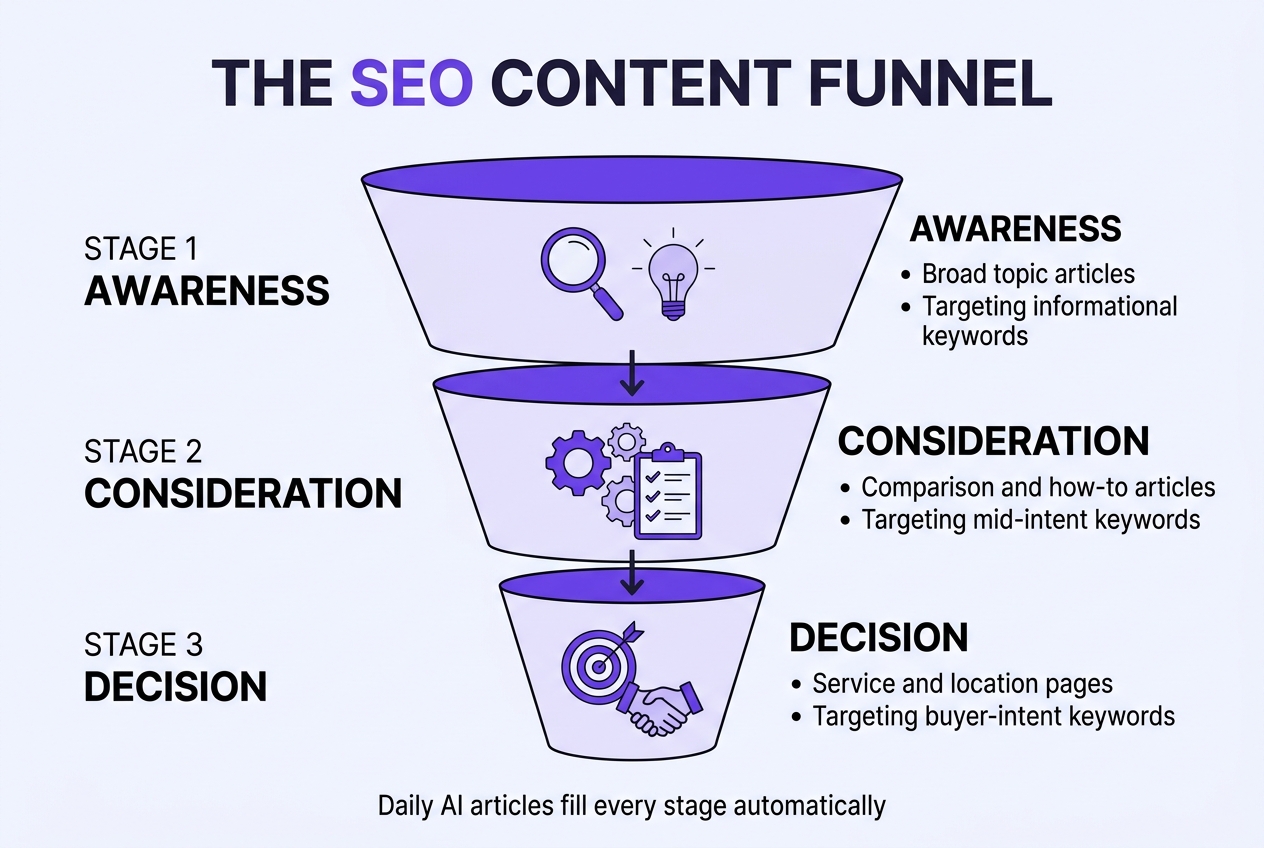
Every buyer moves through three moods before they hand over money: they've got a problem, they're weighing fixes, then they're ready to pick one. Top of funnel searchers ask broad questions like "why is my basement leaking" or "signs you need Botox." They don't want a sales page. They want to understand what's happening to them.
Middle of funnel is where comparison starts. Searches shift to "best roofing materials for humid climates" or "SaaS vs spreadsheet for scheduling." The searcher knows a solution category exists — they're just deciding which one fits. Bottom of funnel is the money zone: "roofing company near me," "book med spa consultation," or a brand name typed straight into Google. These people are close to buying. Treat that query wrong and you'll lose the sale to whoever ranks instead.
Matching content type to buyer intent
Content format has to shift with intent, not just keyword volume. A guide works at the top. A comparison page works in the middle. A service or product page closes at the bottom. Mixing these up is a common reason traffic doesn't convert. This is worth building into a real content scaling guide rather than guessing article by article.
- Top-of-funnel content should answer a single broad question in plain language, with no pitch attached, so readers trust the source before you ask for anything.
- Middle-of-funnel content should compare options honestly, including tradeoffs, because a one-sided comparison gets ignored by skeptical researchers.
- Bottom-of-funnel content should include a clear, low-friction call to action — a quote form, a booking link, a "buy now" button — placed above the fold.
- Each stage needs its own keyword set, since "what is" queries and "buy" queries almost never rank on the same page.
- Internal links should walk readers from awareness content toward transactional pages, guiding them instead of stranding them on a dead-end blog post.
Common mistakes at each stage
The biggest mistake is skipping a stage entirely. Plenty of sites publish only bottom-funnel service pages, then wonder why traffic stalls. Without top-of-funnel content, you're invisible to people who haven't decided anything yet. Others do the opposite: endless blog posts, zero transactional pages, tons of traffic, no revenue. Rankings look strong. Sales stay flat. That's not success — that's a leak nobody's watching.
- Publishing only informational content and never building the comparison or transactional pages that actually convert visitors into leads.
- Using the same generic call to action on every page, regardless of whether the reader just arrived or is ready to book.
- Ignoring middle-funnel comparison content, which leaves competitors to define the categories buyers use to evaluate you.
- Sending all internal links back to the homepage instead of the next logical stage in the buyer's research.
- Assuming one viral article fixes the whole pipeline, when a funnel needs steady coverage across all three stages to keep working.
How the Technical Journey Feeds the Funnel: Crawl, Index, Rank
Before any article can compete for a click, it has to survive three gates: crawling, rendering, and indexing. Miss one, and your content never enters the funnel at all. It just sits there, invisible, no matter how good the writing is. This is the part most people skip when they talk about SEO strategy, and it's exactly the part that quietly wrecks otherwise solid content.
What blocks a page from entering the funnel
Broken internal links, slow-loading pages, messy header structure, orphaned pages with zero internal links pointing to them. These issues don't announce themselves. They just cause search engines to crawl less often, index less completely, and rank the page lower when it does get in. A roofing site with a 6-second load time can publish the best local guide in town and still lose to a competitor's mediocre post that loads in under 2 seconds.
Here's a quick look at common technical blockers and where they typically get fixed:
| Technical issue | Effect on the funnel | Who typically fixes it |
|---|---|---|
| Blocked by robots.txt | Page never gets crawled | Developer or technical SEO specialist |
| Slow Core Web Vitals | Lower crawl frequency, weaker rankings | Developer or performance specialist |
| Broken internal links | Crawl budget wasted, pages orphaned | Developer or site auditor |
| Duplicate title tags | Wrong page indexed or ranked | Technical SEO audit |
| No content freshness | Page drops out of consideration over time | Ongoing content publishing |
That last row is where daily publishing paired with SEO/GEO article scoring earns its keep, once the technical foundation is sound. Think of it as the content engine, not the foundation crew. If your site has real crawl or indexing problems, no volume of new articles fixes that; you need a specialist for the plumbing first. For teams weighing what "automated" should even mean here, an automated content creation guide is a useful place to see where automation helps and where it doesn't.
How AI Search Is Reshaping the SEO Funnel
Why zero-click search doesn't kill the funnel
AI Overviews, ChatGPT, Perplexity, and Gemini now answer plenty of questions before anyone clicks a link. That looks like the funnel is shrinking. It isn't, really. Awareness and consideration still happen — they just happen inside the answer box instead of on ten blue links. Your content still has to do that work, even if the click comes later or never.
Think of it as compression, not deletion. A person researching "how much does roof replacement cost in my area" used to click three or four sites before deciding who to call. Now an AI answer might summarize all three in one paragraph. The brands that get summarized well are the ones whose content already answered that question clearly, with numbers and specifics an AI system can lift confidently.
So the funnel still has a top, middle, and bottom. It's just that top and middle can now happen without a visit to your site at all. A recent academic review of search engine optimisation strategy as a determinant of visibility makes a similar point: ranking factors evolve, but the underlying goal of matching content to intent hasn't changed. What's changed is who's doing the matching.
Getting cited instead of just ranked
Ranking used to be the finish line. Now it's a checkpoint. AI systems decide who to cite based partly on entity disambiguation — can the model tell, with confidence, exactly who you are, what you sell, and where? If your business name is generic, your service descriptions vary page to page, or your NAP details conflict across the web, the model has less reason to trust you as the answer. Consistency is now a ranking signal, not just a branding nicety.
Gaps matter too. If your site has ten strong pages but nothing addressing a common follow-up question, an AI engine simply won't have the context to recommend you for it. It'll cite whoever did answer that question, even if their site is smaller. This is one reason many local businesses researching SEO NJ strategies find that content depth, not just backlink count, decides who shows up in AI answers.
Here's the useful reframe: it's one funnel, not two separate games for Google and AI. The same well-structured, fact-dense, consistently branded content earns organic clicks and AI citations at once. That's why AI visibility tracking across ChatGPT, Perplexity, Claude, and Google AI Overviews matters — it shows you where you're already being cited, and where the content gaps still are.

Comparing Traditional SEO Funnels to AI-First Funnels
Where the two models overlap
A traditional funnel tracks rankings, clicks, and conversions on a search results page. Simple enough. You rank, someone clicks, some of them buy. An AI-first funnel keeps that whole structure but bolts on a new layer: getting cited or recommended inside a chat answer, where there's no blue link to click at all. Traditional SEO leans hard on backlinks and domain authority to prove you're trustworthy. AI models judge trust differently — they reward facts stated the same way, over and over, across many pages on your site. Both systems, though, still punish businesses that go quiet for months. Fresh, consistent publishing isn't optional in either world.
| Factor | Traditional SEO Funnel | AI-First Funnel |
|---|---|---|
| Primary success metric | Rankings, clicks, conversion rate | Citations and recommendations in chat answers |
| Trust signal | Backlinks, domain authority | Repeated, structured factual mentions |
| Content cadence | Regular new pages and updates | Regular new pages and updates |
| Where visibility happens | Google, Bing search results | ChatGPT, Perplexity, Gemini, AI Overviews |
| Growth pattern | Gradual, link-dependent | Faster with clear, factual repetition |
Notice the overlap in that last row of the table. Neither model rewards a site that publishes once a quarter and calls it strategy. Higher education marketers face the same pressure to prove content is actually moving the needle, which is why tracking the right SEO metrics matters as much for a med spa as it does for a university. Whether you're chasing a ranking or a chatbot mention, the fuel is the same: content that keeps showing up.
Finding Where Your Funnel Is Losing Traffic
Before you write another article, figure out where the leak actually is. Traffic problems and conversion problems look similar from the outside, but they need completely different fixes. Diagnosing the stage first saves you weeks of guessing. This is the same discipline behind any well-built marketing funnel, and understanding stages and tactics for growing a marketing funnel makes it easier to spot which one of yours is underperforming.
Signals to check in Search Console
Your data usually tells you exactly what's broken, if you know where to look. A few patterns show up again and again:
- High impressions but low click-through rate almost always means your title tag or meta description isn't earning the click, even though Google is showing your page for the right searches.
- Solid traffic with almost no leads or sales points to weak middle or bottom-of-funnel pages, or content that never gives readers a reason to act.
- Strong rankings but zero mentions in ChatGPT or AI Overviews suggests your content is missing the clear, structured facts these engines like to quote directly.
- Pages that rank on page two for months without moving often need internal links from stronger pages, not a rewrite.
- A sudden drop across many queries at once usually points to a technical issue or an algorithm shift rather than a content quality problem.
Tracking domain-level trends over time, rather than single-keyword swings, gives you a clearer read on whether your authority is actually growing as new content goes live.
When to add content vs. fix existing pages
New content isn't always the answer. Sometimes it's the wrong move entirely. Before adding another keyword to your pipeline, audit what you've already published by funnel stage: count how many pieces target awareness questions versus comparison pages versus buying-intent pages, and you'll usually find one stage is starving while another is overstuffed. Fix the gap first. Only then does adding new articles actually move the needle instead of piling onto a lopsided funnel.

Building a Funnel in SEO That Keeps Working
What daily publishing solves at each stage
A funnel starves when only one stage gets attention. Daily long-form articles targeting a mix of top, middle, and bottom-of-funnel keywords keep every part of the pipeline fed at once, so you're not stuck writing ten awareness posts and forgetting the buyer who's ready to book. Automated keyword research helps here too, identifying high-volume, low-competition terms by niche so each article fills a real content gap instead of guessing what might rank.
That matters because a growth plan and content calendar built from business and competitor analysis can map exactly which stage is thin this week, whether that's comparison content for the middle of the funnel or "near me" pages for bottom-funnel intent. A roofing company might need storm-damage guides one week and pricing pages the next. Nobody has to decide that manually.
For businesses serving mixed-language markets, content generation in 100+ languages extends that same stage-by-stage logic across regions, which is a different job from translating an existing site. It's about writing new, original posts natively for each audience. If you're new to structuring this kind of pipeline, this SEO workshop presentation breaks down funnel logic in plain terms worth reviewing.
What still needs a specialist
Automation has limits, and pretending otherwise helps no one. Backlink exchange and building from verified niche sites supports authority-building as an alternative to manual outreach and PR pitching, but it's matching, not relationship-building with journalists or editors. If you need placements in specific publications, that's a separate effort entirely.
Brand voice customization and plagiarism checks keep hundreds of published articles sounding consistent and original, but there's no assigned human writer reading each piece before it goes live. That's the trade-off: this is automation at $99 a month per site, not an agency retainer with a dedicated editor combing through drafts. For businesses that need every sentence hand-checked, or technical audits, penalty recovery, or paid campaigns running alongside content, those still require a specialist working outside this system entirely.
Frequently Asked Questions About the Funnel in SEO
Is an SEO funnel just a sales funnel with a different name?
No. A sales funnel tracks a buyer from lead to closed deal, often through calls or email. An SEO funnel tracks a searcher through Google, from a vague question to a branded search. They overlap near the bottom but the top is entirely different. One starts with a search bar, the other starts with a form fill.
How often does content need to publish before rankings actually move?
There's no magic number, but thin, occasional posting rarely works. Consistency matters more than volume. Here's what tends to separate movement from stagnation:
- Sites publishing daily or several times a week tend to build topical depth faster than sites posting monthly, simply because Google has more pages to evaluate and connect.
- New domains with zero authority usually need a few months of steady output before rankings for competitive terms start climbing.
- Long-tail, low-competition keywords can rank in weeks, while broad head terms may take six months or more regardless of publishing pace.
- Gaps in publishing, like three weeks on and two weeks off, seem to slow crawl frequency and stall momentum.
- Article length and depth (often 2,000 to 3,000+ words) correlate with better performance than short, surface-level posts.
Can a single article cover more than one funnel stage?
Yes, and it often should. A well-built comparison article can educate a curious reader while quietly answering the objections of someone closer to buying. Just don't force it. An article trying to serve five intents at once usually serves none of them well.
Does AI search replace this funnel or sit on top of it?
It adds a layer, it doesn't replace anything. Traditional rankings still matter for click-through traffic. AI answer engines now pull from that same content to form recommendations, so the funnel just gained an extra exit point.
How do you measure funnel health beyond rank position?
Rankings are a proxy, not the goal. Watch organic traffic by stage, branded search volume growth, click-through rate on ranking pages, and whether AI tools cite the site at all. Domain tracking and AI visibility checks give a fuller picture than position alone.
Before committing to any approach, it helps to be honest about what's actually slowing growth down: is it a lack of fresh, consistent content showing up in search and AI answers, or is it something structural like site health, conversions, or paid budget that content alone won't fix? Those are different problems with different fixes, and mixing them up tends to waste both time and money. Once that's clear, the question becomes less about finding a single fix-all and more about which pieces need to work together.