
Chasing local rankings while juggling clients means you can't spend your week hand-building citations or writing blog posts for every roofing, med spa, or insurance client on your roster. Most agencies searching for a local seo white label solution actually need two different things: someone to handle map pack and Google Business Profile work, and a reliable content engine to keep organic traffic climbing in the background. That distinction matters. This guide breaks down seven options worth considering in 2026, including where automated content platforms like RankPush fit into the mix.
Table of Contents
- What Local SEO White Label Actually Means for Agencies
- White Label vs Reseller vs Referral: Picking the Right Arrangement
- 7 Local SEO White Label Providers Worth Evaluating
- How White Label SEO Pricing and Margins Actually Work
- Common Mistakes Agencies Make Choosing a Local SEO Partner
- Where Daily Content Fits Into a Local SEO Program
- local seo white label: Building a Package That Actually Scales
- Frequently Asked Questions
What Local SEO White Label Actually Means for Agencies
Why agencies outsource local SEO delivery
At its core, local SEO white label means an agency sells location-based SEO services under its own name while a third-party provider does the work behind the scenes. The client, whether it's a roofer in Tampa or a med spa in San Diego, sees your logo on the invoice. They never know a specialist elsewhere handled the deliverables. This is standard practice, not a shortcut. Most agencies you've heard of use it in some form.
The scope usually covers Google Business Profile optimization, citation building across directories, review management, and the ongoing push to land in the local map pack. These are labor-heavy, detail-sensitive tasks. Getting NAP consistency right across fifty directories for one client takes real hours. Do it wrong and you can tank the exact rankings you're trying to build. Agencies package this as "local SEO management" and bill it monthly, even though someone outside their office handles the actual citation cleanup.
Why not just hire in-house? Money, mostly. A skilled local SEO specialist runs $60,000 to $90,000 a year in salary, before benefits or tools. Reading a solid seo automation guide makes it obvious how much of this work can now be systematized rather than staffed. White labeling flips the math: you pay a wholesale rate per client, mark it up, and keep the margin without the payroll risk. That's the framework we'll use to compare providers next.
White Label vs Reseller vs Referral: Picking the Right Arrangement
Before you sign with anyone, figure out how much of the client relationship you want to own. That decision matters more than the price sheet.
Which arrangement protects your agency brand
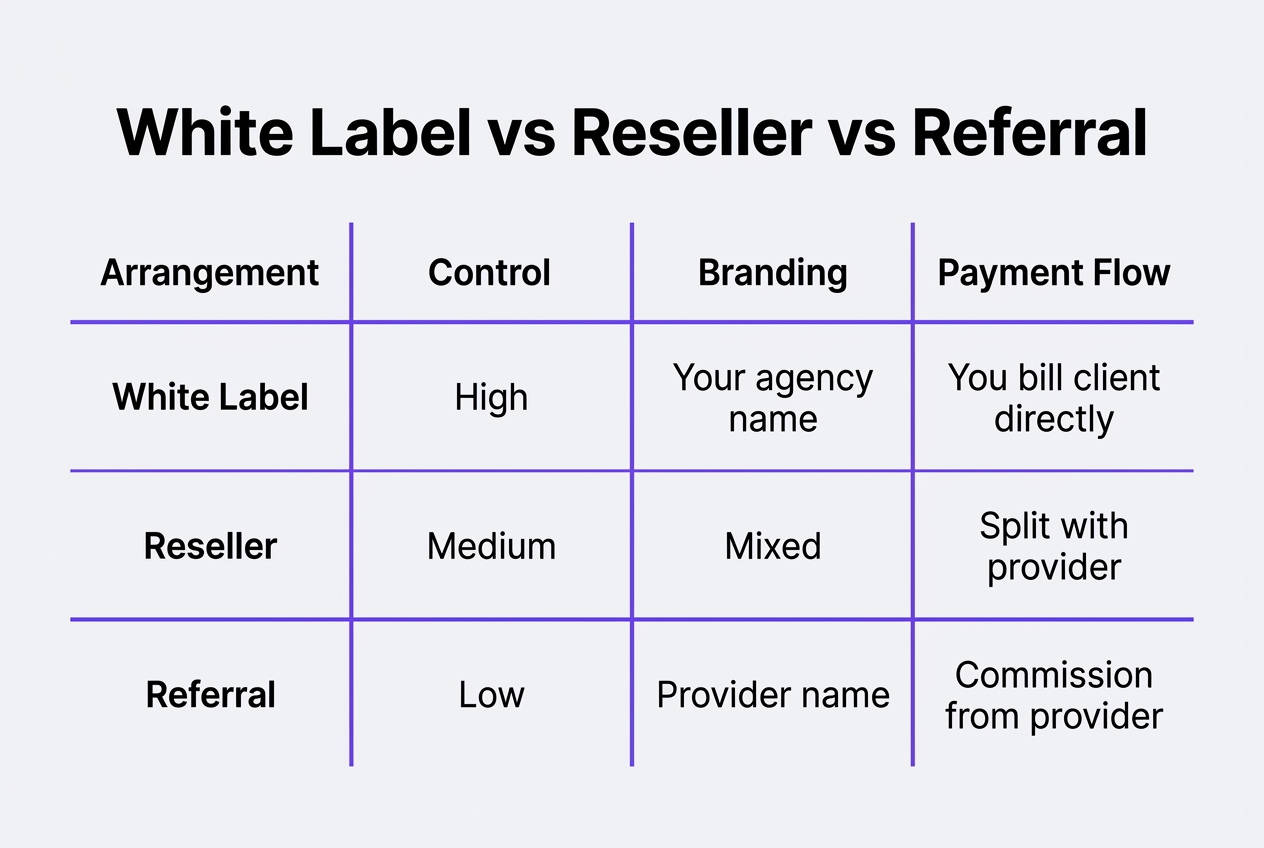
A true white label setup means full rebrand: the client never sees the vendor's name anywhere. Not in the contract, not in the reporting, not in a stray email footer. A reseller arrangement is looser. The vendor sometimes shows up in an invoice line, a login screen, or a report footer, which can raise awkward questions if a client goes digging. A referral model skips the pretending entirely: you hand the client off, the vendor delivers directly, and you collect a commission. No delivery risk, but also no control over the experience they get.
Here's a quick side-by-side to help you place a vendor before you commit:
| Arrangement | Vendor visibility | Your delivery risk | Best fit |
|---|---|---|---|
| White label | None, fully hidden | High, you own outcomes | Agencies protecting a premium brand |
| Reseller | Occasional, in reports/contracts | Medium, shared accountability | Agencies wanting margin without full ownership |
| Referral | Full, vendor deals with client | Low, minimal involvement | Agencies that just want commission income |
If protecting the client relationship is the priority, white label wins every time. Want to offload risk and take a smaller cut instead? Referral makes more sense. Reading up on how local marketing programs typically get packaged can help you spot which arrangement a given vendor is actually offering, since the language in sales calls doesn't always match the contract terms.

7 Local SEO White Label Providers Worth Evaluating
Before you sign with anyone, it helps to know what's actually being sold. Most agencies comparing options run into four broad categories, and each one carries different risk. Some vendors specialize narrowly. Others try to do everything, badly. Here's the breakdown that actually matters when you're the one putting your name on the invoice.
- GBP management specialists — narrow-focused shops that only touch Google Business Profile posts, categories, and map pack signals, usually priced per location with monthly optimization tasks.
- Citation-building services — high-volume directory submission and NAP consistency vendors that scale across dozens of listings but rarely offer any strategic input beyond the spreadsheet they hand back.
- Full-service local SEO resellers — agencies-behind-the-agency that bundle GBP, citations, review management, and some content into one package, sold under your brand name entirely.
- Hybrid platforms — software-driven providers that mix automation with human oversight, often blending reporting dashboards with a thinner service layer than the resellers.
Reporting quality separates the reliable ones from the rest fast. A strong provider shows you raw data — ranking changes, citation status, review velocity — not a polished PDF summary written to look busy. Turnaround reliability matters just as much: some resellers promise 30-day citation cycles and quietly stretch to 60. Margin realism is the quiet killer here. If a provider's price leaves you nothing after your client markup, you're doing free labor with extra steps.
What separates a strong provider from a risky one
Almost every option in this space bundles citation building, NAP consistency checks, and review management as core deliverables. That part's standard. What varies wildly is scope flexibility. Some providers handle a single city location cleanly but fall apart managing ten locations under one contract, with pricing that scales badly and reporting that blends locations together. A provider worth keeping will scope multi-location work as its own line item, not an afterthought bolted onto a single-city package.
Red flags: vague reporting, no direct access to specialists
Watch for account managers who can't answer a technical question without "checking with the team." That's often a sign there's no specialist behind the report at all. Vague reporting — screenshots without context, ranking claims without source data — is the other tell. Can't get a straight answer on turnaround time, or see the actual GBP account activity? You're buying a black box. Reading a solid content scaling guide before you commit to any reseller contract will help you spot which providers actually understand how content and local signals compound together, versus which ones are just reselling someone else's dashboard.
How White Label SEO Pricing and Margins Actually Work
Before you quote a client anything, you need to know what you're actually paying underneath. Wholesale rates vary a lot by market, but most agencies see fairly predictable ranges once they've sourced a few vendors.
Building a pricing sheet that survives real client demands
Here's a rough wholesale-to-retail breakdown many agencies use as a starting point. Adjust for your market, but the math stays similar.
| Service bundle | Typical wholesale cost | Common client price | Effective margin |
|---|---|---|---|
| GBP management (basic) | $150–$300/mo | $400–$600/mo | ~50-60% |
| Citation building (50 listings) | $100–$250 one-time | $400–$700 one-time | ~55-65% |
| Review management bundle | $100–$200/mo | $300–$500/mo | ~50-60% |
| Bundled local SEO package | $400–$700/mo | $1,200–$2,000/mo | ~55-65% |
Those margins look great on paper. They erode fast in real life. Revisions eat hours. So does client hand-holding — the monthly call explaining why rankings didn't move, the "can we just add one more thing" scope creep that never gets billed. A 60% margin can quietly become 30% by month three if you don't guard the scope in writing.
When you bundle, price the whole package above the sum of its parts, not below. Clients undervalue individual line items but respect a package price. That's the trick: sell the outcome, not the task list. And build in a buffer for the hand-holding. It's never actually free.
Common Mistakes Agencies Make Choosing a Local SEO Partner
Most agencies get burned by the same handful of mistakes. They pick a partner on price, skip the test drive, and only think about communication after a client is already yelling. Let's go through them one at a time.
The biggest one is chasing wholesale price over reporting quality. A cheap package that produces vague, unreadable reports will cost you a client eventually. You'll spend more time translating jargon into something a roofing company owner can understand than you saved on the invoice. Another common trap: agencies sign a contract without ever logging into the dashboard first. Can't tell a client what happened last month in under two minutes? That's a problem you created, not one they caused.
Then there's the communication gap. Nobody thinks about escalation paths until a client is already upset about rankings dropping. By then it's too late to negotiate response times. And plenty of agencies resell a service they genuinely don't understand, which shows the moment a client asks a follow-up question.
Before signing anything, run through these questions:
- What exactly shows up in a monthly report, and can a non-technical client understand it without you translating every line?
- Who do we contact when something breaks, and what's the guaranteed response window during a client escalation?
- Can we get sample access to the dashboard or reporting tool before committing to a contract term?
- What happens to content, backlinks, or rankings if we cancel or switch partners six months in?
- Can your team explain, in plain language, exactly how the work gets done — not just what it costs?
- Are there contracts or lock-in periods, or can we walk away on short notice if quality slips?
Answer those honestly before you sign, not after your first client complaint lands in your inbox.
Where Daily Content Fits Into a Local SEO Program
Why local businesses need organic content beyond the map pack
Map pack rankings, Google Business Profile posting, and citation building matter. That work stays with dedicated local SEO specialists. It's a different skill set entirely, and it should stay separate from what we're talking about here. But the map pack only shows three businesses. Everyone else fights for the organic results below it, and that's a battle citations alone don't win.
A roofing company can have a perfect GBP listing and still lose customers searching "how much does a roof replacement cost in [city]." A med spa can rank in the map pack for "med spa near me" and still miss every long-tail search about a specific treatment. Organic content fills that gap. It's what shows up when someone's researching, not just when they're ready to click "call now."
Without it, you're invisible for the questions people actually type into Google before they trust a business enough to visit its profile. That's a lot of missed traffic.
How automated publishing complements manual local SEO work
This is where RankPush comes in: daily long-form articles, published automatically to a client's existing WordPress, Shopify, Wix, Webflow, or webhook-connected site, backed by keyword research that finds local, low-competition terms specific to the niche. A roofing site might get an article on storm damage insurance claims in its metro area; a med spa gets one on a treatment trending in its zip code. No writer hired, no tool stack to manage.
Agencies can layer this in as the content engine running alongside GBP and citation work, rather than replacing it. Brand voice customization keeps every article sounding like the client, not a robot, and backlink exchange from verified niche sites adds authority signals your citation work doesn't touch. It's two separate systems working toward the same result: more visibility, from more angles.
At $99/month per site, with no contract, it's cheap enough to test on one client before deciding whether to roll it out agency-wide. Try it on your slowest-growing account first. If it moves the needle there, it'll move it everywhere else too.

local seo white label: Building a Package That Actually Scales
A package that scales isn't one vendor doing everything. It's a specialist handling map pack and citation work, paired with an automated content layer that keeps publishing whether you've got five clients or fifty. Try to run both manually and you'll hit a ceiling fast. Here's a checklist that keeps the handoffs clean.
A repeatable onboarding checklist for new local clients
Every new client should move through the same steps, in the same order, every time. That's what makes the process repeatable instead of improvised. Consistency here is what lets one account manager oversee ten clients instead of two. The table below lays out a practical sequence.
| Step | Owner | What happens | Typical timeframe |
|---|---|---|---|
| 1. Local presence audit | Specialist | Review GBP status, citations, NAP consistency, current map pack position | 1–2 days |
| 2. Map pack work assigned | Specialist | Citation cleanup, GBP optimization, review strategy handled separately from content | Ongoing, weekly |
| 3. Content automation layered in | RankPush (5-minute setup) | Connect to WordPress, Shopify, Wix, or Webflow; daily articles begin publishing | Same day |
| 4. Domain performance tracking | RankPush dashboard | Watch traffic and domain growth via multi-site management view | Continuous |
| 5. AI visibility check | RankPush dashboard | See whether the brand starts surfacing in ChatGPT, Perplexity, or AI Overviews | Monthly review |
Notice what's missing from that content layer: no GBP posting, no citation building, no review replies. That work stays with your specialist. What RankPush adds is the daily article engine underneath it, plus visibility tracking that shows clients something rank trackers can't: whether an AI assistant is starting to mention their name at all.
Setup per site takes about five minutes. Onboard a roofing client on Monday, a med spa on Tuesday. No technical drama either time.
Frequently Asked Questions
Do agencies need to disclose automation or outsourcing to clients
There's no universal law forcing disclosure, but there's a trust problem if a client finds out on their own. Most agencies land somewhere in the middle: they don't publish a line-by-line breakdown of every tool, but they're upfront that content production and some deliverables are handled by specialized partners or software. Transparency about the outcome matters more than transparency about the mechanism.
Think about what the client actually cares about. They want rankings, traffic, and leads, not a technical explanation of your stack. That said, if a client asks directly whether a human wrote every article or whether work is outsourced, dodging the question is a bad look and can sour the relationship fast.
A simple contract clause covers you legally: mention that deliverables may be produced using third-party tools, platforms, or subcontractors as needed to meet quality and turnaround standards. That's honest without turning into a confessional. Clients rarely object once results show up in Google Search Console.
How much does white label local SEO typically cost per client per month
Pricing varies wildly depending on scope, but a realistic range for a single local client sits between $300 and $1,500 a month for a reasonably active program. On the low end, that might cover a handful of articles and basic optimization work. On the high end, you're looking at more comprehensive programs that include citations, GBP work, and outreach — services that sit outside pure content automation and usually need their own specialist.
Agencies typically mark up whatever they pay a provider by two to four times to cover account management, reporting, and client communication. If your underlying content cost is $99 a month per site through RankPush, charging a local client $400 to $600 for a managed content program isn't unreasonable. It still leaves healthy margin after your time.
Should agencies tell clients the work is outsourced or automated
Yes, in general terms, but you don't owe anyone a play-by-play. Say something like "we use a combination of proprietary processes and specialized platforms to deliver consistent results," and leave it there unless pressed further. That phrasing is accurate for almost any agency using white label content or automation tools.
Where agencies get burned is overselling the human element. Market "our expert writing team" while every article comes from an automated pipeline like RankPush, and that's the kind of claim that blows up when a client compares notes with someone else in the industry. Keep language honest and outcome-focused instead.
How long until a local client sees ranking movement
For a brand-new domain with zero authority, expect three to six months before meaningful movement on competitive local terms. Long-tail, low-competition keywords can move faster, sometimes within four to eight weeks, especially for niches like roofing or med spas where local competition for specific phrases is thin.
Consistency beats speed here. A domain publishing daily for 90 days will usually outperform one that published a burst of content and then went quiet. Set client expectations early: month one is foundation-building, month three is when trend lines usually start bending upward, and month six is when compounding kicks in.
Before committing to any approach, it helps to be honest about where the real bottleneck sits — is it a lack of fresh, consistent content, or something deeper like technical health, conversion paths, or manual outreach that no amount of publishing can substitute for? Those are often separate problems solved by separate specialists, and mixing them up tends to waste both time and budget. Once that distinction is clear, it becomes much easier to judge which pieces you can automate and which ones still need a human hand.