
Your B2B buyers are researching on Google and asking AI tools like ChatGPT and Perplexity before they ever talk to sales. If you're not showing up in both places, a competitor is. That's the real challenge of b2b search engine marketing today: it's no longer just about ranking pages, it's about getting cited by the AI models shaping purchase decisions. Most guides stop at keyword research and backlinks. This one walks you through building consistent organic visibility and AI citations, step by step, without hiring an in-house content team.
Table of Contents
- What You Need Before You Start a B2B Search Engine Marketing Plan
- Step 1: Build Buyer Personas and Map the B2B Sales Funnel
- Step 2: Research Keywords Buyers Actually Use at Each Funnel Stage
- Step 3: Audit Your Site's Technical Health Before Publishing Content
- Step 4: Build a Scalable Content Strategy and Publishing Cadence
- Step 5: Earn Backlinks and Build Topical Authority
- Step 6: Optimize for AI Search Engines, Not Just Google
- Step 7: Measure Results and Scale Across Sites or Markets
- Putting It All Together: Your B2B Search Engine Marketing Checklist
What You Need Before You Start a B2B Search Engine Marketing Plan
Why B2B search behavior differs from consumer search
A consumer googling "best pizza near me" decides in minutes. A B2B buyer researching software or a commercial insurance policy doesn't work that way. There's a finance person, an ops lead, maybe a legal reviewer, all weighing in before anyone signs anything. That means your content has to speak to several people at once, not just one impulsive shopper.
Search volume also looks smaller, and that scares people. Don't let it. A keyword with 90 searches a month from a procurement manager with budget is worth more than 9,000 searches from browsers who'll never buy. Intent beats volume in B2B, every time.
Sales cycles stretch out too, sometimes three, six, even twelve months. Your content needs to show up early, during research, and stay visible through every stage someone revisits before approval. That's a different rhythm than consumer SEO, and it changes how you plan topics and timing.
Tools and access you need on hand
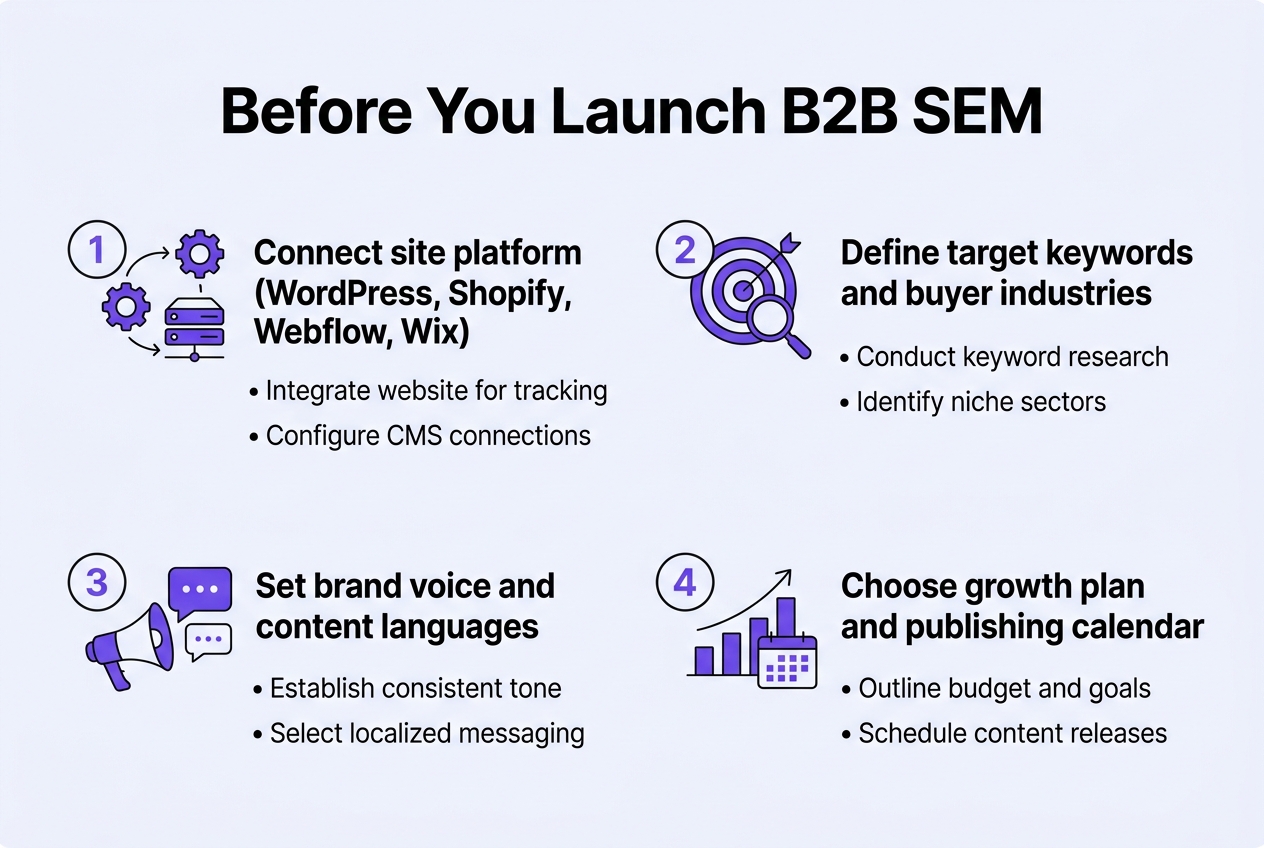
Before touching keywords or content, confirm the basics. You need a live website — WordPress, Shopify, Wix, Webflow, or a custom stack — plus login access that lets you (or whatever tool you use) actually publish. Sounds obvious. People skip it constantly, then wonder why nothing goes live.
You also need a defined buyer persona, even a rough one, and clarity on your goal: ranking in Google, yes, but increasingly getting cited inside AI answer engines like ChatGPT, Perplexity, and Gemini. Those two goals overlap but aren't identical, and knowing which matters more to your business shapes everything downstream. Reviewing a solid content scaling guide before you commit to a cadence will save you from rebuilding your process three months in.
Last thing: set real expectations. Organic growth compounds over months, not days. If you need leads by Friday, this isn't that lever — paid search is. But if you want a channel that keeps paying long after the campaign ends, this is it.
Step 1: Build Buyer Personas and Map the B2B Sales Funnel
Mapping persona pain points to search intent
Before you write anything, figure out who's actually reading it. Most B2B deals involve at least three types of searcher: the economic buyer who controls budget, the technical evaluator who checks whether your product actually works, and the end user who has to live with the thing daily. Each one types completely different queries into Google. The buyer searches "cost of," the evaluator searches "vs." comparisons, and the end user searches "how to." Treat them as one audience and you'll write content that satisfies nobody.
Once you know who you're talking to, line their questions up against the funnel. Awareness-stage searches sound like broad problem statements. Consideration-stage searches compare named solutions. Decision-stage searches look for proof: case studies, pricing, implementation timelines. Someone acting as a content engineer for your site should be mapping each article to one of these stages on purpose, not by accident.
B2B sales cycles rarely run in a straight line. You're often writing for a committee, not a person, and that committee needs months, not minutes, to decide.
That's why qualified content volume beats raw traffic. B2B conversion rates sit low by design. Lots of research, few purchases. A steady drumbeat of specific, funnel-matched articles keeps you in front of every stakeholder through that long, messy decision process, which matters more than any single viral page ever will.
Step 2: Research Keywords Buyers Actually Use at Each Funnel Stage
Top-of-funnel vs. bottom-of-funnel keyword types
Not every keyword deserves the same amount of your attention. A term like "insurance tips" pulls huge search volume but tells you almost nothing about what the searcher wants next. Compare that to "small business workers comp insurance Tampa," which is narrower but screams buyer intent. Broad terms build awareness; narrow terms close deals. Most B2B teams chase the first and wonder why traffic never turns into leads.
Here's a simple way to sort keywords by funnel stage before you write a single article:
| Funnel Stage | Example Keyword | Search Volume | Buyer Intent |
|---|---|---|---|
| Top-of-funnel | "what is liability insurance" | High | Low |
| Mid-funnel | "best insurance for contractors" | Medium | Medium |
| Bottom-of-funnel | "workers comp quote Tampa FL" | Low | High |
| Bottom-of-funnel | "switch roofing insurance carrier" | Low | Very high |
Long-tail, problem-based phrases convert better because they match an actual moment of need, not idle curiosity. Manual tools like Google Keyword Planner or Ahrefs can surface volume data, but they won't tell you which stage a term belongs to; reading an automated content creation guide helps clarify how that mapping actually works in practice. Good automated keyword research solves this by tagging terms to funnel stage automatically, then slotting them into a content calendar so your daily articles cover awareness, comparison, and purchase-ready searches in the right proportion — not just whatever sounds good that morning.
Step 3: Audit Your Site's Technical Health Before Publishing Content
Before you publish a single article, make sure the house itself is in order. Content poured onto a broken foundation just sits there. Google won't rank pages it can't crawl, and no amount of daily writing fixes a site that loads slowly or throws errors on half its pages.
What a technical audit should cover
A proper technical SEO audit is a developer or specialist job, not a content job. It should happen first, before your publishing schedule even starts. Technical health is the foundation everything else sits on. At minimum, have someone check:
- Site speed and Core Web Vitals, since slow load times quietly tank rankings and frustrate visitors before they read a word
- Crawl errors in your server logs or Search Console, which stop search engines from even finding your new pages
- Schema markup on key pages, so Google and AI tools can understand what your business actually does
- Mobile-friendliness across devices, given most B2B buyers now research from a phone at some point
- Indexability settings, making sure you haven't accidentally blocked pages with a stray noindex tag
- HTTPS security and a submitted XML sitemap, the basic hygiene items that are easy to overlook on an older domain
When to bring in a specialist vs. when to start publishing
If any of those items are broken, fix them first. Hire a developer, run a one-time audit, patch it. That's not something an automated content tool does, and it shouldn't pretend to. Once your technical foundation is solid, that's your cue to start daily publishing. This is where content velocity and built-in SEO/GEO article scoring start compounding, article after article, on a site that's actually ready to rank.
Step 4: Build a Scalable Content Strategy and Publishing Cadence
Setting up a daily or weekly publishing cadence
Here's the thing about B2B buyers: they're googling at 11pm, comparing five vendors, reading everything they can find. One article a month doesn't cut it. Consistency beats sporadic publishing because search engines and AI models both reward sites that keep showing up with fresh, relevant answers. A roofing company that posts once a quarter looks dormant. One that publishes daily looks active, trustworthy, and alive.
That's where daily long-form articles become a real growth lever. We're talking 3,000+ words, built with images and internal and external links, not a thin 400-word post that says nothing. Each one targets a different buyer question, a different stage of the funnel, a different keyword gap a competitor hasn't filled yet. Over a few months, that compounds into dozens of entry points into your site instead of one static homepage hoping to rank for everything.
Weekly cadences work too, if daily feels like a stretch for your team. But publish less than that and you're basically asking Google to forget you exist between posts. Pick a rhythm you can actually sustain, then don't skip it.
Matching content format to funnel stage
Not every article should sound the same, and it shouldn't sound like a robot either. Brand voice customization matters here — custom instructions that keep tone, terminology, and formality consistent so a law firm's content doesn't read like a med spa's. Plagiarism checks and an AI editor for manual rewrites keep quality in check too, letting you tweak a paragraph without starting over. Worth noting: this is automation, not a human writer or editor sitting behind the scenes.
If you sell across regions, content in 100+ languages covers original multilingual blogging — handy for a SaaS company selling into Germany, Brazil, and Japan at once. Just know that's not the same as translating existing pages or setting up hreflang; that's a job for a localization specialist.
Auto-publishing to WordPress, Shopify, Wix, Webflow, or via webhooks removes the manual bottleneck entirely. No copy-pasting, no waiting on a developer. Set it up once, roughly five minutes, and the content lands on your site on schedule, formatted and ready, whether you're writing for a cold-prospect blog post or a bottom-funnel comparison page.
Step 5: Earn Backlinks and Build Topical Authority
Backlinks still matter. A lot. They're one of the clearest trust signals Google has, and they help AI engines decide which sites to trust when citing sources. But not every path to links looks the same, and you need to know which lane you're in before you pick a method.
Manual outreach vs. automated backlink matching
Guest posts, HARO-style journalist pitches, and digital PR are relationship work. Someone emails editors, pitches a story angle, follows up three times, and waits weeks for a placement. It works, but it's slow and it doesn't scale without hiring people. An automated alternative exists too: backlink exchange and building from verified sites within your niche, which gets you dofollow links without the back-and-forth. Separately, some B2B topics thrive in community spaces, which is why drafted replies on active Reddit threads can add visibility where buyers are already asking questions. For a sense of how outside experts frame link building more broadly, an outside resource on link building fundamentals is a useful comparison point.
| Method | Effort Required | Typical Timeline | Best For |
|---|---|---|---|
| Guest post outreach | High (manual pitching) | 4-8 weeks per link | High-authority niche placements |
| HARO/journalist pitches | High (ongoing monitoring) | Days to weeks | Press mentions, brand trust |
| Automated backlink matching | Low (set and review) | Ongoing, ran continuously | Steady link volume at scale |
| Reddit thread replies | Low to moderate | Immediate visibility | Community-driven B2B discussion |
Whichever route you lean on, track the results. Domain tracking shows whether authority is actually climbing, which matters most for brand-new domains starting from zero. Watching that curve move, even slowly, tells you the strategy is working.
Step 6: Optimize for AI Search Engines, Not Just Google
How GEO differs from traditional SEO scoring
Traditional SEO asks one question: will Google rank this page? Generative engine optimization (GEO) asks a different one: will an AI model trust this page enough to quote it? AI Overviews, ChatGPT, Perplexity, Gemini, and Claude are now answering B2B research queries directly, often without the reader ever clicking through. A buyer comparing "CRM for insurance agencies" might get a full answer, with your competitor cited and you nowhere in sight. That's the new battlefield.
Scoring for GEO means grading content differently than you'd grade it for classic keyword SEO. AI systems favor clear claims, cited sources, defined terms, and structure they can lift cleanly — think headers, lists, direct answers near the top. A page stuffed with keywords but short on clarity might still rank on Google and still get ignored by an AI summarizer. SEO/GEO article scoring checks both angles at once, flagging content that's strong for search engines but weak for citation, or the reverse, before it ever gets published.
Practically, this changes how you write. Every article needs a tight, quotable answer early on, backed by specifics an AI can trust and repeat. Vague filler doesn't get cited. Precision does.
Tracking whether AI actually mentions you
Ranking on page one used to be the finish line. Now there's a second scoreboard: does ChatGPT recommend you when someone asks for a roofing company nearby, or a med spa with good reviews? Most businesses have no idea what AI assistants say about them, because nobody's watching. AI visibility tracking across ChatGPT, Perplexity, Claude, and Google AI Overviews (coming soon) closes that gap, monitoring whether your content, and your brand, shows up in generated answers over time.
This matters more for B2B buyers than most industries, since research-heavy purchases involve multiple AI-assisted searches before anyone fills out a form. Publishing long-form, well-structured articles daily increases your surface area — more pages means more chances to be the source an AI pulls from. Pair that with domain tracking to see how authority builds, and you get a clearer picture than guesswork ever gave you. Many local businesses are already watching these citations shift month to month.
Step 7: Measure Results and Scale Across Sites or Markets
Publishing on autopilot is great. But you still need to check whether any of it is working. Google Search Console and Analytics are your source of truth here, not vibes. Pull impressions, clicks, and ranking queries weekly. For a brand-new domain with zero prior authority, even modest movement — ten new keywords ranking in the top 100, a jump from zero to a few hundred monthly clicks — is a real signal, not noise.
From there, lean on a personalized growth plan and content calendar built from your business and competitor data. It should tell you what to publish next, not just what you already published. Think of it as your roadmap for the next quarter, not a one-time report you read once and forget.
Signs it's time to scale to multiple sites
Scaling too early wastes money; scaling too late wastes momentum. Watch for these signals before you add sites, markets, or languages:
- Your primary domain shows steady month-over-month growth in organic clicks for at least eight to twelve weeks straight, not just one lucky spike.
- You're managing content for more than one brand, location, or regional site, and a shared dashboard with multi-site and team member management would save real hours each week.
- Early traction includes traffic or queries from international visitors, suggesting a second language edition could capture demand you're already attracting by accident.
- You've identified an adjacent vertical or service line with its own buyer intent, meaning it deserves its own domain instead of competing for space on your main blog.
- Your backlink building has picked up enough referral traffic that a second site could plausibly earn links from the same niche network.
If none of that's happening yet, don't expand. Fix the engine on one site first.
Putting It All Together: Your B2B Search Engine Marketing Checklist
Seven steps, start to finish: build buyer personas, research what buyers actually type, fix technical health, set a publishing cadence, earn backlinks, optimize for AI engines, then track results. Skip a step and the whole chain gets weaker. Do them in order and each one makes the next easier. That's the whole game.
Paid search can absolutely run alongside this. Nothing wrong with ads for a quick lead burst. But organic content keeps working after the ad budget runs dry — that's the real difference. A campaign stops the moment you stop paying. A well-built article library keeps ranking, keeps getting cited by AI tools, and keeps bringing traffic months later for a fraction of the cost.
If you're weighing options, look for setup that takes minutes, not weeks — no SEO background required. Pricing around $99 a month per site, no contracts, is a reasonable benchmark to compare against. Start with one site. Watch the real traffic numbers in your analytics, not vanity metrics. Once you see it move, expand to a second site or market. That's how compounding actually gets proven, not promised.
Getting found by the right buyers often comes down to showing up consistently where they're already searching, and that's largely a content game won through steady publishing rather than a one-time push. A tool that handles keyword research, daily articles, and multilingual content can keep that engine running in the background, and even something like drafting Reddit marketing replies on relevant threads (a small but real part of what RankPush covers) adds another touchpoint without extra manual effort. From here, the natural move is just to look honestly at how much fresh, optimized content is actually reaching your B2B audience each week, and build from there.