
Patients are googling their symptoms and your competitors before they ever call your office. If your site isn't showing up, you're losing them before the first appointment. Searching for doctor seo services in 2026 usually turns up a confusing mix of agencies bundling technical audits, local listings, and link outreach into one expensive retainer. You don't need all of it. This article breaks down what actually moves the needle for a medical practice and where a daily content engine like RankPush fits into the plan.
Table of Contents
- Why Doctor Practices Can't Rely on Reputation Alone Anymore
- What Doctor SEO Services Typically Include
- Comparing Approaches: Agency Retainers vs. Automated Content Platforms
- How Daily AI-Generated Content Builds Visibility for a Medical Practice
- Publishing, Backlinks, and AI Visibility: The Pieces That Compound
- Steps to Get a Practice Website Publishing Daily Content
- Common Questions About Doctor SEO Services
Why Doctor Practices Can't Rely on Reputation Alone Anymore
How patient search behavior has shifted
Word-of-mouth used to be enough. A happy patient told a neighbor, the neighbor called the office, done. That's not how it works anymore. Even patients who get a referral from a friend or another doctor will still pull out their phone and search the practice name, the condition, or "best [specialty] near me" before they book anything. They're checking reviews, comparing credentials, and increasingly asking ChatGPT or Perplexity to summarize their options. If your practice doesn't show up in that research step, the referral can quietly go cold.
This shift matters most for mid-funnel questions: recovery times, insurance coverage, what a procedure actually involves. Patients want answers before they'll pick up the phone. A practice that publishes helpful, specific content around those questions gets found during that research window. One that doesn't simply isn't part of the conversation, no matter how good the care is once someone walks through the door.
What happens when a practice has no organic presence
Here's the uncomfortable truth: you can run a genuinely excellent practice and still be invisible on Google. Offline reputation doesn't automatically translate to online visibility. Search engines and AI assistants don't know how good your bedside manner is. They know what's written on your website, how often it's updated, and whether other sites reference it. No content, no signal, no ranking. It's that simple.
This hits brand-new practice websites especially hard. A domain with zero history has no trust built up yet, and one landing page won't change that. Search engines want to see a pattern — fresh, relevant content published consistently over weeks and months, not a one-time burst. That's also why learning from a content scaling guide can clarify why steady output beats sporadic effort for a young domain. Without that cadence, even a well-designed site with a clean technical foundation can sit on page three for years, quietly losing patients to the practice down the street that simply publishes more often.
What Doctor SEO Services Typically Include
Technical foundation vs. content engine
Most "SEO services" bundles are actually several different jobs wearing one label. It helps to pull them apart. A developer or technical SEO specialist usually handles site speed, schema markup, and crawl errors — the plumbing that lets Google read your site properly. That's work for a specialist elsewhere, not something a content platform does; an article tool doesn't fix broken plumbing. They're separate layers, and treating them as one service is where a lot of practices get confused about what they're paying for.
Local presence work sits in its own lane too. Google Business Profile optimization, citation consistency across directories, review management — that's a local SEO specialist's territory, handled outside RankPush entirely. A practice chasing map pack rankings needs that addressed directly by someone who does that work. What RankPush can do is support it from the content side: daily, locally relevant articles that reinforce your location and specialty signals around the city or county you serve.
Once the technical and local pieces are stable elsewhere, a few things typically make up the actual content engine:
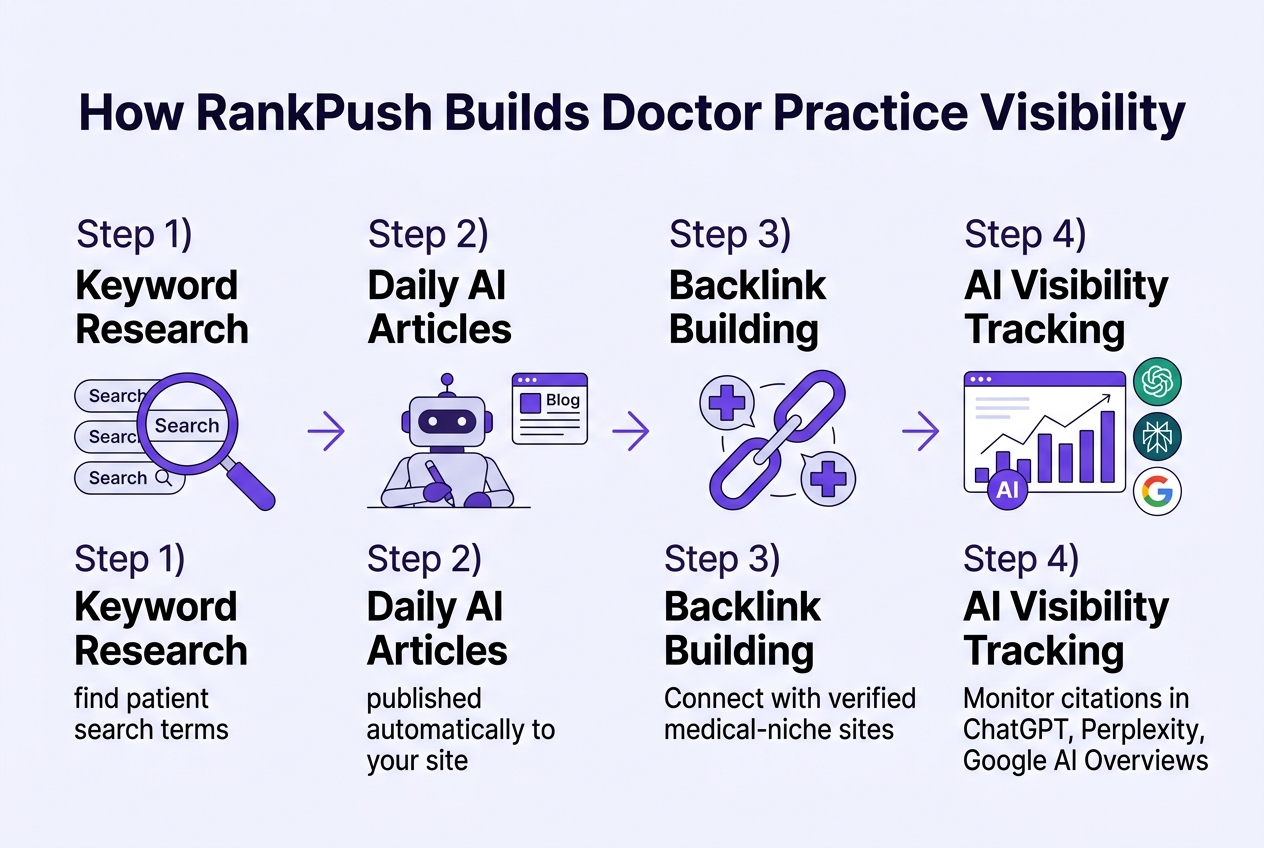
- Keyword research that surfaces what real patients are searching, like symptoms, procedures, or "doctor near me" style queries with actual volume behind them
- Long-form educational articles that answer patient questions in depth rather than skimming the surface with a 400-word post
- A consistent publishing cadence, since one article a month rarely moves rankings the way daily or weekly publishing does
- A content calendar built around your specialty and competitors, so topics aren't picked at random
- Article scoring or quality checks that flag thin or duplicate content before it goes live
Where backlinks and authority fit in
Content alone doesn't carry a site. Google still weighs how many credible, relevant sites link back to yours, and that's what authority building is for. RankPush handles this through automated matching with verified sites in your niche, rather than someone manually pitching journalists or chasing guest post placements — a faster, less labor-intensive route to the same backlink goal. There's also a newer piece worth tracking: whether your practice gets mentioned in answers from ChatGPT, Perplexity, Gemini, and Google's AI Overviews, not just classic blue links. Reading an automated content creation guide is a reasonable way to understand how publishing frequency, structure, and sourcing all feed into that kind of AI visibility. Verdict: a practice with great reviews but zero fresh content still won't show up where patients are actually looking now.
Comparing Approaches: Agency Retainers vs. Automated Content Platforms
Every practice eventually weighs the same three options: pay a human agency, hire a freelancer, or let software handle the grind. Each one makes a different trade-off between cost, speed, and consistency. Before picking one, it helps to see them side by side rather than guess.
| Approach | Typical Cost | Content Cadence | Setup Time | Built-in Extras |
|---|---|---|---|---|
| Traditional agency retainer | $1,500–$5,000+/month | Weekly or monthly articles | Weeks (strategy calls, onboarding) | Human strategist, manual research |
| Freelance copywriter | $50–$500 per article | Inconsistent, depends on availability | Days to find and vet someone | None; no scoring or backlinks |
| Automated AI content platform | Flat rate, roughly $99/month per site | One article daily | About 5 minutes | Keyword research, backlinks, AI visibility tracking |
| In-house staff writer | $45,000–$70,000+/year salary | A few posts per week, at best | Weeks of hiring | Depends entirely on the hire's skill |
The agency model still has a place, especially for complex campaigns needing a dedicated strategist. But velocity is where it usually loses. A retainer producing four articles a month can't match a system publishing thirty. Freelancers sit in between: flexible, sometimes talented, but without any built-in SEO scoring, backlink system, or multilingual output. That gap matters more than it used to, since more buyers now check how AI search engines surface healthcare content before ever landing on a clinic's own site. Automated platforms close that gap with a flat per-site rate instead of hourly or per-word billing. Language coverage is another split point — most freelancers write in one language, while automated tools like RankPush can generate content across 100+ at no extra cost. For a multi-location practice or one near a bilingual community, that difference alone can decide the choice.
How Daily AI-Generated Content Builds Visibility for a Medical Practice
From keyword research to published article
Every piece starts with automated keyword research that digs up high-volume, low-competition terms tied to a specialty and a location — things like "sports medicine clinic Tampa" or "non-surgical fat reduction near me." That's the groundwork most practices skip. Then a personalized growth plan and content calendar gets built from an analysis of the business and its real competitors, so the publishing schedule isn't random guesswork but a mapped-out sequence of topics.
From there, each article runs 3,000+ words, built with images, internal links, and external citations that give it real topical depth. That length and structure matter: a thin 400-word post rarely earns trust from Google or from AI answer engines scanning for authoritative sources. Articles covering recovery timelines, procedure comparisons, or insurance questions in that kind of depth give both readers and algorithms something substantial to chew on.
None of this replaces the technical side of a site. If pages load slowly or have broken schema, a developer or a technical audit elsewhere still has to fix that first; RankPush is the content engine that runs after that groundwork is laid, not the tool that lays it. Think of it as filling the pipes once they're no longer leaking.
Keeping tone consistent across hundreds of articles
Publish daily for a year and you're looking at hundreds of articles. Keeping them sound like the same practice wrote them all is the real challenge. Brand voice customization through custom instructions solves this by locking in how a practice actually talks to patients — warm and plain for a family clinic, more clinical and precise for a specialty surgical group. That consistency builds trust over time, and trust is what gets a practice remembered.
Content generation across 100+ languages adds another layer for practices serving diverse patient populations, a common reality in places like South Florida or parts of New Jersey. A dermatology clinic near Miami, for example, could publish in both English and Spanish without hiring separate writers for each. It's a practical way to reach patients searching in their native language, not just an SEO trick.
Worth noting: there's no human writer or editor assigned to any of this. It's automation, with plagiarism checks and an AI editor on hand for manual tweaks. That's a very different model from a retainer agency, and it's priced like one too. For a sense of how visual, design-forward publishing fits into a broader content strategy, some practices look at resources on building a credible content presence alongside general SEO guidance, though most of that groundwork for a medical practice comes down to consistent, well-structured writing rather than design alone.
Publishing, Backlinks, and AI Visibility: The Pieces That Compound
None of this matters if the content just sits in a drafts folder. Auto-publishing connects straight to WordPress, Wix, Webflow, Shopify, or any site through a webhook, so there's no developer waiting in the wings. You hook it up once, and articles go live on their own, every day, without you logging in to hit publish.
But publishing is just the start. Getting cited and trusted, by Google and by AI tools, takes a few more moving parts working together.
- Backlink exchange and building pulls links from verified sites in your niche automatically, which does the same job as manual outreach or chasing a PR firm, minus the cold emails and the waiting.
- AI visibility tracking shows whether your practice actually gets named when someone asks ChatGPT, Perplexity, Claude, or Google's AI Overviews a question in your field.
- Domain tracking charts how your site's authority and traffic move over weeks and months, so you can see the trend line instead of guessing.
- Plagiarism checks run on every article before it publishes, keeping each one original rather than a reshuffled version of something already online.
- SEO/GEO article scoring grades structure and optimization for both classic search engines and the newer generative answer engines, side by side.
Here's the honest part: none of these pieces do much alone. One backlink doesn't move a domain. One scored article doesn't get you cited in an AI answer. Stack them daily, and they start compounding — each new article adding a little more authority, a little more surface area for AI tools to find and quote you from.
Steps to Get a Practice Website Publishing Daily Content
Getting a practice site from silent to publishing daily isn't a six-week onboarding. It's five steps, and most of them happen once. Here's the sequence, broken down so you know what to expect before you commit to anything.
What a five-minute setup actually involves
Step one is connecting your platform. Whether that's WordPress, Shopify, Wix, Webflow, or a custom site via webhook, the connection itself takes about five minutes. No developer needed. Step two is setting brand voice instructions, so your articles read like your practice wrote them, not like a template pulled off a shelf. Step three is reviewing a growth plan and content calendar, built from competitor analysis, before anything goes live.
| Step | What Happens | Time Required |
|---|---|---|
| 1. Connect platform | Link WordPress, Shopify, Wix, Webflow, or webhook | ~5 minutes |
| 2. Set brand voice | Add tone and style instructions so articles sound like your practice | ~10 minutes |
| 3. Review growth plan | Check content calendar built from competitor and keyword analysis | ~15 minutes |
| 4. Go live | Daily articles publish automatically; edit manually if needed | Ongoing, hands-off |
| 5. Track results | Monitor domain growth and AI citation visibility | Weekly check-in |
Reviewing output without doing the writing yourself
Once it's live, articles publish on autopilot, one every 24 hours. You're not writing anything. An AI editor sits there if you want to tweak a paragraph or swap an example, but it's optional, not a chore you owe the system daily. Most practice owners check in weekly, not daily.
Step five is watching domain tracking and AI visibility data to see what's gaining traction in Google and showing up in tools like ChatGPT or Perplexity. If a topic's underperforming, you'll see it and can adjust the calendar. No contract locks you in, and you can cancel anytime. That alone separates this from the agency retainers most practices already know too well.
Common Questions About Doctor SEO Services
Whether SEO is still worth it for well-known practices
If your clinic already ranks for its own name, great. That's not the problem. Most new patients aren't typing your practice name into Google — they're searching "knee pain won't go away" or "best dermatologist for eczema near me." Name recognition doesn't capture condition-based or treatment-based searches, and that's where the bulk of new-patient volume actually lives.
So yes, SEO still matters, even for the practice that's been around 20 years and gets plenty of word-of-mouth referrals. A steady stream of articles targeting symptoms, treatments, and local intent keeps you visible to people who've never heard of you yet — which is a different audience than the one already loyal to your name.
There's also a compounding angle worth considering. Organic content keeps working after you publish it; a blog post from eight months ago can still bring in appointment requests today. Paid ads don't do that — the moment the budget dries up, so does the traffic. Used well, consistent content can quietly reduce how much a practice leans on paid search or referral networks alone. It won't replace a technical audit or local map pack work, though — those are separate jobs handled elsewhere. Think of daily content as the layer that runs alongside technical fixes and Google Business Profile management, not a substitute for either.
How cost compares to traditional agency retainers
Traditional SEO retainers for medical practices often run $1,500 to $5,000 a month, and that's before you've seen a single published article some months. RankPush, built for daily publishing, runs closer to $99 a month per website, with volume pricing if you're managing multiple locations or brands.
Worth noting: that fee isn't buying a human copywriter or an assigned editor. It's AI-generated content with brand voice customization and an editor for manual tweaks — automation, not a staffed content team. If what you want is a writer who knows your bedside manner personally, that's a different budget line, and one you'd fill somewhere else. If you want daily published output without the agency markup, this is the lane for it. For teams comparing tools, similar automation platforms in this space include Surfer-style content generators and AI writing assistants — most charge per seat or per word, so check whether daily publishing is actually included or an add-on.
Before committing to any approach, it helps to be honest about what's actually slowing growth down: is it a visibility problem, a technical one, or simply a lack of fresh content hitting the site regularly? Some of those answers point toward specialists who can fix infrastructure or run outreach campaigns, while others point toward steady, consistent publishing that compounds over months rather than a one-time fix. Worth asking what you're really optimizing for, and whether the tools you're considering actually address that root cause or just adjacent symptoms.