
You're a roofing contractor, med spa owner, or agency juggling ten client sites. Ranking in local map packs and neighborhood searches feels like a full-time job you didn't sign up for. Hiring a writer is slow. Agencies are expensive. That's why local seo outsourcing has become the go-to move for business owners who want daily, localized content without the overhead. But doing it right means knowing exactly which pieces to hand off and which still need a specialist's touch. This guide breaks down a clear, step-by-step path to outsourcing the content engine correctly in 2026.
Table of Contents
- Before You Start: What You Need in Place
- Step 1: Define Your Local SEO Goals Before You Outsource
- Step 2: Decide Which Local SEO Services to Outsource
- Step 3: Weigh the Benefits Against the Risks of Outsourcing
- Step 4: Evaluate and Choose Your Local SEO Partners
- Step 5: Compare DIY, Agency, and Automated Content Approaches
- Step 6: Set Up Your Content Engine to Support Local Rankings
- Step 7: Monitor, Report, and Build a Long-Term Relationship
- Wrap-Up: Putting the Plan Into Action
Before You Start: What You Need in Place
Access and accounts to gather
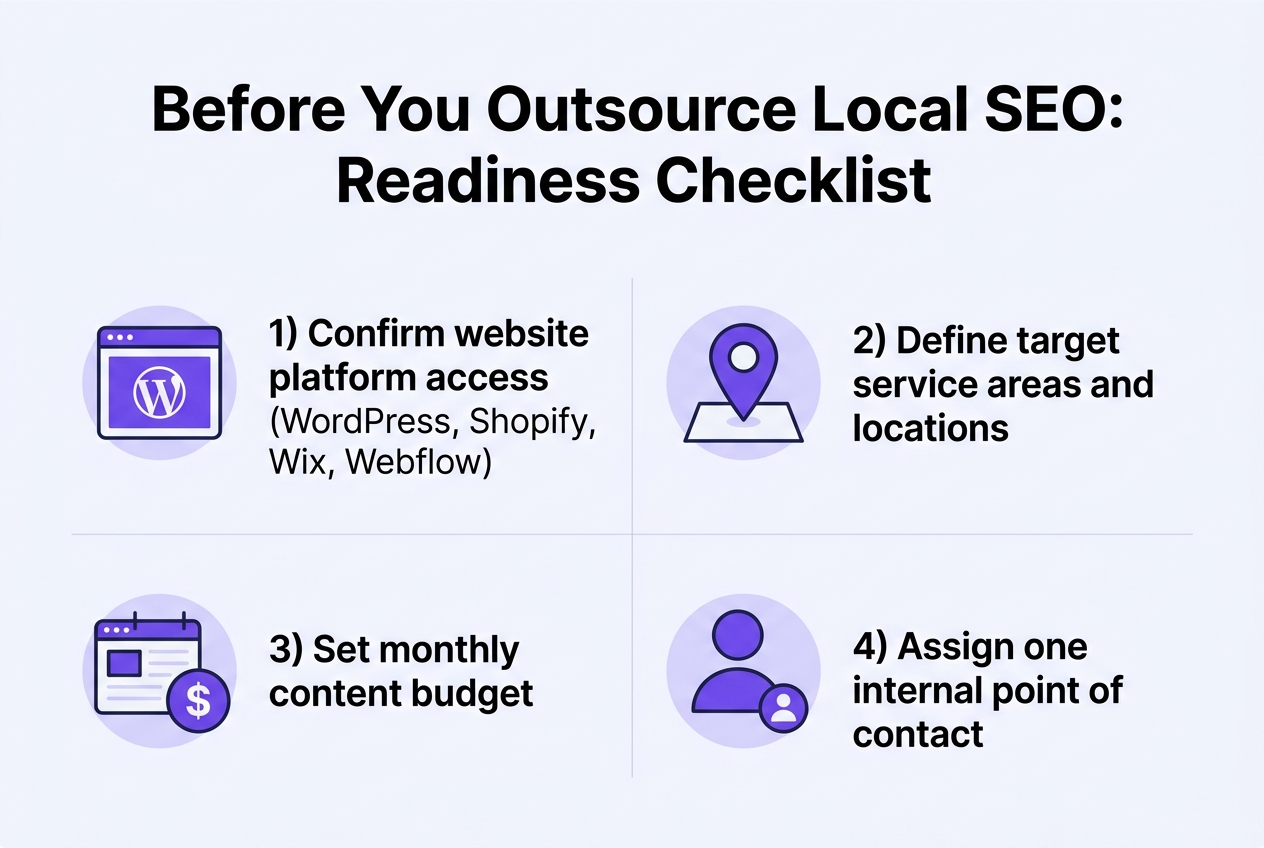
Before you hand anything off, get your house in order. Any outsourcing relationship moves faster when the groundwork is already done. It moves slower, sometimes painfully so, when it's not. Take an hour and pull together the basics first.
- Confirm you personally hold owner-level access to your Google Business Profile, not just a manager login tied to an old employee or agency.
- Verify you have admin rights to your website's CMS, whether that's WordPress, Shopify, Wix, or Webflow, so a partner can connect without delays.
- Check that you (or someone on your team) can access Google Analytics and Search Console directly, since these are your proof of what's actually working.
- Pull together past content you've published, even old blog posts, so a provider knows what's already out there and what tone fits your brand.
- List your existing citations, directory listings, and any competitor names you track, since this context shapes how aggressive your strategy needs to be.
- Write down your target cities or neighborhoods, because "local" means something different for a single shop than for a service-area business covering five counties.
That last point matters more than people think. A single-location med spa needs a very different plan than a roofing company serving twelve zip codes. Define that scope clearly before anyone starts writing content for you.
Setting a realistic budget range
Budget conversations get awkward fast if you skip them upfront. Decide early whether you need a full-service partner handling strategy, technical fixes, and reporting, or a tool paired with lighter human oversight. Many local businesses find a hybrid works best: a specialist handles the technical and map-pack side, while an automated content creation guide covers the ongoing publishing workload. Either way, know your number before you start calling vendors. A vague "whatever it costs" budget attracts vague proposals. Set a range, even a rough one. Don't be afraid to say it out loud on the first call.
Step 1: Define Your Local SEO Goals Before You Outsource
Turning vague goals into measurable targets
"Get more local customers" isn't a goal. It's a wish. Before you hand anything off, write down what you actually want in numbers, because that's the only thing an outside partner or a piece of software can be measured against. Start with visibility: do you want to rank in the map pack for "roofing contractor + your city," land top five organic for "medspa near me," or both? A solo insurance agent might target 15 city-plus-service keywords by month six. A roofing company might aim for three map pack spots within a 10-mile radius. Put a number and a date on it.
Next, set traffic targets tied to specific pages, not just your homepage. How many organic sessions should your location page or service blog get monthly by quarter two? Many local businesses find that reading a solid seo automation guide helps them set realistic traffic benchmarks before they commit budget to anyone. A new domain might realistically go from near-zero to 500 monthly organic sessions in 90 days with daily publishing.
Then get to conversions: calls, form fills, booked appointments from organic local search. A med spa owner should know their current call volume from search and set a target lift, say 20% in 60 days. Finally, track relationship signals: new reviews per month, referral traffic from local directories, repeat-customer rate. Write every number down. That document becomes your scorecard.

Step 2: Decide Which Local SEO Services to Outsource
Before you sign anything, break "local SEO" into its actual parts. Most business owners lump everything together and then wonder why one invoice costs $2,500 a month. The truth is simpler: different tasks need different skill sets, and some of them don't even belong under the same roof.
Google Business Profile optimization, citation building, and review management live in the map-pack world. That work needs a specialized local SEO agency or freelancer who can log into your listings, fix NAP consistency, and respond to reviews weekly. Content creation for local audiences, on the other hand, can run on a completely separate track, often automated, since blog posts and service-area pages don't require touching your Google listing at all.
| Service | Who Typically Handles It | Frequency Needed |
|---|---|---|
| Google Business Profile optimization | Local SEO agency or freelancer | Ongoing, weekly checks |
| Citation building and NAP consistency | Local listings specialist | One-time setup, periodic audits |
| Review management | Local SEO agency or in-house staff | Daily to weekly |
| Blog posts and service-area pages | Content platform or writer | Daily to weekly |
| On-page technical fixes | Developer or technical SEO specialist | One-time, then as-needed |
Local link building and technical fixes are their own workstreams too, separate from both content and map-pack tasks. Map all five out before you hire anyone, and you won't pay one generalist agency full price for everything when three specialists, plus some automation, could cover it for less. For a broader look at how publishing cadence affects rankings over time, the content scaling guide breaks down what consistent output actually does to organic visibility.
Step 3: Weigh the Benefits Against the Risks of Outsourcing
Before you sign anything, do the honest math. Outsourcing isn't automatically cheaper or automatically better. It depends on what you're comparing it to.
Where outsourcing clearly wins
Hiring an in-house SEO specialist means salary, benefits, training time, and months before they're actually productive. A good writer alone can run $50,000+ a year, and that's before tools and management overhead. Outsourcing swaps that fixed cost for something flexible. Here's where the advantage really shows up:
- Cost efficiency — you pay for output, not a desk, a laptop, or a learning curve while someone figures out your industry.
- Specialized expertise on demand — you get keyword research and content strategy skills that would take an in-house hire a year or more to develop.
- Scalability — adding a second location or a new service line means scaling the engine, not recruiting and onboarding another person.
- Continuous monitoring — daily publishing and domain tracking keep running whether your team is swamped or on vacation.
- Faster time to results — you skip the ramp-up period entirely and start publishing within days, not quarters.
Where it can backfire without oversight
Here's the catch nobody tells you upfront: outsourcing without checking the work is how brands end up sounding like nobody. Two risks matter most. First, losing control of brand voice and quality — hand content off blind, and you'll get articles that are technically fine but don't sound like you. Second, generic content that ignores geography. A roofing company in Tampa and one in Newark face different weather, codes, and search intent. Content that doesn't reflect that reads as filler, not local authority. Vet for brand voice customization and local specificity before you commit.
Step 4: Evaluate and Choose Your Local SEO Partners
Questions to ask before signing a contract
Start with experience. A med spa and a roofing company need completely different keyword strategies, different tones, different proof points. Ask the partner for examples from your exact industry, insurance, legal, e-commerce, whatever applies, and ask how their approach changes for a med spa versus a plumber. If they give you the same generic pitch for both, that's a red flag.
Next, dig into local knowledge. Does this partner actually understand your city, not just SEO theory? A good one should be able to name the neighborhoods, competitors, and seasonal patterns that shape your market, not just recite "optimize for local intent" from a playbook. Push them on how they'd handle a town with three ZIP codes versus a metro area with twenty.
Finally, ask about ethics and reporting upfront. Walk away from anyone guaranteeing a #1 ranking. Nobody controls Google's algorithm, and that promise is a sales tactic, not a strategy. Confirm their tactics are white-hat, ask how often you'll get updates, and nail down whether reporting is weekly, monthly, or "whenever you ask." Vague answers here usually mean vague results later.
Where an AI content platform fits alongside a local SEO agency
Agencies are often strong on strategy and technical fixes but slow and expensive on content. That's the gap an AI content platform fills. Look for daily publishing, not weekly, since consistency is what search engines and AI answer engines reward. Also check brand voice customization. Insurance content should sound careful and trustworthy; a med spa should sound warm and client-facing. Generic robotic copy helps no one.
If you operate in multiple cities or serve non-English-speaking customers, ask whether content can scale across locations or languages without a huge markup. Some platforms charge per article or per market, which adds up fast. Others price per site, flat, regardless of volume, which matters if you're running five locations or publishing in Spanish and English side by side.
Think of it this way: the agency handles strategy, technical fixes, and local market relationships. The content platform handles volume. One without the other leaves gaps, either slow output or no direction at all.
Step 5: Compare DIY, Agency, and Automated Content Approaches
Once you know which services you want to hand off, you'll still need to pick a delivery model. Four options come up again and again, and they land very differently on cost, speed, and how much babysitting they need from you.
| Approach | Monthly Cost (typical) | Content Speed | Control Level | Best Fit |
|---|---|---|---|---|
| In-house specialist | $4,000–$7,000+ salary | Slow to scale, 1 person's output | Highest | Larger budgets, long-term hires |
| Full-service agency | $1,500–$5,000 retainer | Often 2–4 articles/month | Medium | Businesses wanting broad strategy support |
| Point tools + specialist | $300–$1,200 combined | Depends on who's writing | Medium-low, more coordination | Teams willing to manage pieces themselves |
| Automated publishing + local specialist | $99/site + local specialist fee | 1 article every 24 hours | Low on writing, high on oversight | Businesses prioritizing content velocity |
A full-time hire gives you the most control, sure. But that salary has to justify itself fast, and ramp-up takes months. Agencies bring broad expertise, yet most retainers buy you a handful of posts a month, not daily output. Mixing point tools with a specialist cuts cost, though now you're the project manager. Many local businesses are landing on a split model instead: an automated content engine handles the research-write-publish loop at a flat fee, while a separate local specialist manages map pack visibility, citations, and reviews. That division keeps each side doing what it's actually good at. It's worth noting this is organic groundwork, not a replacement for paid visibility; understanding how organic and paid channels compound together helps set realistic expectations for when each approach pays off.

Step 6: Set Up Your Content Engine to Support Local Rankings
What gets automated versus what still needs a local specialist
A lot of what used to eat up a week of someone's time now runs on its own. Keyword research is the clearest example: automated tools scan search volume and competition to surface local and service-area terms, like "roof repair near [neighborhood]" or "med spa Botox [city]," that a human might miss or take days to compile. This is the groundwork for everything that follows. Get the keyword layer right and the rest gets easier.
From there, daily long-form articles (3,000+ words, with images baked in) can publish straight to WordPress, Shopify, Wix, Webflow, or any site via webhook, usually after about five minutes of setup. No developer needed. Brand voice customization keeps the tone matching your existing reputation, so a 20-year-old insurance agency doesn't suddenly sound like a Silicon Valley startup. Backlink exchange from verified niche sites adds authority in the background, complementing any manual citation work you've got running elsewhere. If you serve multilingual communities, content in 100+ languages covers that without hiring translators.
Here's the honest line: this is the content layer, not the whole stack. Technical fixes, Google Business Profile management, and map pack strategy still need a specialist working alongside it. Think of it as the engine room under a ship someone else is steering.
Step 7: Monitor, Report, and Build a Long-Term Relationship
Outsourcing isn't a one-time handoff. It's an ongoing loop of publishing, checking, and adjusting. Set up a rhythm early. Businesses that treat this like a vending machine — set it and forget it forever — usually miss the moment something needs a course correction.
Metrics worth reviewing monthly
You don't need forty dashboards. You need a short list you actually check, every single month, without fail.
- Domain tracking and organic trend lines — watch whether your domain's overall visibility is climbing month over month, not just whether one keyword moved.
- Google Search Console and Analytics data — impressions, clicks, and which pages are pulling real traffic versus sitting flat and ignored.
- AI visibility signals — whether your business gets mentioned or cited by ChatGPT, Perplexity, Claude, and Google AI Overviews, a newer metric but one that's only growing in weight.
- A standing monthly check-in with whoever's handling the work, agency or automated platform, to review what published, what ranked, and what needs tweaking.
- A quarterly goal review tying back to whatever you defined in Step 1, so your content calendar and service mix evolve as the business grows instead of staying frozen.
Resist the urge to switch providers every few months chasing a faster result. Local SEO compounds over 6 to 12 months. Patience, paired with steady reporting, is what actually separates the sites that rank from the ones that quietly plateau.
Wrap-Up: Putting the Plan Into Action
Seven steps, one goal: visibility that actually turns into calls and foot traffic. You defined what winning looks like, picked which pieces to hand off, weighed the risks, vetted your partners, compared DIY against agency against automated content, built a content engine, and set up a way to track results. Skip a step and the whole chain gets wobbly. Sequence matters more than speed here.
The real trick is blending help, not picking one lane. A GBP specialist handles your map pack, citations, and reviews. Automation handles the research and writing workload that never stops needing fresh output. Neither replaces the other, and trying to make one do both jobs usually ends in mediocre results on both fronts.
Start small. Run one service, measure it against the Step 1 goals, then add a second once you see movement in Search Console or your call logs. Don't sign every contract on day one. Honestly, most businesses that fail at this just tried to do everything at once and burned out by month two. Daily publishing paired with solid map-pack upkeep is what builds visibility that sticks around. Not a single campaign, but a system you keep feeding.
Before committing to any approach, it helps to be honest about what's actually slowing growth down right now—whether that's a technical gap on the site itself, a lack of fresh content, or simply not enough consistent publishing to build authority over time. Some of these problems call for a specialist's hands-on diagnosis, while others respond well to steady, automated content production working quietly in the background. The right mix usually comes down to budget, patience for compounding results, and how much manual oversight feels sustainable long term.