
You've probably compared a dozen agencies promising a white label seo program that fills your calendar with content, only to end up paying thousands a month for a few articles and a slow turnaround. Meanwhile, AI content automation tools claim they'll publish daily without the agency markup. Which one actually moves your organic traffic in 2026? This article breaks down both paths honestly, so you can pick the one that fits your budget and your growth goals.
Table of Contents
- White label SEO program vs. AI content automation: the core difference
- Head-to-head: traditional white label SEO vendors vs. RankPush
- Comparing the leading white label and SEO software options
- Feature-by-feature: what's included, what isn't
- Pros and cons of resold agency SEO vs. self-serve automation
- Real scenarios: matching the model to the business
- The verdict: which option actually fits your goal
White label SEO program vs. AI content automation: the core difference
Who each model is actually built for
A white label SEO program exists to serve agencies, not end businesses. An agency signs up, gets access to someone else's audits, link outreach, and reporting, then slaps its own logo on the deliverables before selling them to its own client list. You, the roofing company or med spa owner, never see the actual vendor doing the work. You just get a report with your agency's name at the top. That's the whole model: a middleman reselling a service at a markup.
AI content automation skips the middleman entirely. There's no agency in between, no reseller relationship, no rebranded deliverables. You run the tool yourself, directly, without hiring a writer or signing an agency retainer. For a solo insurance agent or a one-person e-commerce shop, that distinction matters more than it sounds. It's the difference between paying someone to manage a vendor on your behalf and just doing the thing.
This is why the two models attract such different buyers. Agencies want white label programs because they need deliverables to sell under their own brand, at scale, across many clients. Small business owners want results, not a vendor to manage. If you're a SaaS marketing manager trying to grow organic traffic fast, you don't care who's "behind the curtain." You care whether articles get published and whether traffic shows up in Search Console.
Where the dollars go in each setup
Pricing logic reveals the real business model. White label SEO programs typically charge per deliverable (per audit, per link placement, per article) or lock clients into retainer tiers, because the agency reselling the work needs margin on top. That margin exists whether or not it benefits you. You're paying for the audit, the markup, and often a long contract, before a single article goes live.
A direct-use automation platform strips that layer out. Flat pricing, around $99 a month per website, with no contracts and no per-deliverable billing. You can cancel anytime. There's no agency account manager taking a cut between you and the content being published. For a roofing company watching every marketing dollar, that's a simpler equation: one flat fee, one output, every day.
Here's the thing most searchers miss: a lot of people typing "white label SEO program" into Google don't actually want a reseller relationship at all. They want consistent content and rankings, full stop. If that's you, reading a solid seo automation guide will clarify fast that you don't need an agency layer, you need a publishing engine. Skipping the reseller markup isn't a shortcut. It's often just the more direct path to the same result.

Head-to-head: traditional white label SEO vendors vs. RankPush
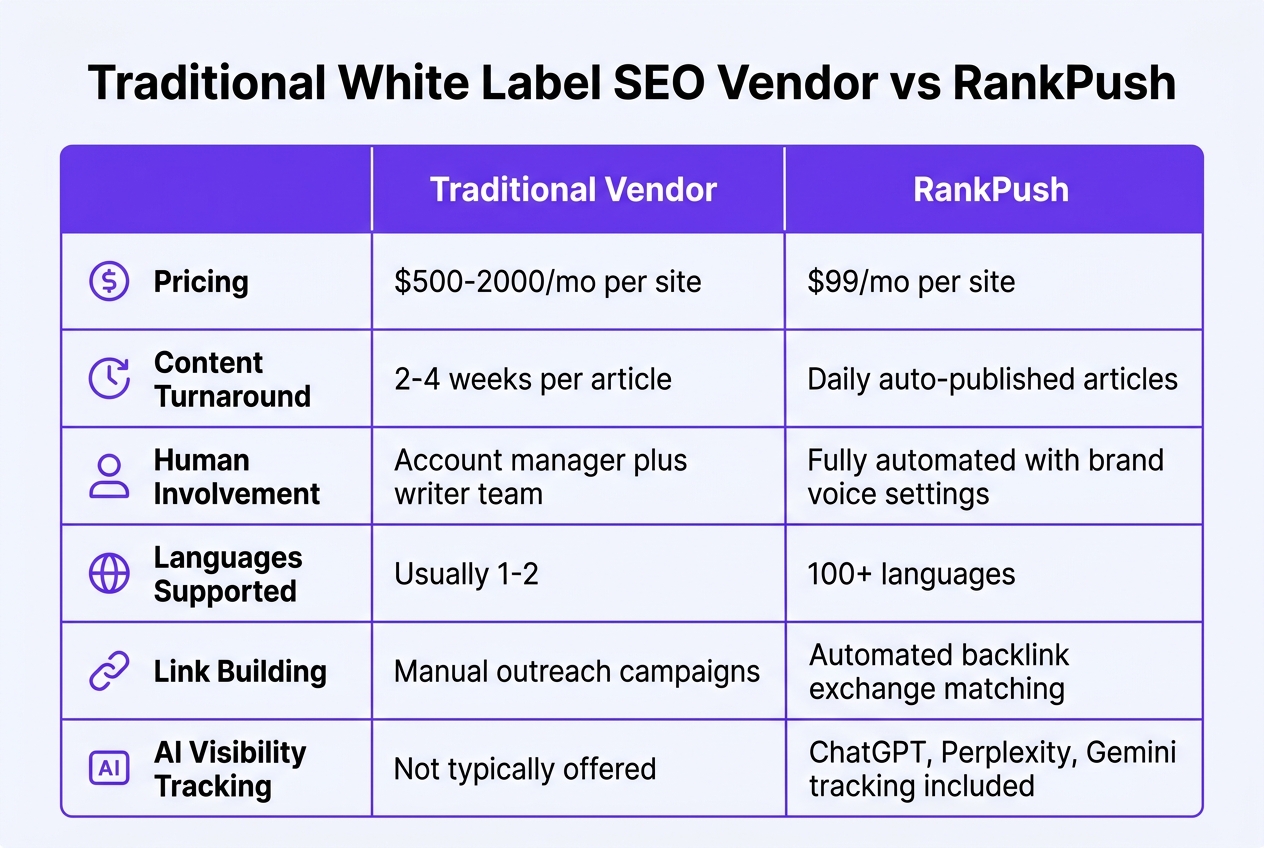
Traditional white label vendors sell you someone else's agency, wrapped in your own logo. You get audits, local SEO work, link outreach, and a reporting dashboard, but a human account manager still has to run all of it behind the scenes. RankPush skips the agency layer entirely. It doesn't resell services. It replaces the content production piece of that stack with articles that publish themselves, every day, without a strategy call.
Here's where the two models actually diverge, point by point.
| Factor | Traditional white label vendor | RankPush |
|---|---|---|
| Setup process | Contracts, discovery calls, weeks of strategy | About 5 minutes to connect your site |
| Content cadence | Monthly batches, often 2-4 posts | One 3,000+ word article every 24 hours |
| Ongoing management | Human project manager on the agency side | Runs unattended once connected |
| Planning | Manual strategy meetings | Content calendar built from competitor analysis |
| Commitment | Often locked into contracts | Cancel anytime |
That cadence gap matters more than it sounds. A roofing company getting four posts a month is publishing once a week, if the agency stays on schedule. RankPush fires off a new article daily, racking up over 30 in that same stretch. Volume isn't everything, but in a game where a documented automated content creation guide shows search engines rewarding fresh, consistent publishing, it's not nothing either.
The honest tradeoff: you lose the human hand-holding of an account manager. No one's hopping on a call to explain strategy. What you gain is speed and a flat $99/month price instead of a retainer that climbs every quarter. For a solo agent or a med spa owner with no time to manage vendors, that's often the better trade.
Comparing the leading white label and SEO software options
What fulfillment-style vendors actually deliver
Most "white label SEO" names you've seen are fulfillment shops. Search Logistics, Boostability, The Hoth, and HigherVisibility all work the same basic way: an agency sells SEO packages under its own brand, then hands the actual work to one of these partners. You get audits, link building, maybe some content, produced by a team you'll never talk to directly. Vendasta plays a slightly different game — it's a software-plus-fulfillment marketplace agencies can white label across dozens of services, not just SEO content, so you might find yourself buying social posts and website builds bundled in whether you need them or not.
Here's the catch. Fulfillment vendors are built for agencies that need to resell, not for a med spa owner or roofing company that just wants their own site to rank. You're paying for a middle layer. A solo insurance agent doesn't need a reseller relationship — they need articles published. That's a different problem entirely, and it's worth understanding before you sign a retainer.
What reporting-focused software actually deliver
Then there's the reporting side: AgencyAnalytics, Moz, Semrush, SE Ranking, BrightLocal, and SiteGuru. These are dashboards. They track rankings, pull Google Search Console data, and let agencies package results under their own logo for clients. None of them write an article. None of them publish anything. They just tell you, in nicer charts, what already happened.
So you end up needing two separate systems that don't talk to each other:
- A fulfillment vendor or in-house writer to actually produce the audits, links, or content your site needs
- A reporting tool to track whether any of that work moved rankings or traffic
- Someone to coordinate between the two, since neither vendor type manages the other
- A separate process for technical fixes, since none of these platforms touch core web vitals or crawl errors themselves
- Ongoing manual oversight to make sure publishing cadence and reporting cycles actually line up
That's a lot of moving parts for a business that just wants to be found on Google. RankPush sits outside this whole category: it researches keywords, writes long-form content in your brand voice, generates images, and pushes it live to your own site daily — no reseller, no separate dashboard subscription. If you want to understand why consistent output matters more than any single tactic, a solid content scaling guide lays out the math on compounding traffic over months, not weeks. For a business that just wants new articles live every day, RankPush replaces the need to juggle a fulfillment vendor and a reporting tool as two separate line items.

Feature-by-feature: what's included, what isn't
Not every program covers the same ground, and that's where most buyers get tripped up. Some agencies hand you a strategist and a stack of reports. Others hand you software and a login. Here's how the pieces actually line up, feature by feature.
| Feature | Typical white label vendor | RankPush |
|---|---|---|
| Keyword research | Human strategist picks terms, often on a monthly call | Automated, finds high-volume low-competition terms by niche daily |
| Content production | Freelance writers, quality and turnaround vary a lot | 3,000+ word articles daily, with plagiarism checks and SEO/GEO scoring |
| Backlinks | Manual outreach and guest posting, negotiated by an account manager | Automated backlink exchange and building from verified niche sites |
| Technical SEO, schema, Core Web Vitals | Sometimes bundled, usually a separate line item | Not included; this stays with a developer or technical SEO specialist |
| AI visibility (ChatGPT, Perplexity) | Rarely tracked, most legacy stacks ignore it | Tracked across ChatGPT, Perplexity, Claude, and Google AI Overviews (coming soon) |
A few gaps are worth naming plainly. Technical SEO audits aren't part of what RankPush does; think of RankPush as the content engine that runs after a developer fixes crawl errors or site speed. Same story with local SEO: daily localized articles help a roofing company or med spa rank, but Google Business Profile optimization and citation cleanup need a separate specialist.
Backlinks work differently too. Rather than an account manager cold-pitching bloggers for guest posts, RankPush's automated backlink exchange matches you with verified sites in your niche. Same goal, earning real links, just no manual pitching involved. No human is drafting those emails. That's the trade-off, and it's a fair one for $99 a month.
Pros and cons of resold agency SEO vs. self-serve automation
Both models can work. The question is what you're actually buying, and whether you need it to impress a client or just grow your own traffic.
When a reseller model wins
Resold agency SEO makes sense when there's a human relationship to manage. You get a strategist who adjusts plans around your business, bundled services that go beyond content, and reporting that looks polished enough to hand to a paying client.
- A dedicated strategist can interpret nuance, like a lawsuit-shy legal client needing extra review before publishing.
- Bundled technical and local work often gets packaged in, so one invoice covers more ground.
- Established, client-facing reporting templates save agencies from building their own dashboards from scratch.
- But markup adds up fast. Agencies price in their own margin on top of whatever vendor they use.
- Turnaround slows down too. You're waiting on a team, not a script that runs overnight.
- You're also dependent on their internal staff and often locked into a 6 or 12-month contract.
When direct automation wins
RankPush wins when you just need your own site publishing consistently, without paying for a layer of account management you don't need. Setup takes about 5 minutes, articles go out daily, and pricing sits at $99 a month per site with no contract.
It also tracks early signs of AI visibility, something few reseller dashboards cover yet. The tradeoff: no technical audits, no Google Business Profile work, no human copywriter, no paid ads, and no client-ready rank-tracking reports. It's a content engine, not an agency replacement.
So pick based on who you're serving. Running client accounts under your own brand favors a reseller. Growing your own business's organic traffic favors RankPush.
Real scenarios: matching the model to the business
Service businesses vs. product businesses
Picture a solo insurance agent in New Jersey. She doesn't want a vendor relationship to manage, calls to schedule, drafts to approve. She wants posts to just appear. For her, daily automated publishing plus niche backlink exchange beats signing a reseller contract that bills monthly for work a stranger does on her behalf. Less overhead, same goal.
A SaaS marketing manager has a different problem: speed and volume, paired with technical debt only a developer can fix. RankPush's daily long-form articles cover the content side. Core Web Vitals and schema markup stay with a developer working in parallel. One handles output, the other handles plumbing. Neither replaces the other.
A med spa owner in Florida wants fresh local content pulling in beauty clients every week. RankPush's articles can do that. But her Google Business Profile, her reviews, her map pack ranking? Those need a local SEO specialist working alongside the content engine. Content and local listings are two separate jobs — don't expect one tool to do both.
A roofing company in California is fighting for the same handful of local search results as five competitors. Slow monthly content batches won't cut it here. Daily localized articles paired with verified dofollow backlinks build momentum faster than a quarterly blog push ever could. Speed matters more than polish in a crowded local fight.
An e-commerce owner wants new product content published automatically, every day, without touching it. That's doable — RankPush's articles can promote products inside the copy itself. What doesn't change: the product pages and category pages. Those stay with the store's existing team, or a dedicated CRO specialist who knows the storefront.
The verdict: which option actually fits your goal
Final recommendation by business type
Here's the simple split. If you're an agency reselling SEO services under your own brand to external clients, a traditional white label SEO program with bundled audits, reporting dashboards, and account management still makes sense. That model exists to let you mark up fulfillment work you didn't build yourself, and clients expect the full package.
But if you're a single business — the insurance agent, the med spa, the roofing company — just trying to get found on Google and show up when someone asks ChatGPT for a recommendation, hiring a reseller to manage a team you'll never meet is overkill. RankPush researches keywords, writes daily articles, and publishes them for you — the lower-cost, lower-friction path to the same outcome. No account manager translating your needs to a writer you can't talk to.
The budget math backs this up. $99 a month per website is a rounding error next to typical white label retainers, which often climb into the thousands once fulfillment, reporting tools, and agency margin get stacked on top. And there's documented Google Search Console and Analytics growth on brand-new domains with zero prior authority, proof the model works without the reseller markup or a contract locking you in.
So here's the practical move: use RankPush's daily content, keyword research, and backlink building as your growth engine, then bring in specialists only for technical audits, local listings, or paid ads. Pay for expertise where you actually need a human. Don't pay reseller margin for a bundle you could assemble yourself for less.
Before committing to any path forward, it's worth asking how much of the work needs a human hand versus how much can run on autopilot in the background—technical fixes and penalty recovery, for instance, really do call for a specialist's judgment, while ongoing content production is a different kind of problem entirely. The honest question is whether your bottleneck is visibility infrastructure or visibility output, since those get solved in very different ways. Whichever it turns out to be, it helps to separate the one-time diagnostic work from the steady, compounding kind before deciding where to spend your time and budget.